Short Drama App Offers: A Media Buyer’s Guide in Five Episodes
She opened the envelope. Her hands were shaking. The billionaire leaned closer and whispered: ‘You’re not who you think you are…’
Want to know what happens next? That’ll be 50 coins.
That’s how short drama apps make money. And here’s how you can try to earn with them too.
Episode 1: What Are Short Drama Apps?
Short drama apps stream micro-dramas (also called vertical dramas): series filmed vertically for the phone screen. Each episode lasts 1 to 3 minutes, and a full series can have 50 to 100 of them. The format comes from China and is now popular worldwide, with series translated into multiple languages on global apps like ReelShort and DramaBox.
Short drama apps make money in one of three ways:
- IAP (in-app purchases): you pay to unlock the next episodes one by one, or get a weekly or monthly subscription that unlocks all of them. Subscriptions are the more popular option.
- IAA (in-app ads): episodes are free, but you watch ads to unlock them.
- Hybrid: both. Pay to keep watching right away, or watch an ad and get the next episode for free.
Episode 2: Short Drama Apps in Numbers
More than 700 million people in China had watched micro-dramas by mid-2025, according to Dao Insights. And the format keeps spreading: global downloads passed 850 million in Q1 2026, up 140% year over year, and short drama apps made roughly $750 million from in-app purchases in the same quarter, according to Sensor Tower.
2026 Snapshot
Short Drama Apps in Numbers
China built the format. Now the rest of the world is catching up.
Daily active users, July 2026 (millions)
ByteDance’s free, ad-supported short drama app now has more daily users than China’s four biggest streaming platforms combined.
There’s a plot twist, though: most viewers don’t stay for long. Here’s what Echo Lyn, PropellerAds Business Development Manager, shared:
‘According to Adjust, only about 10% of short-drama users in APAC come back on day 1, below the global benchmark of 15%. At the same time, APAC posts the highest short-drama revenue per MAU, at about $1.45. So paying users tend to decide quickly, which favors creatives that sell a specific series or cliffhanger over a long warm-up.’
So how do you jump on this trend? We asked our experts to share some insights.

Episode 3: Four Funnels, One Secret
Short drama app marketing campaigns sell a story. So, your job is to hook the user on a cliffhanger so they want to see what happens next – instead of just talking about an app. Our partners’ campaigns show it, too.
As Viktoria Demskaya, Account Strategist at PropellerAds, told us, sending Popunder traffic straight to the App Store works much worse than a funnel that hooks users with a story first.
So, let’s see which exact short drama funnels are popular among media buyers – including the one that has worked best for our partners on PropellerAds traffic.
Funnel 1: Organic clip on TikTok/Reels/Shorts – Install app button – App
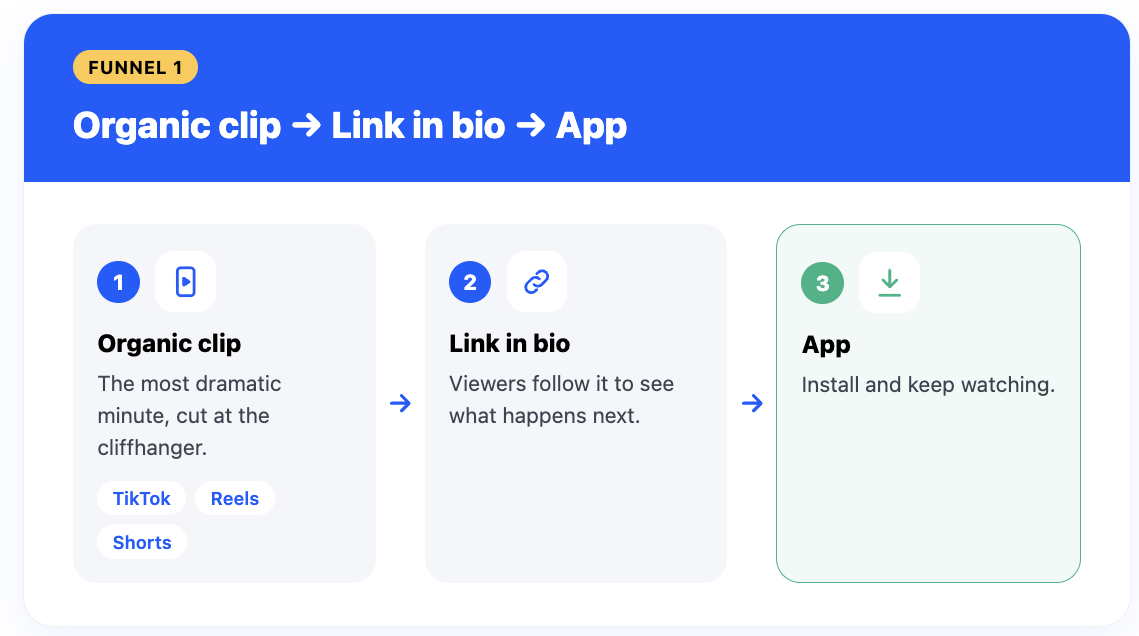
Short clips from a series – often, the most dramatic minute of the first episode – on TikTok, Instagram Reels, or YouTube Shorts. The clip ends on a cliffhanger and points to the Install app button, which leads to the app.
Funnel 2: Paid social ad with a clip – App
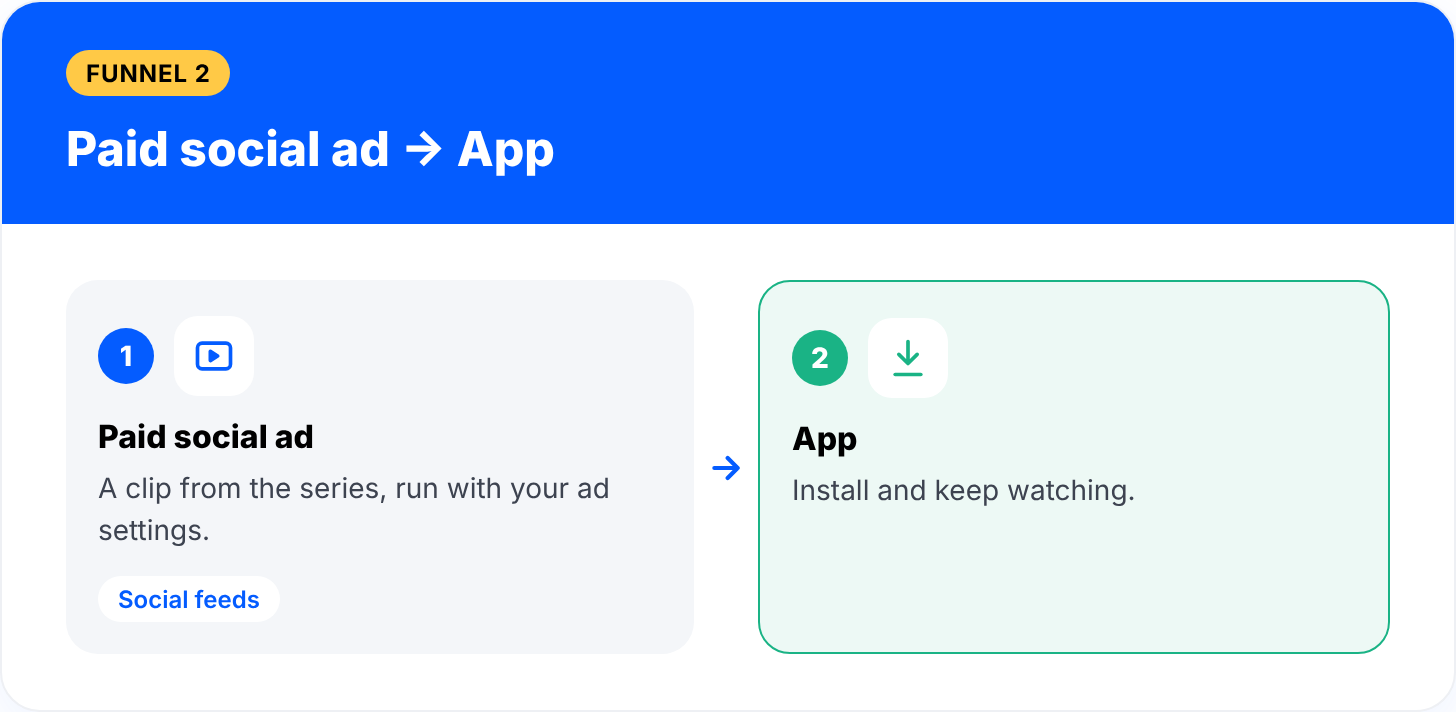
Almost the same as the previous one but more predictable, as you rely on your ad settings instead of organic traffic algorithms.
Funnel 3 (China exclusive): Short video ad – Mini program – App
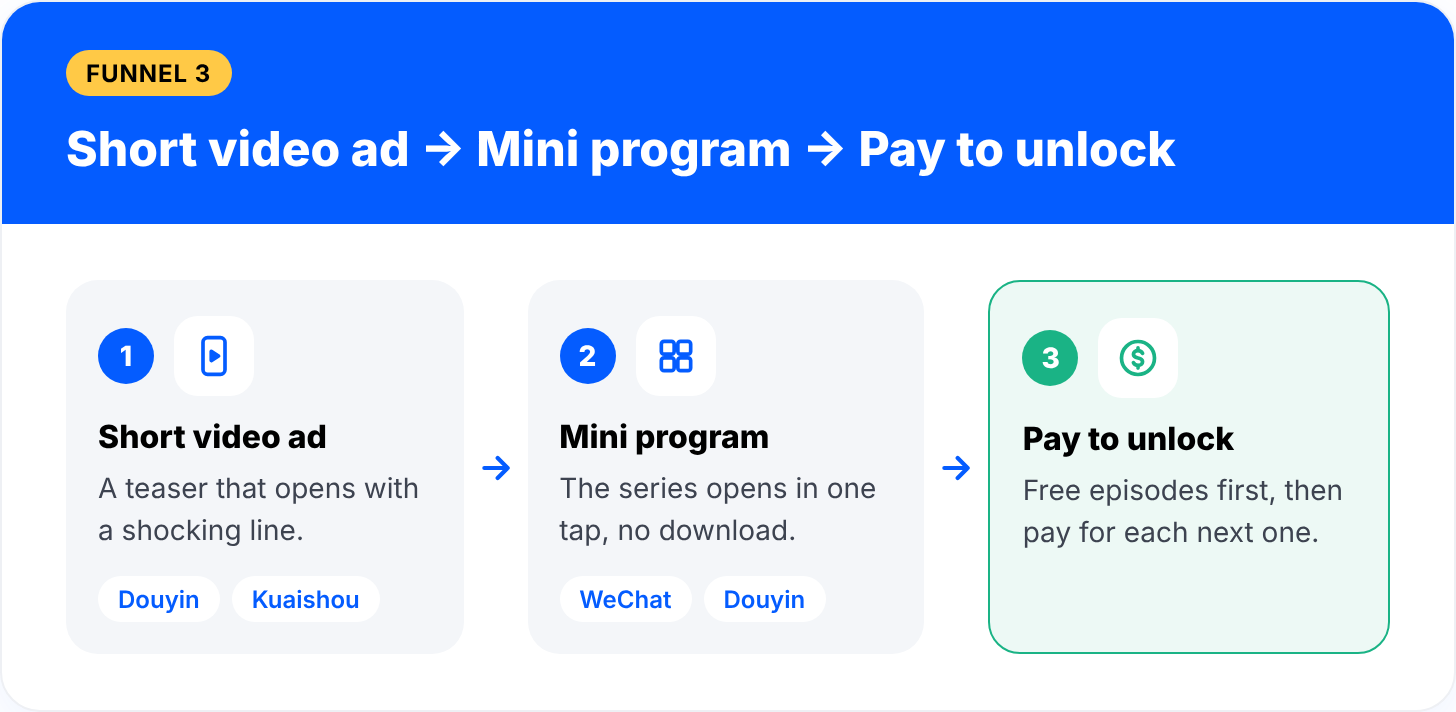
In China, this is the funnel the short drama market grew on, and the budgets behind it are huge. According to Rest of World, one publisher spent about $5.8 million on ads for a single 101-episode series and earned over $7 million back. It works because Chinese users already spend their day inside WeChat and Douyin and use mini programs* there.
Here’s the mechanics:
- A teaser clip runs on Douyin or Kuaishou and opens with a shocking line to stop the scroll;
- One tap opens the series in a mini program, so there’s no app to install
- The first episodes are free, each ends on a cliffhanger, and after that the viewer pays to unlock each new episode.
*Mini programs are lightweight apps that run inside a super app like WeChat or Douyin. They open instantly with one tap, need no download from an app store, and use the payment method already linked to the user’s account.
Funnel 4: Popunder / Push Notifications – Cliffhanger prelander – App
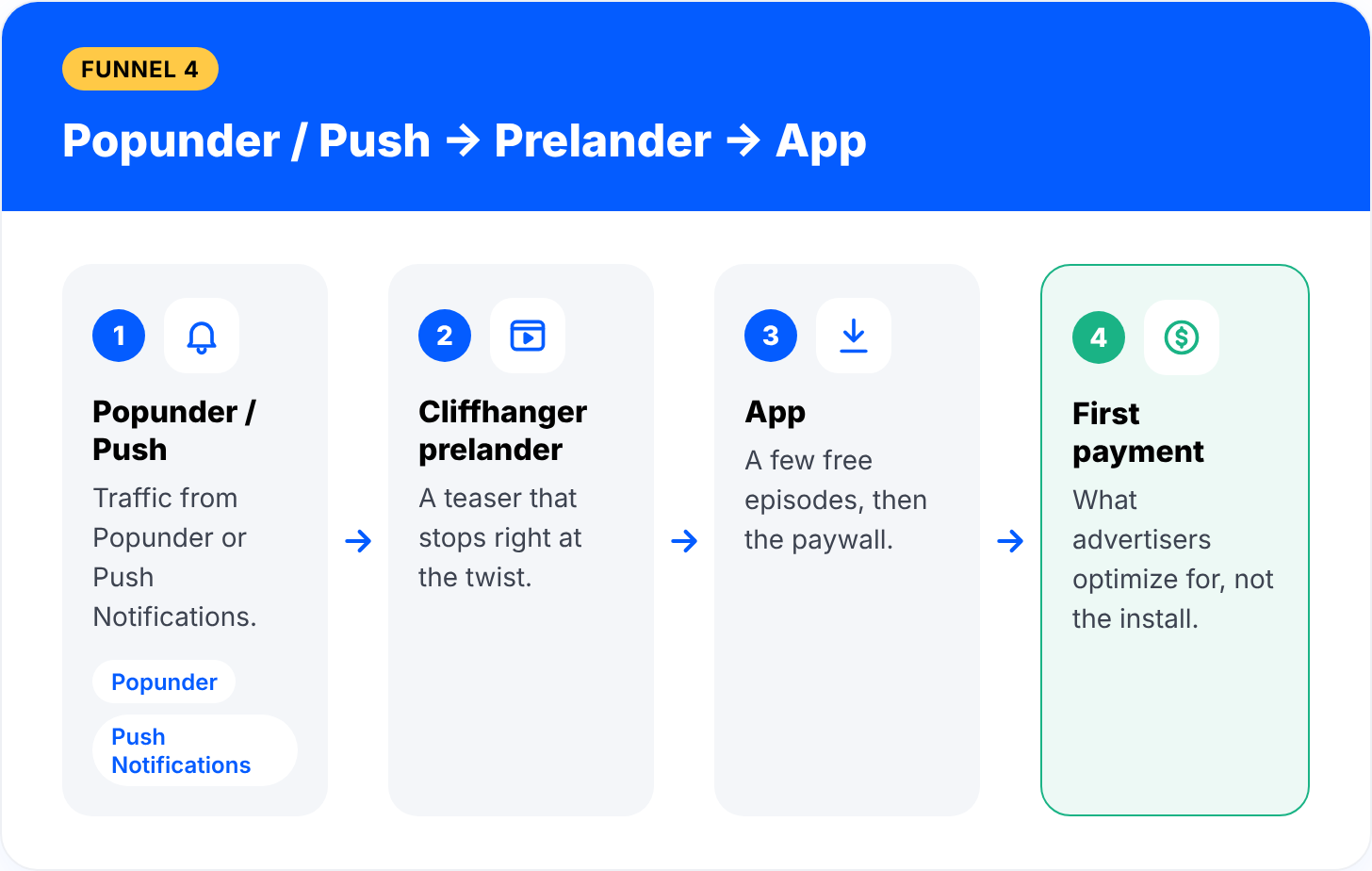
The traffic comes from Popunder or Push formats, and works like this: a user lands on a prelander that hooks them with the story: a scene or a short teaser that stops right at the twist. The ‘Watch the next episode’ button leads to the store, and after the install, a viewer gets a few episodes for free, and the paywall appears at the biggest cliffhanger.
The goal advertisers optimize for is the first payment.
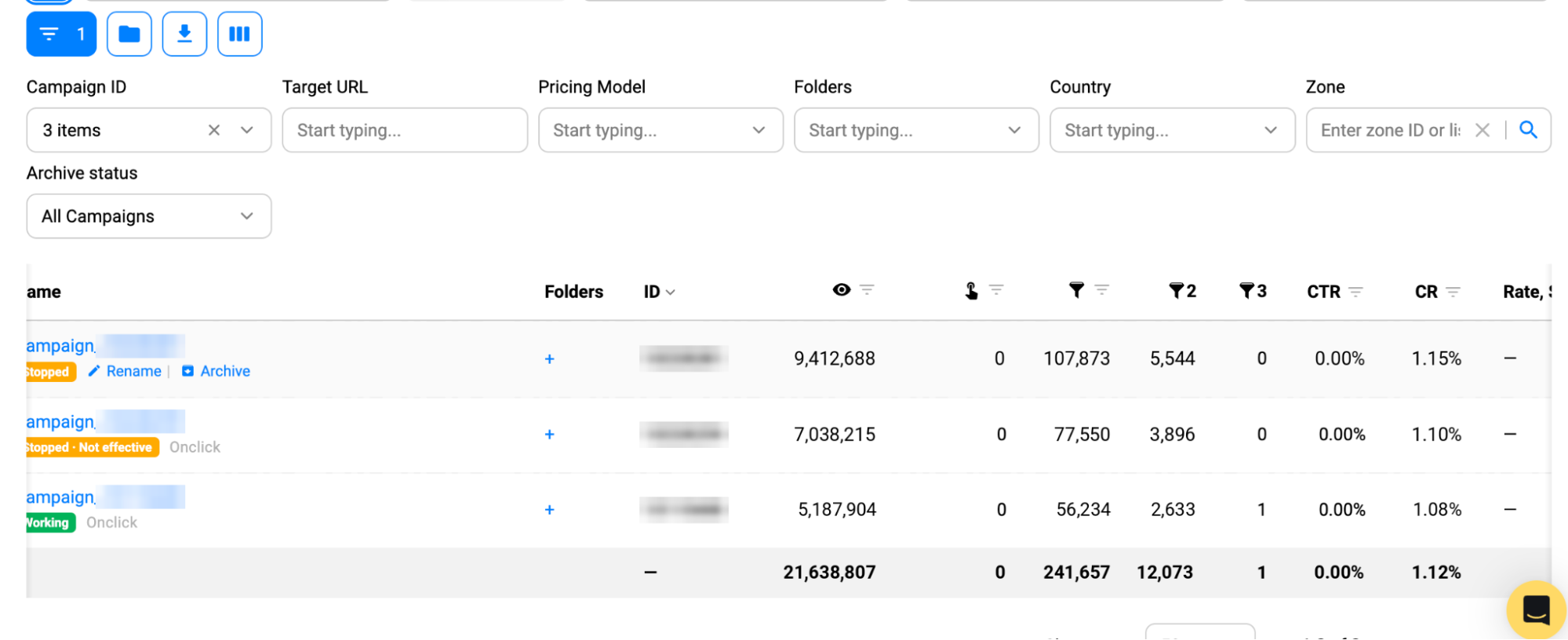
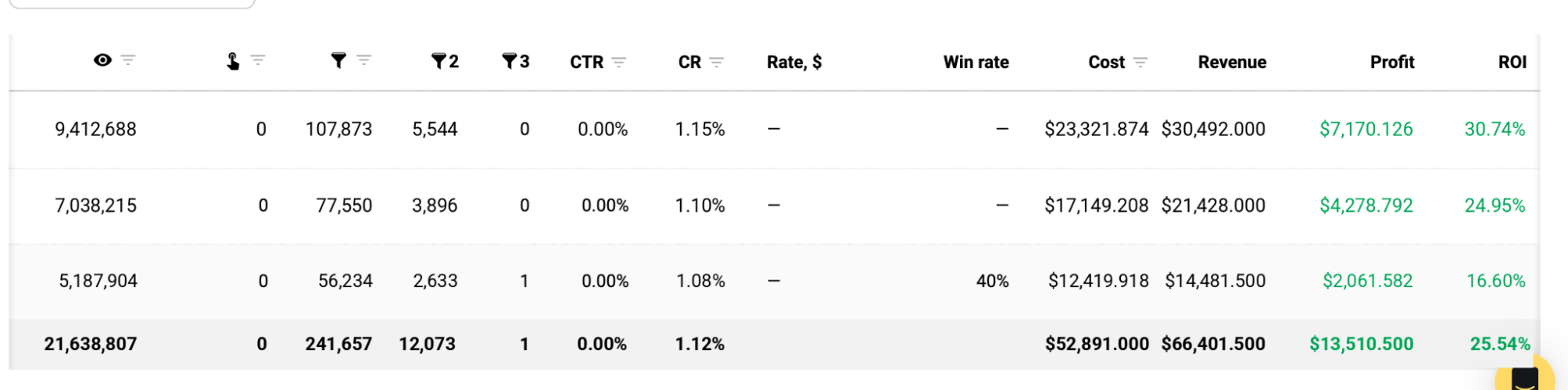
Here is a PropellerAds case study with this funnel:
Short drama app on Popunder
One advertiser, 3 campaigns, two tracked events: app install and first payment (FTD)
By campaign
| Campaign | Spend | Installs | First payments | Cost / FTD | Install → FTD |
|---|---|---|---|---|---|
| Campaign 1 | $23,322 | 107,873 | 5,544 | $4.21 | 5.1% |
| Campaign 2 | $17,149 | 77,550 | 3,896 | $4.40 | 5.0% |
| Campaign 3 | $12,420 | 56,234 | 2,633 | $4.72 | 4.7% |
| Total | $52,891 | 241,657 | 12,073 | $4.38 | 5.0% |
All materials and creatives were provided by the partner. Results are this advertiser’s and depend on the offer, GEO, creatives and traffic. They are not typical or a forecast.
Episode 4: Building the Campaign
So you decided to run a PropellerAds campaign – and we’ve already shown you a ready funnel. But that’s how the funnel looks in general, and what are the details? Formats, creatives, tracking, and other settings. We asked Viktoria and Echo to share what they do with their clients who run short drama apps in Asia.
Start with Popunder
In our experience, Popunder is the format we most often see working for short dramas in Asia. As Viktoria explains it, the format opens a full page and gives the story the user’s full attention, so users get hooked with video prelanders… especially with some nice cliffhangers. Be honest: if a video stopped right as the billionaire said ‘Wait, you’re my…’, you’d install the app too.
Note: Popunder isn’t the only option, though. Echo suggests testing other formats too, since each one fits short drama in its own way:
Social Traffic reaches users in social feeds, where short-drama audiences already are. It needs only a landing page, with no creatives to design, and it’s available in several key short-drama GEOs: PH, BR, BD, TH, MY and ID. Interactive Ads add a quick engagement step before the offer, so users arrive warmer. They run on ready-made templates rather than video or banner creatives. Volume is smaller, and the cost per impression is higher. And Onclick and In-Page Push offer the largest volume.
Prelanders are a must-have
…but only if they’re good. A good prelander is the one that hooks users with the story before they even think about the store.
Palai Media figured out several important things that creatives must have:
- The story is clear without sound. Actors overplay on purpose, and the first frames show a strong emotion and a conflict you get in a second.
- The hook fits the audience. Ads for women often use betrayal, revenge and forbidden romance. Ads for men use hidden identity and a big comeback.
- The videos change often. Creatives burn out fast: the average short drama app ran 1,887 creatives in the first half of 2026.
- AI helps keep up. VibeShort makes its series fully with AI and was earning around $6 million a month by August 2026 (AppStoreSpy estimate).
AI isn’t just helping with creatives, but changing the series themselves. So creatives made with AI don’t stand out as fake: the series often look exactly the same. According to CGTN, more than 90% of new micro-dramas in China this year were AI-made, and viewers keep watching them.
Echo:
AI-generated and comic (‘manhua’) dramas have entered the top 5 ad themes. At ChinaJoy 2026, InMobi named AI-generated, manga-based, and live-action dramas as the three content types driving short-drama revenue, with live-action growing the slowest.
Easier to show than to tell, so here’s how it looks in real ads.
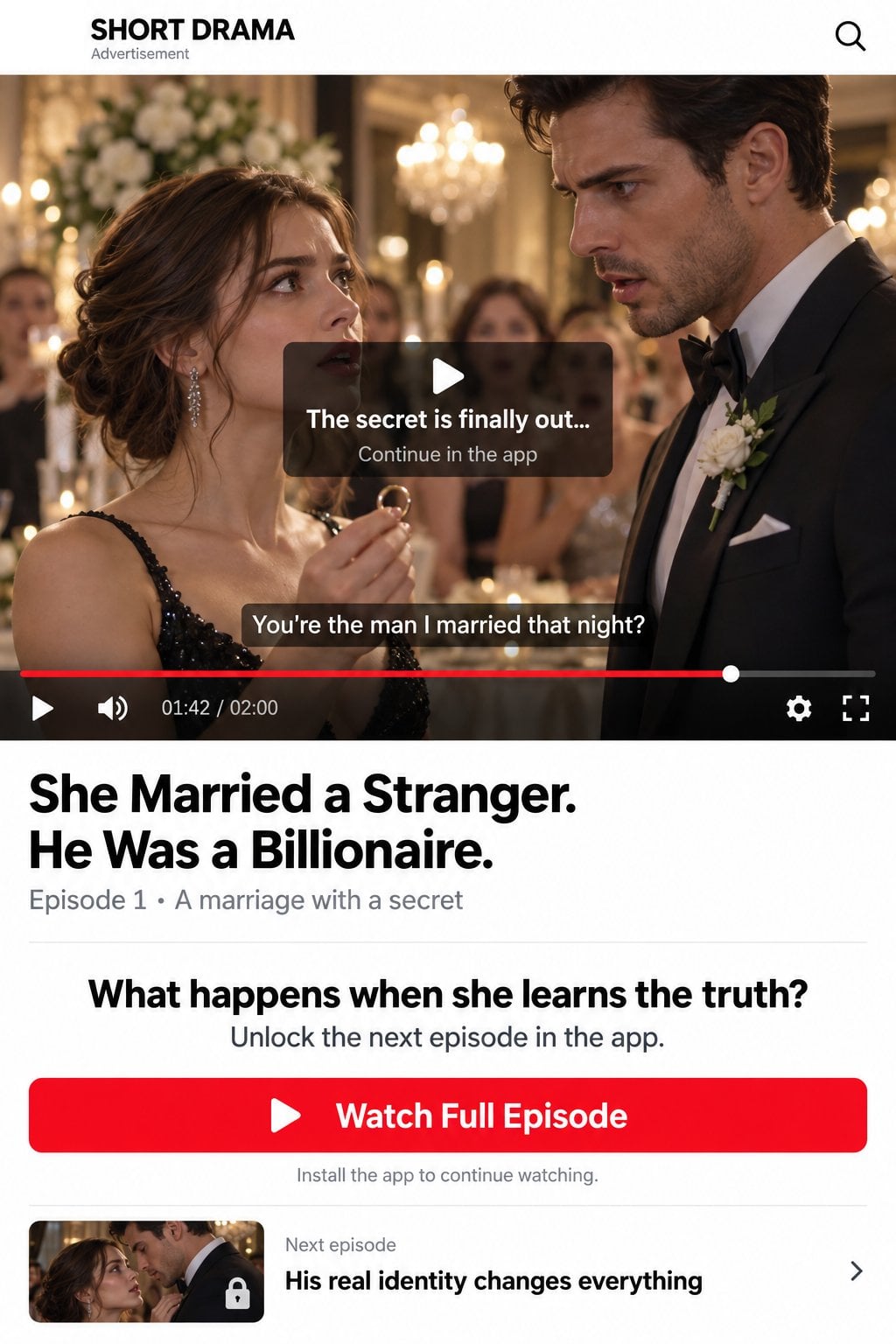
This is a Popunder prelander. According to Viktoria, the creatives that work best at PropellerAds funnels imitate a video player. The user watches a piece of the story, the video cuts off at the most exciting moment, and then they’re asked to install the app to see what happens next:
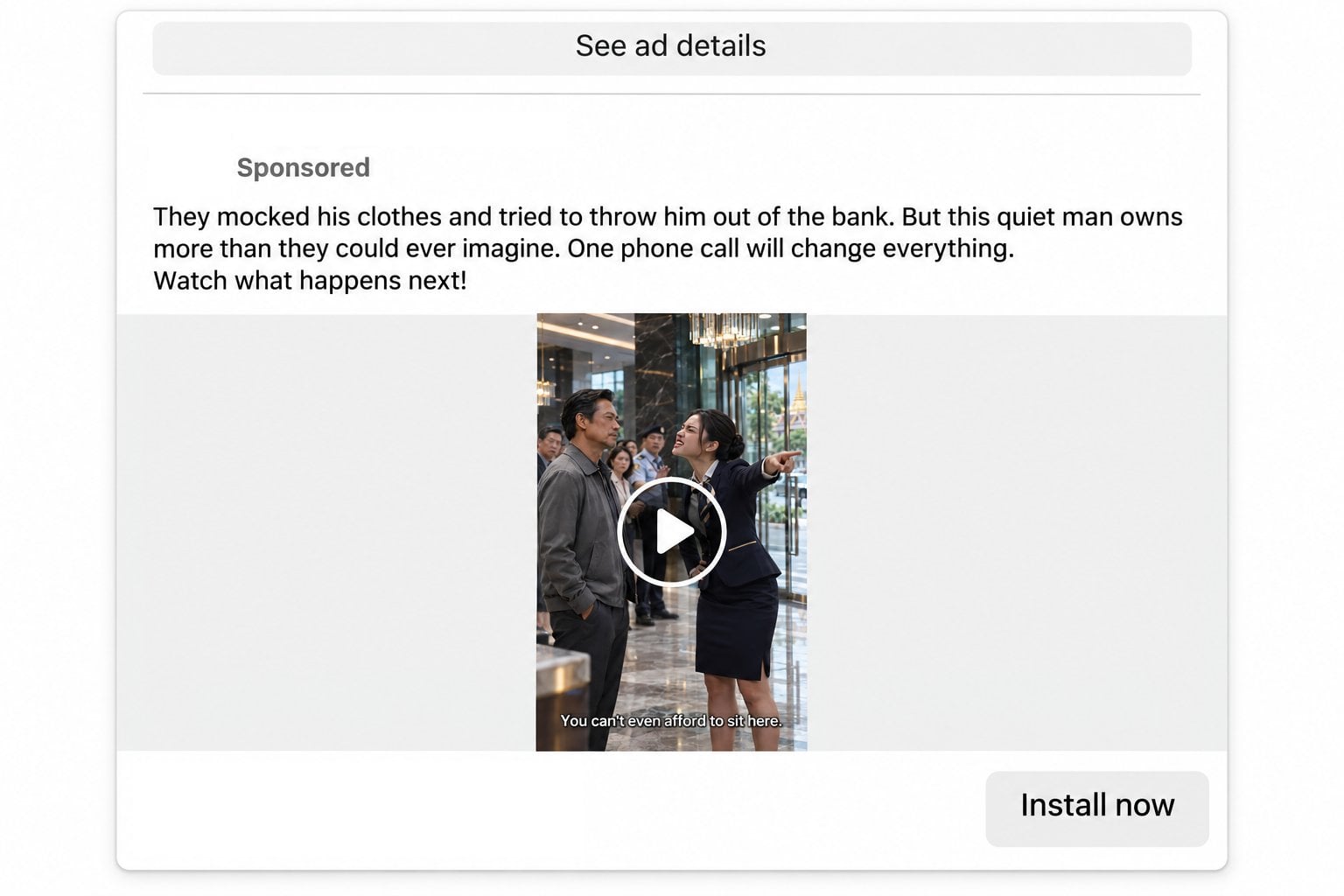
And this one is from Meta ads – in case you want to scale your campaign with social media traffic, too:
One important note: as Palai Media points out, finding short drama creatives in spy tools is easy, but copying them isn’t. Even if you make videos with AI, each one is a separate story: you need a script, characters that look the same from scene to scene, and emotions that feel real. So you can’t just download a winner and run it as your own test. You’ll need your own scenes, but luckily AI makes that faster and cheaper every month.

Pick the right GEOs
Short dramas come from China, but people watch them all over the world now. So, you don’t need to focus on a single GEO – especially when promoting global apps. In Q1 2026, more than three-quarters of all downloads came from Southeast Asia and Latin America, according to Sensor Tower.
So where should you launch? Echo explains:
North America has the money, but acquisition there costs far more. We’d suggest North America mainly for IAP-focused apps with proven payer value. For IAA and hybrid apps, SEA and LatAm are the more efficient starting point.
Episode 5: Launch Day
Your prelander is ready, so it’s time to set up the campaign. Viktoria broke it down into three short episodes, cliffhangers included. Scroll it to learn more!
A 3-episode mini-series by Viktoria Demskaya, PropellerAds
- Most of the volume
- Cheaper in many cases
- Less volume
- Test it to compare payback
Testing both is the only way to see which OS pays off better and brings higher quality users.
- There’s no universal bid: it depends on how well the product converts
- Brand awareness matters too: is the app already known in that GEO?
- Watch if the campaign stays within the rate or beats it, then adjust
Season Finale: Time to Scale
So the campaign is live, the first installs are coming in, and everything looks good. The happy ending? Not yet. This is the part of the series where our hero gets bigger. Here’s how Viktoria suggests doing it:
- Start wide. Launch on CPA Goal and test several ad formats at once: Social Traffic, Interactive Ads, Popunder, Push Notifications, and In-Page Push. Run them on RON (run of network) with an above-market bid. It means your ads run across all available sites and zones in the network, without picking any specific ones at this point. CPA Goal then adjusts your bid toward the optimal rate on its own, usually within 24 to 72 hours. The price can go up or down, so don’t be shy with the bid at the start: a higher bid helps you collect data faster and see which traffic performs best.
- Find your allies. Check the results and keep the zones and targets that performed best. The rest can leave the story.
- Go big on SmartCPM. Move the winning zones and targets to SmartCPM and scale the volume.
Viktoria:
‘We use the whole arsenal: different traffic types and ad formats, audiences, zone whitelists, and all pricing models.’

Post-Credits Scene
Let’s recap the season. Short drama apps sell one thing: the next episode, and so should your funnel. Hook the user with a story on the prelander, cut the video right at the twist, and let the app do the rest. In Asia, Popunder brings the volume, CPA Goal shows you what works, and SmartCPM helps you scale it.
But some questions are still open. How many conversions will you get on day one? Will your creatives really burn out that fast? And will the billionaire ever finish his sentence?
You don’t need 50 coins to find out – just launch your campaign and see for yourself.
Trends
View more postsFrom 11/11 to Cyber Monday 2026: What the Data Shows and How to Run Your Campaigns
Short Drama, PWAs, and AI Among 86% of Game Developers: 6 Key Trends from ChinaJoy 2026
Sporting Events 2026/27 for Affiliate Marketers [Interactive Calendar]
6 AI Trends Shaping Traffic Buying. Insights from Alex Vasekin