From 11/11 to Cyber Monday 2026: What the Data Shows and How to Run Your Campaigns
It’s THAT time of year again, and we’ve got some planning to do. Why? Because it’s the sales season!
Singles’ Day, Black Friday, and Cyber Monday are coming up, bringing some of the year’s biggest opportunities to make money in eCommerce.
But here’s an interesting bit: last year, eCommerce conversion rates on PropellerAds started climbing well before the November sales, then rose again after Cyber Monday. Those extra days deserve a place in your campaign schedule too.
Today, we’ll look at the PropellerAds data and, obviously, talk to Matvey Sсhmidt, Sales Director at PropellerAds, who works closely with eCommerce advertisers through every sales season, so he knows when to launch, how often to show your ads, and how to turn abandoned carts into sales.
Let’s dive in!
3 Sales With 3 Different Shoppers
When you hear “sales season,” it sounds like one big event. And that can lead to decisions like making one big set of creatives and calling it a day.
But in practice, these “discount days” bring in different audiences, different product categories, and different buying moods. So, let’s look at each one.
11/11 (Singles’ Day): Asia’s Biggest Shopping Event
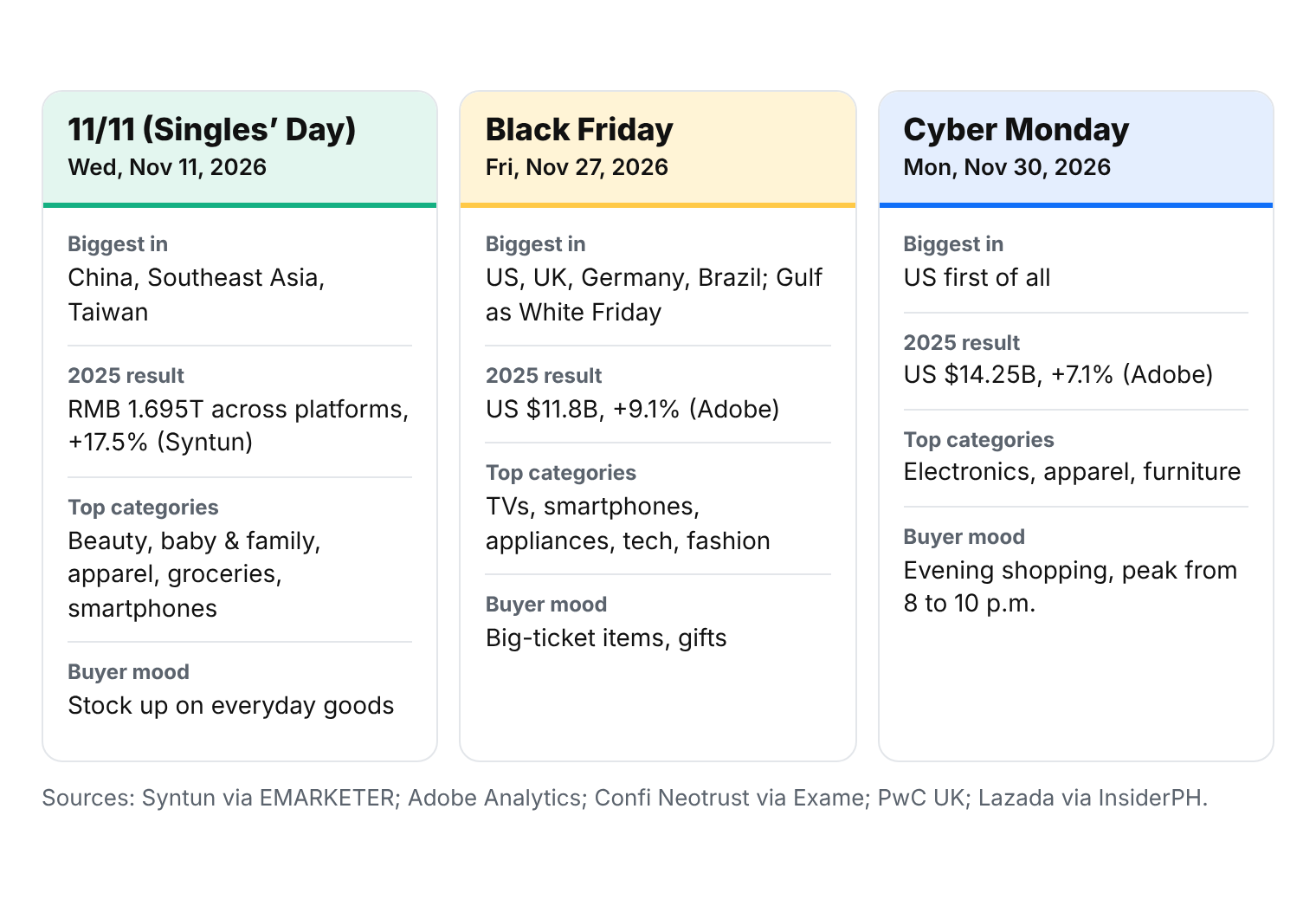
Singles’ Day started in China and grew into the world’s biggest online shopping event. How big?
In 2025, Syntun estimated sales at RMB 1.695 trillion (about $236.6 billion), as reported by EMARKETER. And calling it a “Day” is a bit of an understatement: the event lasted 5 whole weeks.
If you run offers outside China, let’s look at Southeast Asia. Meltwater tracked online mentions of Singles’ Day, Black Friday, and Cyber Monday across the region.
Singles’ Day accounted for 93% of those mentions, compared with 6.2% for Black Friday and less than 0.5% for Cyber Monday. The tracking covered September 29 – October 28, 2025, so people were already talking about deals weeks before November 11.
Shopee, Lazada, and TikTok Shop were among the platforms getting that attention, with creators and livestreams helping shoppers discover offers.
What sells in Southeast Asia on 11/11:
- Beauty, clothing, and baby products. These were among the fastest-growing categories in Criteo’s Q4 2024 review of Southeast Asia’s double-date sales. Preferences varied by country: apparel and accessories stood out in Indonesia, health and beauty in Singapore, and baby products and home and garden in Thailand.
- Groceries and everyday essentials. These were among the top performers in Lazada Philippines’ 11/11 2025 results. Its Mother & Baby category also reported a fivefold increase in gross merchandise value – the total value of goods sold.
- Smartphones and sportswear. The same Lazada Philippines report highlighted strong results for Samsung and POCO, along with Nike, Adidas, and Puma.
So, start with the GEO when choosing your 11/11 offers. Based on the reports above, apparel is worth testing in Indonesia, beauty in Singapore, and baby products and home goods in Thailand. Lazada’s results also give you a reason to test groceries and family essentials in the Philippines.
Use these results to decide which products to promote in each GEO, then build your creatives around the actual deals you’re offering.
Black Friday: Big-Ticket Items and Local Versions
Black Friday is where expensive items move. In the US, online spending on Black Friday 2025 reached $11.8 billion, up 9.1% year over year, according to Adobe.
But let’s look a little closer. Across the full Cyber Week 2025 (November 25 – December 1), Salesforce counted $336.6 billion in global sales, up 7%. Order volume grew just 2%, while the average selling price rose 6%. People placed only slightly more orders, and the items they bought cost more on average. That matters when you’re using last year’s revenue growth to plan this year’s campaigns.
Each market adds its own flavor:
- Brazil. TVs, smartphones, and refrigerators led Black Friday revenue in 2025. Total eCommerce sales reached R$4.76 billion, up 11.2%, according to Confi Neotrust data reported by Exame. Orders grew much faster, up 28% to 8.69 million, while the average order value fell 12.8%. More orders, smaller checkouts. So, expensive products deserve a look, but test different price points within those categories and make the price and savings clear in your creatives.
- UK. Technology and fashion topped shoppers’ plans in PwC’s 2025 pre-sale research, at 48% and 38%, respectively. PwC expected £6.4 billion in Black Friday 2025 spending, up 1.5%, with 80% going online, including click & collect. Another useful detail: 68% of shoppers planned to buy something for themselves. Give upgrades and personal purchases a place in your creatives alongside Christmas gifts.
- Germany. HDE forecast €5.8 billion in spending across Black Friday and Cyber Monday 2025, down nearly 2% and the first expected decline since its data collection began in 2016. Around €1.6 billion was expected to go toward Christmas purchases. That gives you a reason to test gift-focused offers, with clear prices and savings for shoppers watching their holiday budget.
- Saudi Arabia and the Gulf. Check the retailer’s campaign name before making your creatives. Amazon uses White Friday in Saudi Arabia and the UAE, while noon runs Yellow Friday. Check the dates too: noon’s 2025 event ran from November 20 to 30. Match your ads to the sale name and offer window shoppers will see on the landing page.
For advertisers, these results suggest two ways a Black Friday advertising campaign can grow. Brazil’s increase in orders makes conversion volume worth testing for. The global Cyber Week figures give more reason to track purchase value alongside conversion count: revenue grew much faster than orders.
Set both targets in your campaign plan, so you can see whether your ads bring in more purchases, higher-value orders, or both.

Cyber Monday: Electronics and Evening Shopping
Black Friday gets plenty of attention, but Cyber Monday still brings in more online spending in the US. In 2025, it reached a record $14.25 billion, up 7.1% year over year, according to Adobe.
Electronics led with $3.7 billion (+12.8%), followed by apparel at $2.6 billion and furniture at $1.8 billion. Together, those three categories accounted for 57% of the day’s online spending. Discounts were substantial too: Adobe reported peaks of 31% off listed prices for electronics, 28% for toys, and 25% for apparel.
Now, here’s something for your campaign schedule: between 8 and 10 p.m., US shoppers spent $16 million per minute.
Mobile devices accounted for 57.5% of Cyber Monday’s online spending. Looking at the broader Cyber Week, Salesforce reported that mobile drove 70% of online orders, both globally and in the US.
For advertisers, that makes budget pacing worth a closer look. If your US campaign spends its daily budget by the afternoon, you could miss a busy buying window. Leave some campaign budget for evening, then check which hours actually bring in purchases.
And test the full funnel on mobile: with so much spending happening on mobile, the landing page and checkout deserve as much attention as the ad.
What Last Year Looked Like on Our Network
So, what happened on PropellerAds?
While international numbers look intriguing, we wanted to see whether the same trends showed up in our own stats.
We looked at eCommerce offers running on PropellerAds from late October to early December 2025, using September 29 – October 26 as the baseline. For the sale days, we also checked the markets where each sale matters most.
One thing to keep in mind: a conversion can mean different things across offers, so these figures don’t all represent completed purchases. We’re looking at when traffic and conversion rates changed, rather than comparing individual offers.
Stats Highlights
- More impressions, especially on weekends. From November 6 to December 2, average daily impressions were about 10% above the baseline. Two Sundays stood out: November 9 and November 30 both came in around 29% higher.
- The sale dates brought higher conversion rates, especially in their own markets. Here’s how CR compared with the baseline:
- October 30–31: roughly double.
- November 4–7: around 50% higher.
- November 11, Singles’ Day: about 50% higher in Indonesia and Vietnam.
- November 12: around 50% higher overall and about twice the baseline in Southeast Asia.
- November 28, Black Friday: about 60% higher in the main Black Friday markets: the US, the UK, Germany, Brazil, and Saudi Arabia.
- December 1, Cyber Monday: about 80% higher in the same markets.
- December 2–3, after Cyber Monday: around 30% higher.
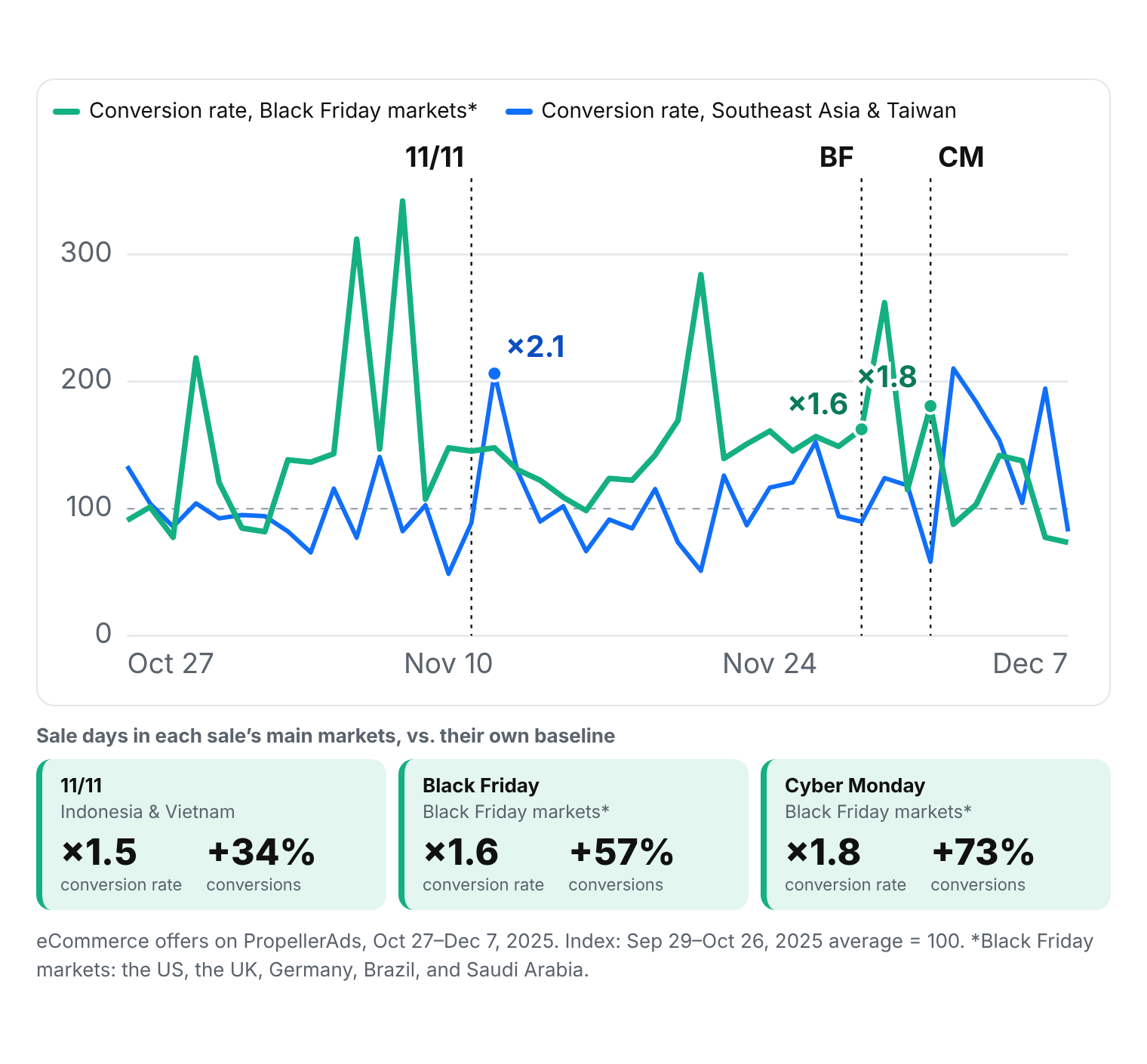
- Conversion rates were higher both before and after the main sales dates. That gives you a reason to test a longer campaign window and leave some budget for the days after the sale. Starting early also allows you to see which ads and audiences perform best before the main event.
- This season, there’s a lot more traffic to work with. We compared the last four weeks (September 28 – October 25, 2026) with the same weeks of 2025 across 11 GEOs Matvey recommends for the sales season. Across all 11, impressions on PropellerAds grew 3.5 times, and clicks rose 87%:
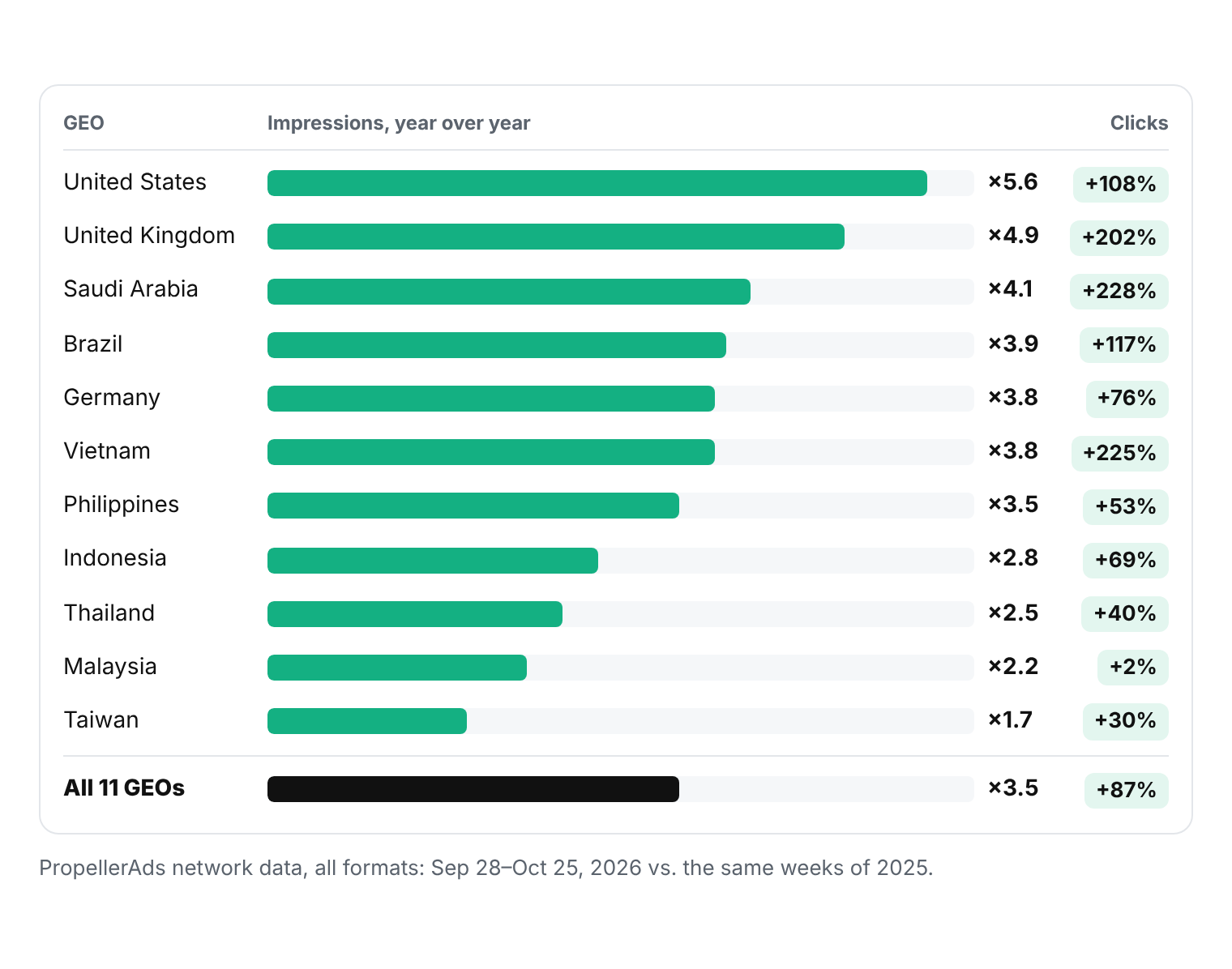
The biggest jumps came in the US, the UK, and Saudi Arabia, the markets where Black Friday and White Friday are the main events. Every GEO on the list grew in both impressions and clicks. That means more room to scale campaigns this year, which supports Matvey’s advice on wide coverage below (read on!).
How to Set Up Black Friday and 11/11 Advertising Campaigns: Matvey’s Recommendations
Now that we’ve gone through the stats, let’s talk about what to do with them. And who better to ask than Matvey? He works with eCommerce advertisers through every sales season, so we asked him to walk us through the campaign setup.
Start a Week Before the Event
Our November data points the same way as Matvey’s first rule: start early.
“Launch a week before the event to warm up the user. Most brands run pre-sale campaigns and banners that already give small discounts and build interest, and that lets you get the most out of the day of the event itself.”
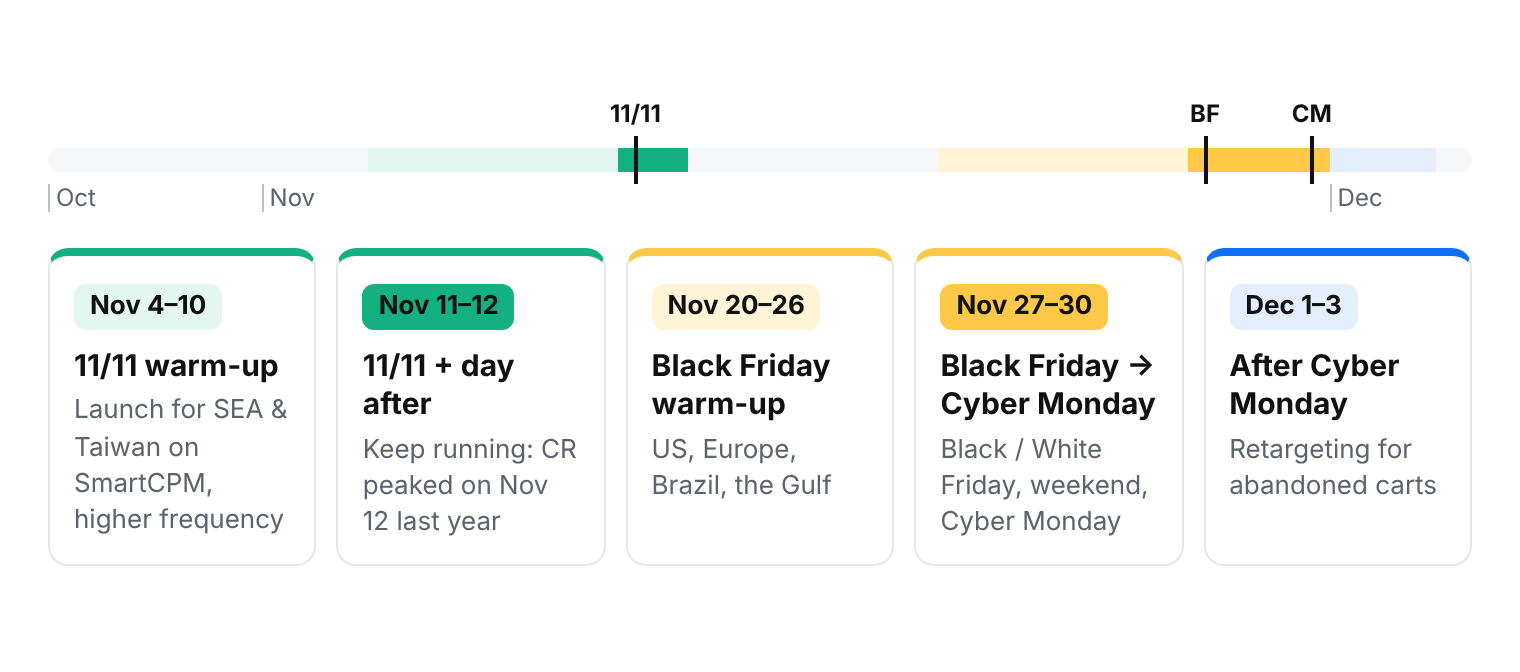
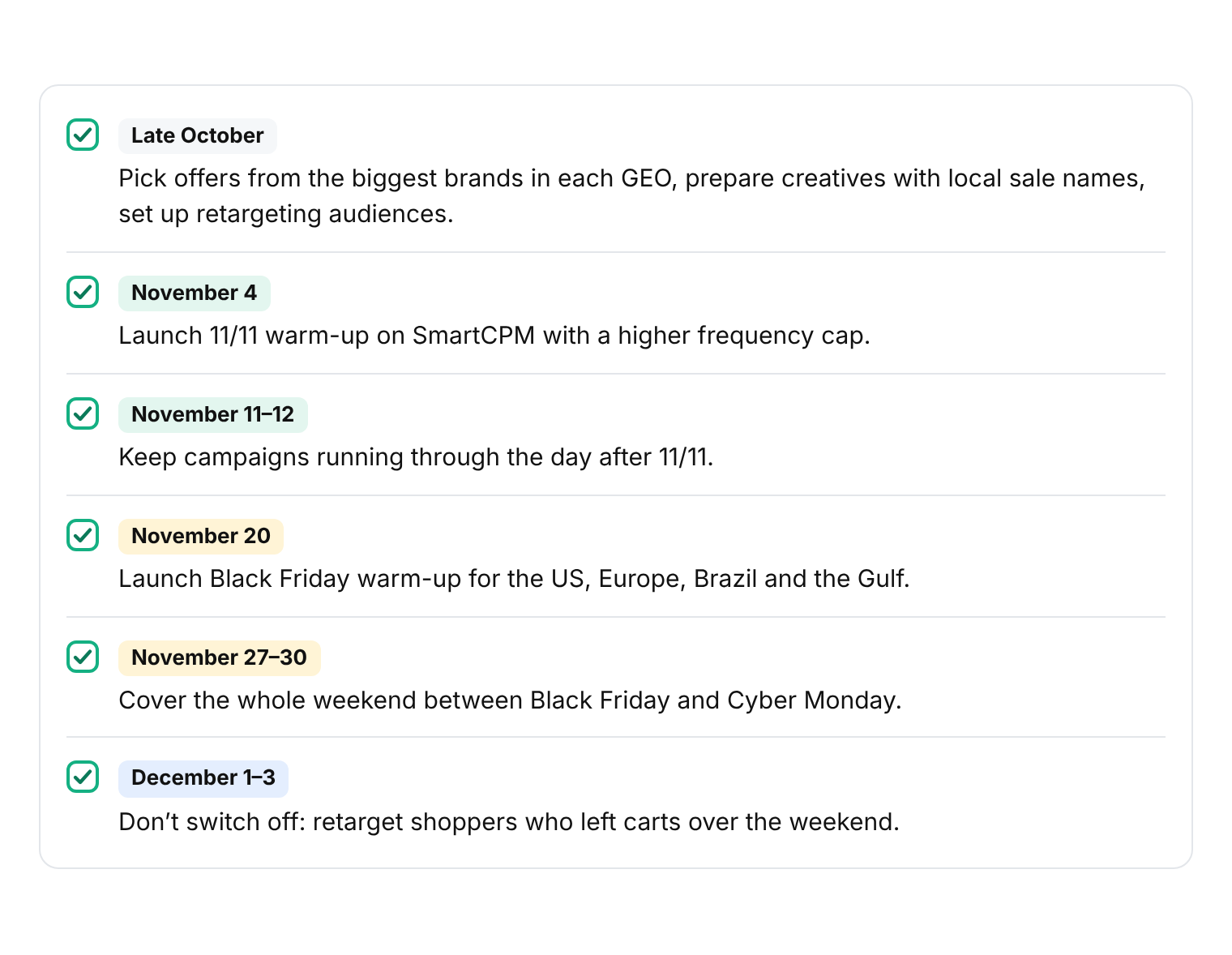
For your 2026 calendar, that means November 4 for 11/11 and November 20 for Black Friday.
If you’re already offering early access or pre-sale discounts – or promoting a brand that is – send shoppers straight to that page. They’ll have something to browse and buy while your main sale is still a week away.

Go Wide and Show the Ad More Than Once
So, you’ve launched early (well done!). Now you need enough reach and enough repeat impressions for shoppers to remember your offer among all the other sale ads.
As Matvey puts it:
“Reach matters a lot during a sale. The more often the ad flashes in front of the user, the higher the chance they’ll remember the brand and make their purchases right there. Memorable creatives and wide coverage are the key to success.”
Matvey connects this directly to the pricing model and frequency settings:
“When working with us, SmartCPM or SmartCPC is the most effective revenue type: it lets you cover the largest number of sources without overpaying. We recommend setting a higher ad frequency and capping for your campaigns, for example, showing 3 ads every 6 hours. That way, you’ll definitely show the user your ad at different times of day. Maybe someone saw the ad during class and couldn’t make the purchase, but after seeing it again in the evening, it’s easier to pay.”
SmartCPM is a CPM model where you set the maximum bid you’re ready to pay, and the system checks the competition for each placement so you don’t overpay. It’s available for Popunder campaigns. For Push and In-Page Push, the closest option is SmartCPC, while Social Traffic, Interactive Ads, and Telegram Mini Apps Ads run on CPC, SmartCPC, or CPA Goal.
The evening part of his advice fits the market data too. On Cyber Monday 2025, US online spending peaked between 8 and 10 p.m.
Pick the Right Flow
Next, where do you send the shopper? Matvey’s recommendation is:
“The most effective flow is web2web. For in-app, you should already be working with apps.”
For web traffic, that means sending people straight to the store’s website, where they can browse and buy. Asking them to install an app first adds another step before checkout.
If you already run app campaigns, build on that setup and optimize for the in-app events you track. Otherwise, keep the purchase on the website.

Target by Device, Not Only by Country
You’ve picked your GEOs. Now, Matvey suggests looking at devices within each market:
“Evaluate the region relative to devices. Using devices, you can build smarter targets. For example, statistically the average iPhone price is higher, so you can show iPhone users deeplinks to more expensive products, and cover Android users with more practical goods.”
To see whether this works for your campaigns, compare device groups within the same GEO and product category.
Look at both purchase rates and revenue per visitor: a higher order value may be worth it even if fewer people buy. If the split pays off, you’ll have a reason to give each device group its own offers, creatives, and budget.
Use Retargeting to Bring Shoppers Back
Some shoppers will leave before buying. Matvey explains how retargeting can help:
“Use retargeting to push the user through the cart funnel, from registration to completing the purchase. Most large eCommerce projects let you set up lots of events. In absolute numbers, the cost of such campaigns is low, but it can raise CR a lot.”
Build separate audiences for registration, product views, add-to-cart, and checkout started. Then match the message to where each shopper stopped. Someone who browsed several products may need another look at the selection. Someone who left sneakers in their cart already has a product in mind – remind them of the current price or the offer’s actual end date.
Make sure shoppers move between audiences as they progress, and exclude completed purchases from reminders for the same item. Otherwise, you could spend your retargeting budget asking people to buy what they’ve just ordered.
Combine Formats
You’ve got the offer and the audience. Now, give shoppers a few different ways to notice it. Here’s Matvey’s approach:
“Combine different ad formats. That way, you increase reach and get around banner blindness. For example, a native push with a discount triggers a more natural, engaged reaction than a less personalized offer.”
That means adapting the creative to each format. With Popunder, you have a full landing page to show the promotion, explain the deal, and let shoppers browse. Push and In-Page Push need a shorter message: the product, the discount, and a reason to click.
Keep the offer consistent across formats, so someone who sees your ad again can recognize the deal.
And leave room to test Social Traffic, Interactive Ads, and Telegram Mini Apps Ads – we’ll look at those next.
Follow the Biggest Brands in Each GEO
The brand behind the offer matters too. For affiliates choosing which stores to promote, Matvey has a clear preference:
“For countries, always focus on the biggest brands. In eCommerce affiliate marketing, there’s a direct link between how recognizable a brand is and how it performs.”
His priority GEOs for this season are the US, Indonesia, Malaysia, Saudi Arabia, Taiwan, the UK, Brazil, Germany, the Philippines, Vietnam, and Thailand.
If you’re choosing affiliate offers, check which familiar marketplaces and retailers are available in each GEO: Shopee and Lazada in Southeast Asia, noon and Amazon in Saudi Arabia, for example. Shoppers already know and trust the store, so they can focus on the deal.
If you’re advertising your own store, use the pre-sale week to build that familiarity. Keep your branding recognizable across ads and landing pages, and make delivery, returns, and payment information easy to find.
Tip from PropellerAds: Match your campaign calendar to the market. Give 11/11 priority in Southeast Asia and Taiwan, and plan around Black Friday and Cyber Monday in the US, the UK, Germany, and Brazil. For Saudi Arabia, check the retailer’s own promotion: Amazon calls it White Friday, while noon runs Yellow Friday, each with its own offer window.
Formats Worth Adding This Season
Three formats are worth adding to your sales campaigns this year: Social Traffic, Interactive Ads, and Telegram Mini Apps Ads.
Social Traffic will go through its first big sales season on PropellerAds, while Interactive Ads and Telegram Mini Apps Ads give you more ways to reach shoppers beyond the usual banners. Test them alongside the formats you already run.
To help you plan, we checked where each format gets the most traffic across the 11 GEOs in this article. Here’s each GEO’s share of the format’s impressions across those 11 countries (October 12–25, 2026):
| Format | Where it has the most traffic (share across the 11 GEOs) |
|---|---|
| Social Traffic | Brazil 34%, Indonesia 28%, Thailand 25%, Philippines 12% |
| Interactive Ads | Brazil 27%, United States 14%, Philippines 12%, Indonesia 12% |
| Telegram Mini Apps Ads | Germany 17%, United States 15%, Indonesia 15%, Brazil 13% |
So if you’re planning 11/11 campaigns in Southeast Asia, Social Traffic gives you volume in Indonesia, Thailand, and the Philippines. For Black Friday in Brazil, both Social Traffic and Interactive Ads have the most traffic there. Telegram Mini Apps Ads are spread more evenly, with Germany and the US at the top.
Here’s where each one fits in a sales campaign:
- Social Traffic shows your ads to people active on social platforms through paid placements, and you launch it as a separate format right in your PropellerAds account.
- Interactive Ads warm users up with a short tap or swipe before they reach the landing page. That works well for the pre-sale week, when you want people to remember your brand before the big day.
- Telegram Mini Apps Ads show ads inside Telegram mini apps, where users are usually more engaged than average. This is a good fit for GEOs where Telegram is part of everyday life.
A simple way to start: add one of these formats to the warm-up campaigns you launch a week before the sale, compare its results with the formats you already use, and shift more budget to whatever performs best before the main date.
Your Sales Season Timeline
Putting it all together for 2026:
Wrapping Up
Three big sales, several weeks of campaigns, and quite a few decisions to make. But now you’ve got last year’s numbers and Matvey’s experience to help you plan.
The part we’d keep in mind? The sale days themselves worked well in their own markets: last year, conversion rates rose by about 60% on Black Friday and 80% on Cyber Monday in the main Black Friday markets, and by about 50% on 11/11 in Indonesia and Vietnam. But the days around the sales deserve a place in your schedule too.
On our network, conversion rates also rose ahead of the November events and again after Cyber Monday. Launching early gives you time to test, while keeping campaigns running afterward lets you follow up with shoppers who haven’t bought yet.
You also have more traffic to work with this year: across the 11 GEOs we checked, impressions were 3.5 times higher than in the comparison period, and clicks grew 87%. That gives you room to try different audiences and formats, but you’ll still need to see which ones bring in purchases.
So, pick your GEOs, check the local sale calendars, and get your creatives and tracking ready. You’ve got campaigns to run.
FAQ
Matvey suggests starting about a week before each event. For 2026, that means November 4 for 11/11 and November 20 for Black Friday. Leave some budget for afterward too: on our network in 2025, higher conversion rates appeared before and after several headline dates.
Start with Southeast Asia: Indonesia, the Philippines, Malaysia, Vietnam, and Thailand. Taiwan is also on Matvey’s list. Then check which categories and brands are popular in your chosen market – the same offers won’t necessarily work across all of them.
Last year’s results give you a starting point: electronics, apparel, and furniture led US Cyber Monday spending, while TVs, smartphones, and refrigerators topped Black Friday revenue in Brazil. In the UK, technology and fashion led shoppers’ pre-sale plans. Use those findings to build your shortlist, then test the offers you have available.
Matvey suggests combining formats to increase reach and give shoppers more chances to notice your offer. You can test Social Traffic, Interactive Ads, Telegram Mini Apps Ads, Popunder, Push, and In-Page Push. Adapt the creative to each format and compare the results before putting more budget into it.
Join our Telegram for more insights, and tell us how your sales season is going.