Short Drama, PWAs, and 86% AI Adoption: 6 Key Trends from ChinaJoy 2026

Here’s what buyers in China and China-outbound teams wanted at ChinaJoy 2026, and what it tells you about GTC Shanghai, where we’re heading next.
From the outside, the Chinese market often seems huge and secretive, with a billion users, closed platforms, and rapid changes. At ChinaJoy, though, things get clearer because customers share exactly what they want to buy.
ChinaJoy 2026 took place in Shanghai from 31 July to 3 August. The organizers stated that the total number of attendees over the four days was 438,900, including a record 44,000 professional visitors, about one-fifth of whom came from outside China. For those selling to the China-outbound market, this is the week when the entire market is concentrated in a single building.
We were joined by a delegation of nine people and had a booth; this was our second year at the exhibition, and over four days we asked almost everyone the same question: what are you buying right now, and on what terms?
Next on our calendar is GTC Shanghai on 4-5 November, and we’ll have a team there too. If you’re going, the trends below are a good preview of the conversations you’ll have on the floor.
Answers stopped surprising us by day 3; six common trends started to appear:
- Short drama now has its own business model, and growth is strongest in IAA titles.
- AI has moved from a tool people try to the layer companies run on.
- App traffic gets delivered as PWA or APK by default.
- CPA pricing, whitelists, and S2S are the opening ask, not the advanced one.
- Buyers are adding channels beyond Meta and TikTok, mainly because scaling there has become costly.
- Beneath all that, DSPs are seeking ORTB pipes.
Trend 1: There’s now a distinct economic aspect to short drama
No one present at the event was still testing short drama. Discussions focused on how to manage it, and the most helpful approach came from the team at Adjust, who divided the category into two types:
- IAP short drama, where users pay for a subscription
- IAA short drama, where they watch advertisements instead. The IAA segment is newer and growing faster; overseas short-drama revenue hit $3.24 billion in 2025, up 195% year on year, and IAA’s share of category downloads rose from 4.7% to 24.7% over those twelve months.
For a media buyer, the two model types represent different roles. With an IAP title, you aim to identify the user who will become a payer; as a result, the top-of-funnel standard is higher, the user pool is smaller, and you focus on trial conversions or first purchases.
That part of the market is also highly competitive at the top; Sensor Tower shows that between ReelShort and DramaBox, the two of them account for about 70% of global short-drama IAP revenue. With an IAA title, revenue comes from sessions and ad impressions that build up over several days. A user who watches four episodes and then leaves still brings you money, so you buy with retention in mind, look at watch time from D1 to D7 rather than a purchase event, and can accept wider traffic.
Regarding IAA: it takes a while to assess ROAS. You won’t be able to tell whether a source is profitable within a week, or sometimes two, and if you eliminate zones on day two, you’re guessing. The IAA titles that we test, including in-page push and Interactive Ads, require a larger test budget for this very reason.
According to InMobi’s team, short drama has now become a major source of revenue for them, with revenue being driven by three different types of content: drama generated by AI, drama based on manga, and short-form drama featuring real people, the latter of which is growing more slowly than the other two. All concerned are watching ROAS closely, which shows finance teams are deeply involved.
Our clients gave us a warning: several believe AI-generated short drama has about two years before the market becomes saturated. Of course, no one can prove this, not even us!
But the reasoning makes sense: AI titles can be produced quickly and in large numbers, which can flood the market. In contrast, dramas with real people take longer to make and keep their value longer.
Trend 2: AI is the operating layer
These AI-generated titles tie into the show’s official theme, “Level Up with AI.” Organizers say about 86% of Chinese game developers now use AI in some part of their process. While trade show themes are often aspirational, this one matched what we saw at the event.
AI adoption is further along in China than you might expect. According to GDC’s 2026 State of the Industry survey, only 36% of Western game professionals use generative AI.
The Kochava team told us that not much at this year’s show felt truly new, except for one thing:
AI is the one new thing. Everything else is pretty much as usual.
Admate described a similar shift within their company. A year or two ago, AI was just a chatbot for feedback. Now, it runs data analysis and is deeply integrated into business operations. A DSP operator at their first ChinaJoy shared the same story, saying AI has moved from simple chat replies to handling data analysis and building algorithm models.
Admate also pointed out something you rarely hear at trade shows: there is still uncertainty about how to use AI effectively. Almost everyone is adopting it, but not everyone feels confident.
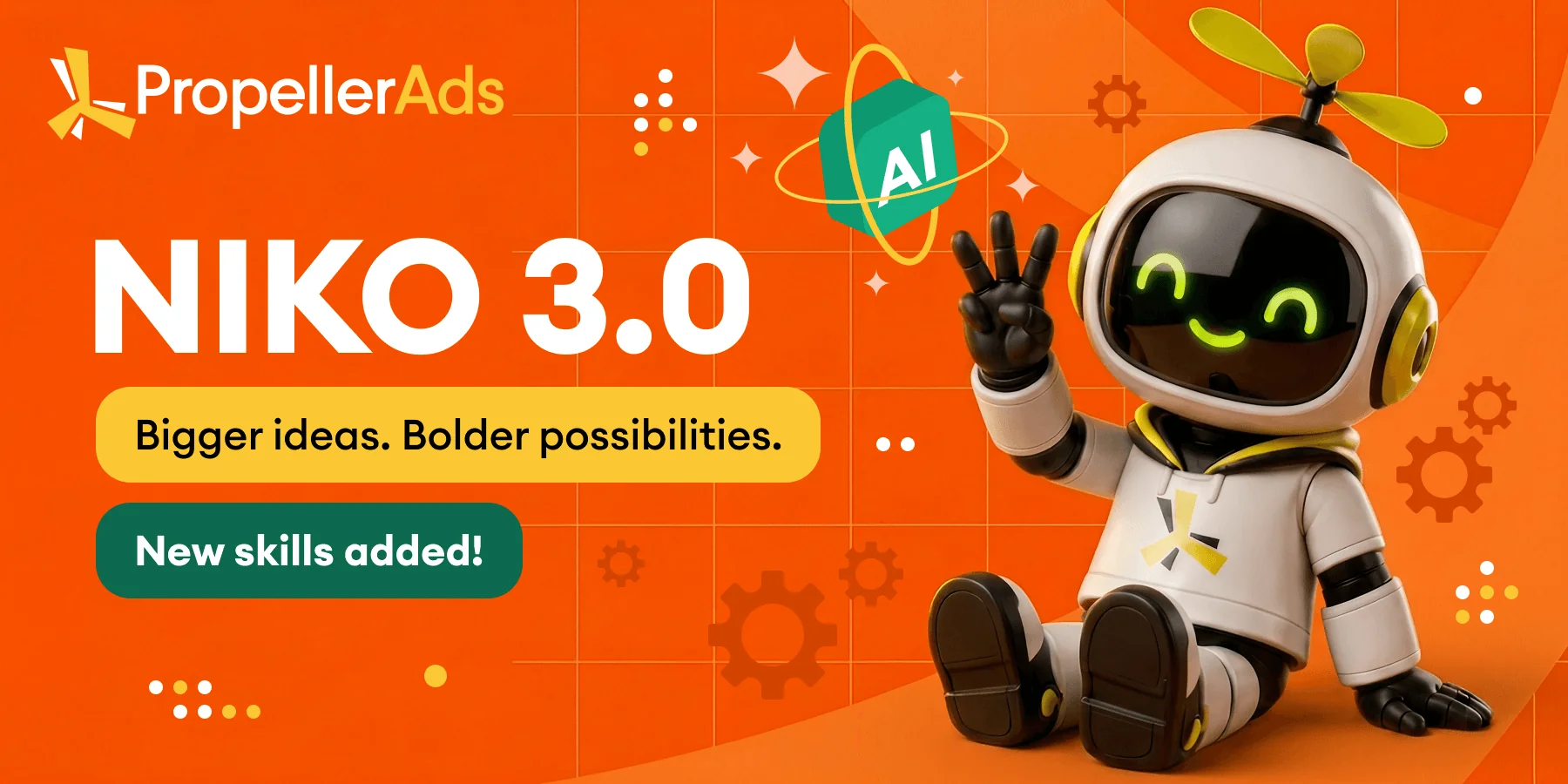
We hear the same uncertainty from our own advertisers, and it’s the reason we built NIKO, an AI agent inside the PropellerAds self-serve platform. You describe what you’re promoting in a chat, and NIKO takes it from there: it sets up the campaign, launches it, and helps you manage it. It works best paired with CPA Goal and S2S postbacks, so the optimization has real conversion data to learn from.
Trend 3: PWA and APK are the default delivery formats
This trend is from our own observations: a lot of app traffic in this market goes out as a PWA or an APK, and the buyers we met treated that as settled. The question we heard most at the booth was never whether a PWA flow works. It was how ours is set up, whether events pass back cleanly, and what install rates look like.
There are practical reasons for this. Store distribution adds review time before launch, and a PWA or APK lets advertisers ship and update on their own schedule. A PWA added to the home screen can be re-engaged with push notifications, which is almost free retargeting once you have the user. Also, CPI in these GEOs is usually lower than for store installs.
Where it does not work: iOS; web push there requires the user to install the PWA to their home screen first, and in the EU, Apple’s DMA response in iOS 17.4 removed PWA push support entirely. An APK is Android-only by definition. So if your audience skews iPhone, the whole model gets harder, and in Tier 1 GEOs a store listing still buys trust that a PWA cannot. Treat it as a Tier 2 and Tier 3 play.
Within these limits, PropellerAds has traffic for APK promotion: Android audiences across Tier 2 and Tier 3 GEOs, formats that send users straight to a download, and postbacks that track installs and in-app events. PWA campaigns run the same way. We already run PWA and APK campaigns, and after the event we started putting together a standard setup kit for them, so clients don’t have to figure it out from scratch.

Trend 4: The first request is performance terms
Almost every buyer we met asked for the same things, and usually in the same order:
CPA or performance-based pricing
- a dedicated whitelist of zones that already convert
- S2S postbacks, RTB or API integration
- an account manager who speaks Chinese
Reach came up later. Buyers already knew we have the volume; what they wanted to settle first was how they’d pay for it.
This isn’t just a China-specific trend; the market is simply ahead of others. Across the industry, S2S postbacks now make up 71% of new affiliate program integrations, up from 58% in 2024. The key difference is that here, it’s the starting point, not just an advanced option.
If you’ve had problems with broad traffic before, you know why buyers want a whitelist. It’s a set of zones the buyer has picked based on their own read of the results: how the offer performed there, how the creatives did, and what the buyer considers a good result. These zones have already converted, so it feels safer. The downside is lower volume. The zones that work now aren’t the only ones that ever will, and a whitelist-only approach finds new ones slowly. Buyers who want to scale usually use a whitelist as the core, but also run CPA Goal with broad campaign targeting to test new zones.

The request for a Chinese-speaking account manager is more about how business is done here than just language. Deals rely heavily on relationships and in-person contact, and buyers want someone who can read briefs in Chinese and respond quickly during Shanghai business hours. That’s why we have Chinese-speaking account managers, along with CPA Goal, custom whitelists, S2S postbacks, and API access.
Trend 5: Diversification is all about cost in large-scale operations
This same approach explains the next trend. Buyers who start with CPA terms and postback requirements don’t switch channels for novelty; they move when the numbers make sense.
Nobody is abandoning Meta or TikTok. The team at Adjust was careful on this point, and so will we be: traditional traffic, they told us, “still provides the best foundation and reliable volume.”
The challenge comes when you try to scale. Everyone is spending on the same mainstream inventory, so costs keep rising: Meta CPMs went up about 20% year over year in 2025, and average cost per acquisition rose 38%. That’s why people look for alternatives. Adjust summed it up best:
If something can deliver a positive ROI at scale, people will invest in it.
There’s no loyalty to any one channel here, so new sources get a fair trial. But the real test is ROI at scale, not just at $200 a day; the goal is to find where the next $10,000 a day can come from.
From our perspective, the two alternatives buyers asked about most were Paid Social Traffic, which reaches users through social feeds via our supply partners, and Interactive Ads, which are a newer second channel.

Trend 6: Advanced buyers are connecting to ad networks via direct oRTB integrations
The DSP operator we mentioned earlier is a good example of the last trend. Their company uses its own bidding logic and wanted direct bid-level access, not just a dashboard. We had several conversations like this, with DSPs asking for ORTB integrations.
ORTB integration is just what it sounds like: you get the bid stream and handle your own optimization, relying only on your own data to see which zones work. This setup is ideal for DSPs with data science teams, but not for small media buying shops, who benefit more from CPA Goal and whitelists. We see real demand for ORTB across the market, and some platforms are adopting it earlier than we expected. But here’s the spoiler: classic buying with smart optimization on the client side is still holding its own, even against strong RTB players.

Conclusion: A market that already knows how to buy
This year, we hosted our first client-only evening in Shanghai. The conversations summed up the article: everyone wanted performance terms, alternative supply, app-style delivery, and direct technical integration, all at once. If you’re entering this market from abroad, focus on the deal terms more than the GEOs.
The show itself has changed as well. There are fewer AAA announcements, more hardware, more cross-platform licensing, and more related technology. That’s why Niko Partners now describes ChinaJoy as a broader digital entertainment exhibition. Buying trends have shifted in the same way.
Here’s what we offer today: CPA Goal, whitelists, S2S postbacks, API access, PWA and APK campaigns, and Chinese-speaking account managers.
Join our Telegram community to get more insights and connect with other affiliates.