eCommerce Advertising & Marketing: All the Basics
eCommerce advertising is the paid promotion of an online store’s products across ad networks, search, and social platforms – using formats like Push Ads and In-Page Push Ads to drive shoppers into the sales funnel. It works alongside eCommerce marketing (organic, email, and content efforts) to build a complete customer-acquisition strategy for online stores.
Get the mix right, and traffic turns into orders, then into loyalty. Get it wrong, and you leak attention at every step.
This guide stays practical: what matters, what to skip, and how to use a few reliable tactics to lift sales without guesswork.
What Is eCommerce Advertising?
eCommerce advertising means paying to bring potential customers to an online store or product offer. These ads can appear in search results, social feeds, on websites, or as notifications delivered to users’ devices. The goal may be a first visit, a product purchase, or a return visit from someone who has already shown interest.
Advertising is the paid part of marketing. Organic search visibility, unpaid social posts, and useful content can attract shoppers without paying for each placement, although they still require time and resources. Paid campaigns let you purchase exposure and test specific audiences, messages, and offers.
PropellerAds is a multisource advertising platform. It lets advertisers create and manage campaigns themselves. Formats relevant to eCommerce include:
- Push Ads: short messages delivered to users who have opted in to notifications, including when they are not browsing.
- The In-Page Push Format: notification-style ads displayed within websites, without requiring notification opt-in. It also supports iOS and macOS.
- Interactive Ads: short flows using taps, swipes, quizzes, or other interactions before users reach an advertiser’s landing page.
- Popunder Ads: landing pages opened in a background tab or window.
- Paid Social Ads: traffic from social feeds, available through PropellerAds without managing separate social advertising accounts.
- Telegram Ads: ads that reach users within Telegram Mini Apps, introducing products and offers to audiences on the messaging platform.
Your product category, delivery coverage, and local shopping habits should guide your targeting. Explore our ecommerce vertical trends to learn more.
What is eCommerce Marketing?
Picture a shopper who spots your product on Instagram, looks it up on Google, skims a few photos, then finally clicks “Buy”. eCommerce marketing is the plan that makes this moment more likely. It helps people find you, feel sure about their choice, and come back when they need you again.
It lives inside digital marketing, but stays close to the shopping journey. In practice, eCommerce and digital marketing work as one system. The goal is simple: be useful at every step, not loud.

In practice, you:
- Attract: show up where people already look — search, social, partners, marketplaces
- Convert: make product pages clear, fast, and reassuring, with proof and simple checkout
- Retain: stay in touch with eCommerce email marketing, helpful content, and small loyalty perks
If the experience feels helpful rather than pushy, you are doing eCommerce marketing right.
eCommerce Advertising Strategies to Scale Fast
Scaling starts with finding a campaign that brings useful results at a cost your store can support. These strategies give you clear areas to test.
Retarget Interested Shoppers
Create separate audiences for product viewers, cart abandoners, and previous customers where your advertising platform supports them. Match the message to what each group needs: product details for browsers, delivery information for hesitant shoppers, or a relevant follow-up offer for existing customers.
Exclude recent buyers from campaigns promoting products they’ve already bought, and control how often people see your ads.
Plan Seasonal Campaigns
Build campaigns around shopping events that matter in your target GEO. Prepare your products, stock, delivery deadlines, landing pages, and advertising messages together.
You can use the ecommerce sales calendar to identify relevant dates and test your campaign before the busiest period, so you have time to address weak creatives or checkout problems.
Optimize by Device and GEO
Review mobile and desktop results separately. A campaign may attract clicks on both but lose mobile shoppers because of slow pages or difficult payment forms.
Compare GEOs against delivery availability, local language, payment options, and conversion cost. Adjust targeting and bids using purchase results rather than click volume alone.
Expand What Already Works
Once a campaign produces consistent results, test another audience, placement, or format while keeping the successful version available for comparison. Increase budgets gradually and watch whether conversion cost and order quality remain acceptable.
Ecommerce Advertising & Marketing Techniques That Actually Lift Sales
You do not need tricks; you need habits that make buying feel easy. Start with these and build from there.
Personalization That Stays Simple
Show recently viewed items, suggest related products, and adjust offers by location or season. Light personalization raises click-through and average order value without heavy tooling.
Product Page and Checkout Fixes
Clarity beats cleverness. Use plain benefits, tight bullets, clear pricing, and strong photos or short clips. At checkout, reduce fields, offer guest checkout, and show the total cost early. Cart abandonment is a major issue in eCommerce marketing, so every extra step is a leak you can plug.
Everlane offers a useful example of simplifying checkout. In Shopify’s Everlane case study, the retailer explains how adding Shop Pay reduced the need for shoppers to re-enter their payment and shipping details. The practical lesson: make completing an order easier by reducing repetitive steps.
Email Automation That Runs in the Background
Ecommerce email marketing pays off when it is timely and useful. Set up four flows: welcome, abandoned cart, post-purchase care, and win-back. Keep messages short, answer objections, and include one clear action. Tune timing and subject lines monthly.
Retargeting with intent
Most visitors browse first and buy later. Retarget with dynamic product ads so people see the exact items they viewed. Cap frequency, refresh creatives often, and exclude recent purchasers so it feels helpful, not pushy.
For notification-style campaigns, test a clear product benefit or a timely promotion. Use retargeting audiences only where the selected format and campaign settings support them.
Offers and Pricing That Reduce Hesitation
Test free shipping thresholds, bundles that raise perceived value, and first-order incentives that do not hurt margin. Small changes here often move conversion more than another ad campaign.
Social Proof Where it Matters
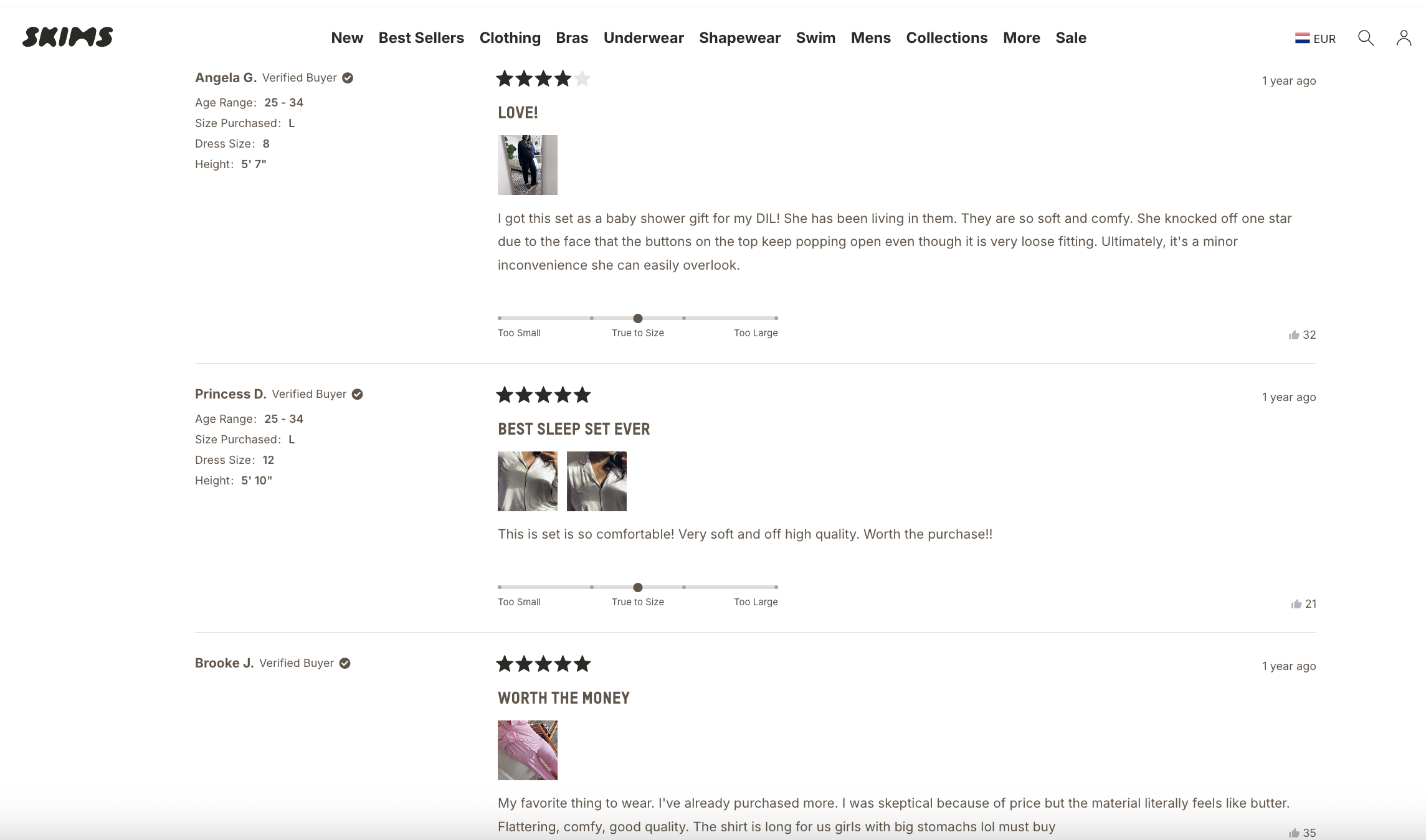
Place ratings, reviews, and UGC next to the price and the Add to Cart button, not hidden in a separate tab – these are your secret eCommerce marketing weapons. Borrow credibility from creators or customers who match your audience. This is content marketing for eCommerce at the point of decision.
Here is an example from Skims, an eCommerce brand specializing in women’s shapewear and clothes:
Mobile Experience First
A huge share of the eCommerce market is already on phones, and mobile commerce is projected to reach $3.4 trillion by 2027, according to Statista. Keep pages fast, buttons large enough to tap, and payment options like Apple Pay or Google Pay available. Fewer taps, fewer drop-offs.
Keep Channels Working Together
This is where digital marketing and eCommerce meet. Search and social bring intent and discovery, email closes gaps, and your site carries the load. When channels tell the same story, marketing strategies and eCommerce goals line up, and results compound.
Match Paid Formats to Your Offer
Push Ads and In-Page Push Ads give you a short message to introduce a product benefit or promotion. Interactive Ads add an engagement step before the landing page. Popunder Ads give your landing page more space to explain the product and offer.
Paid Social Ads let you test offers with traffic from social feeds without managing separate social advertising accounts. Telegram Ads introduce products to users within Telegram Mini Apps; pair them with a clear offer and a landing page that works well on mobile.
For a closer look at individual formats, see our guide to product ads examples and types and our breakdown of Google product ads. If your store runs on Shopify, our Shopify advertising guide covers channels and budgets specific to that platform.
eCommerce Advertising Formats Compared
Choose formats by their role in the shopping journey and the campaign you want to test. Compare costs using the same GEO, reporting period, and conversion goal. eCommerce CR is the share of ad-driven visits that turn into orders.
| Format | Role in the eCommerce funnel | Best suited to testing | eCommerce CR | Top GEOs |
|---|---|---|---|---|
| Paid Social Ads | Bring shoppers from social feeds to a product offer | Testing product offers with social-feed traffic | 0.96% | Brazil, Indonesia, Thailand, Bangladesh |
| Telegram Ads | Introduce products to audiences within Telegram Mini Apps | Mobile-friendly product offers and new-audience tests | 0.71% | Nigeria, Bangladesh, Indonesia, Germany |
| In-Page Push Ads | Reach shoppers while they browse, without notification opt-in | New-audience acquisition and promotional offers | 0.81% | United States, Brazil, Indonesia, Mexico |
| Push Ads | Encourage visits or return visits with short promotional messages; retargeting depends on campaign settings | Flash sales and relevant reminders | 0.18% | Indonesia, Thailand, Bangladesh, Vietnam |
| Interactive Ads | Build engagement before the landing-page visit | Product discovery and offer testing | 0.12% | Brazil, South Africa, Indonesia, United States |
| Popunder Ads | Bring shoppers to a full landing page opened in the background | Seasonal promotions and offers needing more explanation | 0.12% | Indonesia, United States, Brazil, Egypt |
You can find out how to launch these formats for your store on our eCommerce advertising platform page.
How to Market an eCommerce Business: Step-by-Step
These steps can help you plan your campaign, prepare your store, and measure what works before spending more.
- Choose a goal and channel. Decide whether the campaign should drive purchases, introduce a product, or bring back previous visitors. Select a channel and format that suit that goal.
- Set your targeting. Start with GEOs you can serve, relevant devices, and a clear audience. Separate audiences when their needs or offers differ.
- Prepare the destination. Make sure the landing page matches the advertisement, loads properly, and explains pricing, delivery, and returns.
- Set up measurement. Track the intended conversion and check that your analytics or tracking system records it correctly.
- Launch a controlled test. Set daily and total spending limits. Test a small number of clear creative variations so you can understand the results.
- Measure and adjust. Review conversion cost, purchase conversion rate, order value, and returns. Improve weak parts of the campaign before increasing spend.
Use what you learn from the first test to plan the next one. Keep the ads that drive results, fix problems in the buying journey, and increase spend when the numbers support it.
eCommerce Advertising & Marketing Metrics and Measurement
Good marketing reads the numbers, then acts. Pick a small set, review them often, and tie each one to a goal.
- Acquisition: CAC and ROAS by channel; watch both level and trend
- On-site: conversion rate, AOV, bounce rate on key pages, checkout completion
- Retention: repeat purchase rate, LTV, time to second order
- Email and cart: placed-order rate from flows and campaigns, unsubscribe rate, cart recovery rate
- Category view: branded search growth and eCommerce market share as directional signals
For paid advertising, also track:
- CPM: cost per 1,000 impressions. Calculate it as advertising spend ÷ impressions × 1,000.
- CTR: click-through rate, or the percentage of impressions that produce clicks. Calculate it as clicks ÷ impressions × 100.
- Cost per conversion: advertising spend divided by tracked conversions. Define the conversion clearly, such as a completed purchase.
- Purchase conversion rate: the percentage of tracked visits that become orders. Use the same measurement method when comparing campaigns.
Read these metrics together. A high CTR may show that an advertisement attracts attention, but purchase conversion rate and cost per conversion show whether those visits support your sales goal. For campaigns billed by clicks, eCPM can express the effective cost per 1,000 impressions.
Match metrics to intent. If the goal is new customer growth, optimize first-order conversion and CAC. If the goal is profitability, lift AOV and contribution margin, then raise the repeat purchase rate.
Run simple tests, one change at a time, use holdouts where you can, and compare modeled results with a clean last-click view to sanity-check.
Common eCommerce Marketing Challenges and Quick Fixes
Every store hits the same walls. The fix is rarely a hack; it is a small, steady change.
Crowded Market
It is hard to stand out when ten brands sell similar things and do the same eCommerce marketing as everyone else.
Fix: sharpen positioning, speak to a specific use case or audience, and show the after — how life is better once they buy. Use comparison pages and side-by-side photos to make the choice obvious.
Platform Shifts and Rising Costs
Search and social rules keep changing, and clicks get pricier.
Fix: diversify traffic and build owned audiences through email and SMS. Keep one experiment running — a new creative angle, format, or offer — so you always have a fresh winner ready.
Attribution Noise
With many touchpoints, it is easy to overcredit the last click or a favorite channel.
Fix: set channel-level goals, run holdout tests when possible, and review both modeled and simple last-click views. Trust trends more than single-day spikes.
Cart Abandonment
People get spooked by surprise costs, long forms, or second thoughts. Rates often sit above 70 percent, according to Baymard Institute’s cart abandonment research, so you are not alone.
Fix: show total cost early, allow guest checkout, offer fast wallets, and send timely reminders that answer objections about sizing, shipping time, or return policy.
Margin Pressure on Marketplaces
Marketplaces bring reach, but price competition is constant.
Fix: protect margin with bundles, limited editions, and add-ons that raise AOV. Keep your best content and perks on your site so shoppers have a reason to buy directly.

Content Strain
Keeping content fresh across your site, social, and email can stretch a small team.
Fix: build a simple content system: one hero piece each month, then cut it into short clips, carousels, and email snippets. This is content marketing for eCommerce that scales without burnout.
Data Gaps Across eCommerce Marketing Tools
Different tools track differently, which muddies decisions.
Fix: define a single source of truth for revenue and orders, then use other tools for directional insights. Tie your digital marketing and eCommerce goals back to that one source.
Ad Fatigue
When shoppers repeatedly see the same ad, they may eventually stop paying attention. A falling CTR or rising conversion costs can signal it is time to review your creatives, audience, or frequency.
Fix: test a new product angle, image, headline, or format. Change one element at a time, compare the results, and limit repeated exposure where frequency controls are available.
FAQ
eCommerce advertising is paid promotion that brings shoppers to an online store or product offer. PropellerAds offers Push Ads, Popunder Ads, Interactive Ads, Paid Social Ads, Telegram Ads, and In-Page Push Ads. Unlike organic promotion, it involves paying for advertising delivery or the resulting interaction, depending on the pricing model.
eCommerce marketing is the full set of activities used to attract shoppers, help them buy, and encourage repeat purchases. It includes paid advertising alongside organic search, content, email, social activity, and improvements to the shopping experience. Advertising is the paid part of this broader strategy.
Look for platforms with flexible bidding, daily spending limits, conversion tracking, and controls for adjusting traffic sources. You can see our ecommerce advertising platform page for available options.
Search, social, and multisource advertising platforms can all suit eCommerce brands; performance depends on the product, audience, GEO, and campaign setup. To explore PropellerAds’ options, see our ecommerce advertising platform page.
Affiliate marketing is a partnership in which publishers promote a retailer’s products and receive a commission for qualifying sales. Explore our guide to ecommerce affiliate programs for more details.
In eCommerce advertising, CPA means Cost Per Action: payment is tied to a qualifying action, such as a sale or lead. Here, CPA refers to the advertising payment model, rather than Certified Public Accountant. Learn more in our guide to CPA networks for eCommerce.
Conclusion
eCommerce marketing works best when you focus on a few things that compound. Show up where buyers already look, remove friction on key pages, and keep the relationship going after the first order. Tie each channel to a clear goal, review the numbers often, and adjust with small tests.
Keep adding useful touchpoints and keep promises on speed, price, and returns. Do this consistently, and traffic turns into customers, then into regulars.
Now that you understand how eCommerce advertising fits into your marketing strategy, the next step is to choose a platform and plan your first test. Explore the available formats and campaign options before deciding where to spend.
Join our Telegram for more insights and share your ideas with fellow affiliates!
Trends
View more posts