Ad Inventory in 2026: Types, Pricing Models, and How Advertisers Buy It
Most explanations of ad inventory start in the wrong place. They define it from the publisher’s perspective, list the formats, then leave the buyer to figure out what any of it means for the campaigns actually running.
From a buying-side perspective, what we see most often is the opposite problem: teams know what inventory is in theory, but they conflate two completely different ways of accessing it, and that conflation costs them money.
This piece walks through ad inventory the way a buyer needs to think about it: what it is, what types matter, how it gets bought, where quality varies, which controls actually work in 2026, and where the boundaries are. The throughline is buyer decisions, not publisher mechanics.
Key takeaways before the long version:
- Ad inventory is the total volume of ad placements a publisher, network, or platform has available to sell. Buyers care less about the raw number than what’s behind it: who sees the ad, in what context, and whether the impression was a real human view.
- Three buyer-side metrics anchor any inventory conversation: impressions (the unit), fill rate (how much sells), and eCPM (revenue per thousand). Each says something different about quality and efficiency.
- Inventory is bought through two operationally distinct models that most articles conflate: open programmatic supply chains (DSP, SSP, exchange, PMP) and performance networks. The controls that work in one don’t always apply in the other.
- More than four in five US programmatic display ad dollars now flow through PMPs and programmatic direct deals, per eMarketer, with open exchange spending growing roughly four times slower than PMP spending.
- The most common “bad inventory” diagnosis in our experience turns out to be a tracking failure, not an inventory failure. Postback hygiene is a precondition for any inventory evaluation.
- New inventory formats like Telegram Mini App Ads and Interactive Ads don’t behave like the formats you already know. Run them as separate tests with their own budget, and give them more time before drawing conclusions: roughly a week of data for Telegram Mini-Apps, against the 36 to 48 hours that works for familiar formats.
What Ad Inventory Means When You’re Actually Buying It
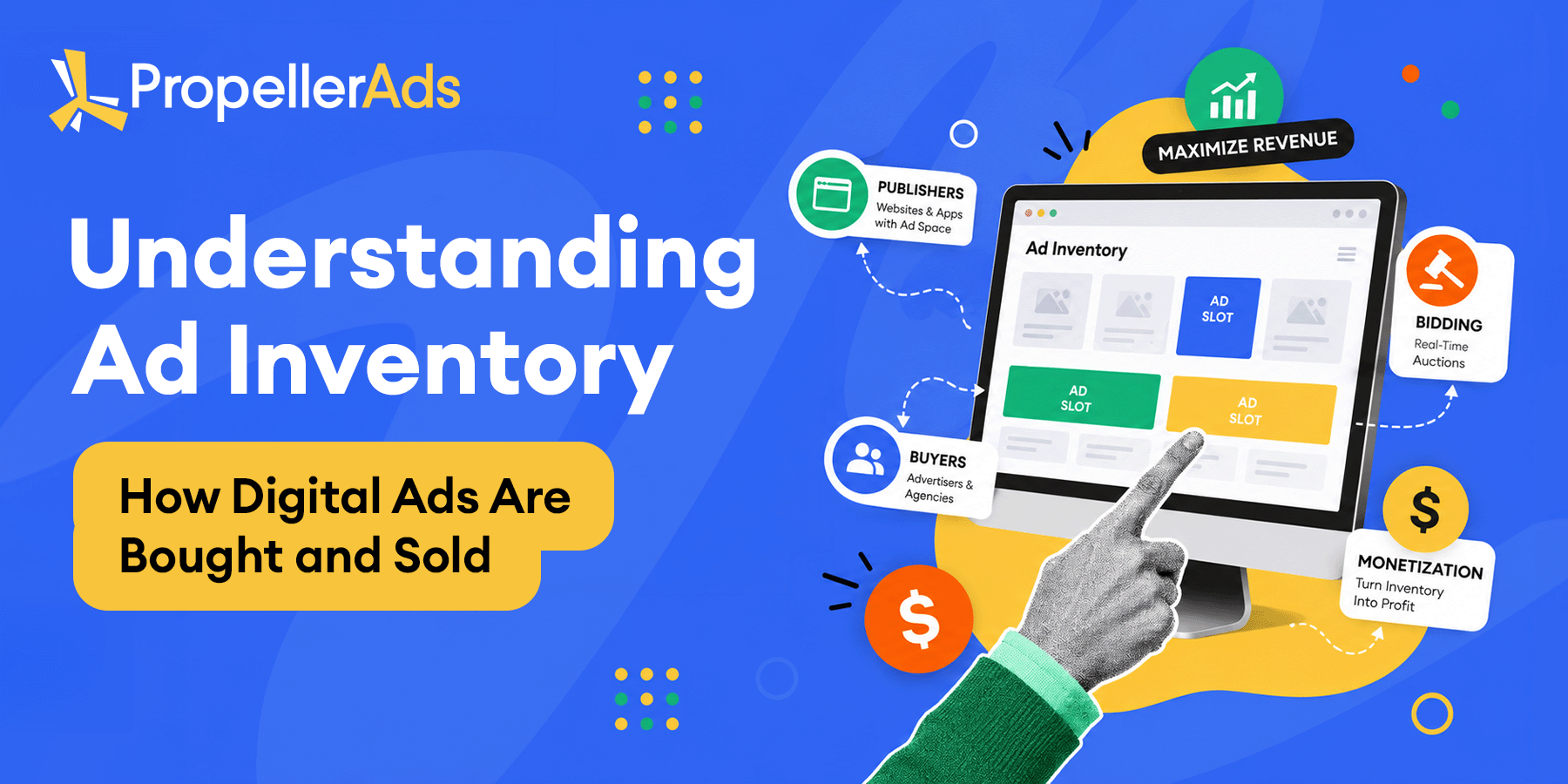
Ad inventory is the total volume of ad placements a publisher, network, or platform has available to sell. Measured in impressions, it’s what your budget actually buys.
A site with one million monthly page views and three slots per page carries three million monthly impressions of inventory.
For advertisers, that abstract number matters less than what’s hidden behind it: who sees the ad, in what context, on what device, and whether the impression was a real human view or a wasted server call.
The same word, “inventory,” can describe an impression that loaded below the fold and was scrolled past in half a second, and a five-second view from a logged-in user on a premium news site. If you treat those two impressions as the same thing when you’re planning a campaign, every decision after that is built on a wrong assumption.
When we look at how teams actually buy across platforms, the question that matters is rarely “do we have access to inventory?” It’s “do we have access to qualified attention, at a price the business can afford, in a way we can measure?” Everything that follows is about the mechanics behind that question.

The Three Metrics That Anchor Inventory Conversations
Three numbers come up in almost every conversation about ad inventory, and each says something specific.
- Impressions are the unit. One impression equals one served ad. Total impressions tell you the scale of inventory available.
- Fill rate is the percentage of available ad requests that were actually filled with an ad: ad impressions divided by ad requests, times 100. Low fill rates mean the publisher is missing revenue, or the inventory isn’t moving at its asking price. For buyers, a publisher’s fill rate is a rough indicator of demand for that inventory.
- eCPM (effective cost per mille) is revenue per thousand impressions: total revenue divided by total impressions, times 1,000. eCPM lets buyers compare inventory tiers on a unit economics basis even when the underlying pricing model differs. CPC, CPA, and CPM all resolve to an eCPM for comparison.
None of these three numbers is sufficient on its own. Impressions without viewability or context are just a raw count. The fill rate without price tells you nothing about value. eCPM without volume can hide problems with delivery or quality. The pattern across all three is what matters.

Types of Ad Inventory
Inventory is sliced along several axes at once. Four of them matter most to buyers.
Premium vs. Remnant
Premium inventory is the publisher’s most visible, high-value placements: above-the-fold positions, homepage banners, and exclusive sponsorships. It commands higher CPMs and is usually sold through direct deals or private marketplaces (PMPs), where the buyer and publisher negotiate price, terms, and audience upfront.
Remnant inventory is whatever didn’t clear through premium channels. It flows into the open exchange to be auctioned in real time, usually at lower CPMs.
The label “remnant” used to imply low-value leftover supply, but on properly curated supply paths, remnant impressions can still reach engaged audiences. The category is now better understood as “inventory available through programmatic auctions” rather than “low quality.”
Direct-Sold vs. Programmatic
Direct-sold inventory involves a negotiated deal between publisher and advertiser. Terms, price, and placement are agreed upon up front, and delivery is usually guaranteed. Premium placements with reach commitments typically clear this way.
Programmatic inventory is bought and sold automatically, with technology evaluating and pricing each impression.
Programmatic doesn’t mean “lower quality,” it means “transacted via automated systems.” Programmatic transactions can be open auctions (RTB), private marketplaces, or programmatic guaranteed deals.

Format Categories
Inventory gets organized by ad format, since each format has its own visibility, engagement profile, and supply characteristics.
- Display is banner ads embedded in web pages. The most common format. Priced and evaluated by viewability, placement (above- or below-the-fold), and size (300×250, 728×90, and so on).
- Video is ads that play before, during, or after video content. Pre-roll plays before the main video starts. Mid-roll plays inside the content, similar to a TV commercial break. Outstream plays inside non-video environments, like between paragraphs of a text article. And CTV (Connected TV) is video inventory delivered through smart TVs and streaming devices. CTV is one of the fastest-growing categories in 2026, with most major streaming services now monetizing through programmatic.
- Mobile is inventory on the mobile web and inside mobile apps. Mobile banners are small-format displays, cheap and high-volume. Interstitials are full-screen ads shown between content transitions, with strong CTR. In-app native is integrated into the app’s interface. Rewarded video is a closed-loop format in which users opt in to watch in exchange for in-app currency or content, and it offers the highest viewability of any mobile video format because users chose to watch.
- Native ads designed to match the look and feel of surrounding content. Sponsored articles, promoted listings, in-feed cards. Native typically achieves higher engagement than standard display because it doesn’t read as a traditional banner.

- Social is inventory on platforms like Meta, X, TikTok, LinkedIn, and Reddit.
- Audio is inventory in streaming audio (Spotify, podcast networks). A growing category with a different attention economy from video or display: listeners are usually doing something else while audio plays, but they’re often listening through headphones with no visual competition.
Surface-Specific Emerging Formats
A few formats matter that did not exist as scaled inventory two years ago.
- Telegram Mini-App Ads is one example: an inventory layer that sits inside Telegram rather than on the open web, accessed through the same self-serve interface as other performance network formats and available on CPC, SmartCPC, or CPA Goal billing.
Our Telegram Mini-App Ads report covers the surface, volume, and where it fits in a buyer’s mix.

- Interactive Ads is our exclusive format that delivers users to the advertiser after they have already engaged with a lightweight gamified experience: tap sequences, quizzes, mini-playables. In our internal benchmarks, conversion rates run up to 5x higher than on traditional display, with around 60 million daily impressions globally. That number is our own
The Two Inventory Models Most Articles Conflate
There are two ways of buying ad inventory that work very differently in practice. They are not minor variations on a theme: they use different infrastructure, different quality controls, and ask the buyer to think differently about each.
- Open programmatic supply chain
Inventory flows from publishers through supply-side platforms (SSPs), exchanges, and demand-side platforms (DSPs), with each hop documented by industry-standard files such as ads.txt and sellers.json, introduced by the IAB Tech Lab to surface authorized seller chains.
Buyers using a DSP can see the path their bid took, evaluate the seller chain, and make supply path optimization (SPO) decisions based on which intermediaries add value and which add cost.
- Curated performance network
A single platform like PropellerAds aggregates inventory from a wide range of publishers, applies its own quality controls, and offers a single self-serve dashboard where advertisers buy at the zone or subzone level rather than the individual placement level.
The buyer doesn’t see every URL behind the impression. The buyer also doesn’t need to manage a verification stack, a seller whitelist, or a supply path strategy on their own. The network does that work upstream, before the impression reaches the campaign.
These models coexist in 2026, and most serious buyers end up running both. The biggest mistake we see across campaigns running on our side isn’t beginner confusion. It’s experienced buyers benchmarking the two models on the same KPIs.
A typical version: a buyer pulls CPM, viewability, and Invalid Traffic (IVT) rates from their DSP reports and compares them directly to the same metrics inside their network campaign. But the numbers aren’t measuring the same thing. On a programmatic buy, the IVT figure is post-bid: it’s what the verification vendor flagged after the impression cleared the auction. In a performance network buy, the IVT figure is the one that survived the network’s pre-bid filtering. Comparing the two side by side makes one model look cheaper or cleaner than it actually is.
A second version of the same mistake: a whitelist of high-converting domains, carefully built on a DSP, is applied to a network campaign. The network’s traffic isn’t organized by domain. A single zone aggregates ad placements that the buyer can’t unpack, so the whitelist doesn’t port.
The right move isn’t to fight the model. It’s to rebuild the optimization layer using the controls that exist in that model: zone and subzone management, format and tier exclusions, and the network’s published quality framework.
The practical rule for serious buyers: never assume a metric or a control transfers across models just because the name is the same. Check how the metric is measured on each side and which lever the model actually exposes before drawing conclusions.
| Dimension | Programmatic | Curated Performance Network |
|---|---|---|
| Access | Programmatic DSPs, open exchanges, and private marketplaces | Performance Network A single self-serve interface |
| Visibility | Programmatic Individual placements and URLs | Curated Performance Network Aggregated zones and subzones |
| Quality controls | Programmatic Third-party verification, ads.txt, sellers.json, SupplyChain Object | Curated Performance Network Network-level pre-bid filtering, traffic score, manual review |
| Pricing | Programmatic CPM, vCPM, RTB-driven | Curated Performance Network CPM, CPC, CPA, automated bidding like CPA Goal |
| Brand safety | Programmatic Verification vendors, blocklists, PMP curation | Curated Performance Network Zone exclusions, vertical and format exclusions, the network’s published quality framework |
| “IVT rate” measures | Programmatic Post-bid: what verification flagged after the auction cleared | Curated Performance Network Pre-bid: what survived network filtering before reaching the buyer |
| Portability | Programmatic URL and app-ID whitelists transfer cleanly between DSP campaigns | Curated Performance Network Whitelists built on a DSP don’t map to a network’s zone structure |
How Inventory Is Classified Inside Each Model
Inside open programmatic, the classifications from the previous section (premium vs. remnant, direct-sold vs. programmatic, format) apply directly. Buyers see them on their DSP dashboards as filterable axes.Inside a curated network, inventory gets sliced differently.
First by format (push notifications, popunder, in-page push, interstitial, native, Telegram Mini-App Ads, Interactive Ads), then by zone and subzone (the network’s own groupings of traffic sources), then by audience tier (engagement signals like User Activity Targeting on PropellerAds).
Premium and remnant don’t map cleanly onto this structure, because the network has already filtered remnant out before the impression reaches the buyer.
How Each Model Slices Inventory
Premium · Remnant
Push · Popunder · In-page push · Interstitial · Telegram Mini-App Ads
Direct-sold · Open auction
Network’s own groupings of traffic sources
Display · Video (CTV, pre-/mid-/outstream) · Native · Audio
Engagement signals (User Activity Targeting)
PropellerAds · Premium and remnant don’t apply on a Performance network: the network filters remnant before the impression reaches the buyer.
Pricing Models From the Advertiser Side
The pricing model determines what the advertiser pays for, which determines who carries the risk if the impression doesn’t perform. Five models matter in 2026.
- CPM (Cost per Mille) charges per thousand impressions. The advertiser pays whether or not anyone notices the ad. This works for upper-funnel brand campaigns where reach is the deliverable.
- vCPM (Viewable CPM) is CPM with a viewability gate. Per the MRC viewability standard documented in the IVT and viewability guidelines, at least 50% of the ad’s pixels must be on screen for at least 1 continuous second (2 sec for video). Buyers pay only for impressions that meet that threshold.
- CPC (Cost per Click) ties spend to engagement. The advertiser pays when a user clicks. Useful for traffic acquisition, though click quality varies enormously across inventory types, and a low CPC on poor inventory can be more expensive than a high CPC on good inventory.
- CPA (Cost per Action) charges for completed conversions: a registration, a purchase, an install. The publisher or network bears the delivery risk, which is why CPA pricing usually correlates with more stringent quality filtering on the supply side.
- Flat-rate and sponsorships are fixed-price arrangements where an advertiser pays a set amount for a defined period or placement. Common in direct-sold deals for premium positions: a brand pays a fixed sum to sponsor a publisher’s homepage for a week, with no per-impression metering. Simple, predictable, and ideal for guaranteed-delivery situations where you want budget certainty.
- Automated bidding sits on top of these. CPA Goal lets advertisers set a target cost per conversion and let the platform optimize bids in real time to hit it. SmartCPM and SmartCPC automate price discovery within a budget envelope. These models require the platform to have sufficient conversion signals to learn from, which is why every campaign that relies on automation must have a working postback in place.
Five Pricing Models in 2026
CPM
Pay per 1,000 impressions. Best for reach.
vCPM
Pay only for impressions that meet the MRC viewability bar.
CPC
Pay per click. Best for traffic acquisition.
CPA
Pay only on conversion. Publisher carries the risk.
Automated bidding (CPA Goal, SmartCPM, SmartCPC) sits on top of any of the above. Requires a working postback so the platform has conversion signal to learn from.
PropellerAds · The model determines what you pay for, which determines who carries the delivery risk.
Setting the right bid and predictive bidding are worth a deeper read for anyone running automation at scale.
The choice between these is rarely about which is “best.” It’s about how much delivery risk the advertiser wants to take, how much conversion data the platform has to optimize on, and how deep into the funnel the goal sits.
The Mechanics: Auctions, PMPs, and Network Buying
In programmatic, the standard mechanism is real-time bidding (RTB). When a page loads, an ad request fires, multiple DSPs evaluate the impression in roughly 100 milliseconds, and the highest bid wins.
Header bidding lets multiple SSPs compete simultaneously, rather than the older sequential “waterfall” pattern, which used to leave money on the table for publishers.
Beyond the open auction, PMPs (Private Marketplaces) and programmatic guaranteed deals carry more weight every year. According to eMarketer’s programmatic transaction-method data, more than four in five US programmatic display ad dollars now flow through PMPs and programmatic direct deals (excluding social), with PMP spending growing at roughly four times the rate of the open exchange.
PMPs and curated supply also typically deliver higher CPMs, better viewability, and lower invalid traffic rates than the open exchange, which is why buyers accept the higher price. Buyers are paying more for inventory they trust, and that signal isn’t slowing down.
In Performance network buying, the mechanism is different. The advertiser sets up a campaign in the network’s interface, selects formats and targeting, sets pricing model and bid, and the network distributes the spend across its zone-level inventory according to optimization rules.
PropellerAds, for example, distributes 14 billion daily ad impressions across 195+ countries.
Unlike RTB, where every impression triggers an open auction that the buyer’s DSP responds to in real time, here the buyer sets a bid at the campaign level, and the network handles per-impression allocation internally.
Optimization happens at the zone, subzone, and creative level over the campaign’s lifecycle. This is why network buying follows a different cadence: CPA Goal and SmartCPM need 36 to 48 hours of data before drawing conclusions.
What teams optimizing on our platform usually underestimate is how much of the work on inventory selection happens before the impression is ever shown. The network runs three layers of quality control upstream of the buy: real-time bot detection, automated and manual review of traffic patterns, and source-level traffic scoring. The decisions made there shape every number the buyer sees later.
Where Inventory Quality Variance Concentrates
Quality varies in both models. It just shows up in different places and is managed with different tools.
In programmatic, the MRC defines two categories of invalid traffic (IVT).
- GIVT (General Invalid Traffic) is the obvious set: known bots, data center IPs, pre-fetch activity, traffic identified by routine filtration.
- SIVT (Sophisticated Invalid Traffic) is the harder set: hijacked devices, adware-driven impressions, cookie stuffing, and human fraud farms. SIVT detection requires advanced analytics and multi-vendor corroboration. Verification vendors like DoubleVerify, IAS, Adex, and Pixalate operate in accordance with these standards.
In programmatic, the supply path itself affects quality. By “supply path,” we mean the chain of exchanges, SSPs, and resellers through which an impression travels before reaching the buyer’s DSP.
The risk concentrates on unverified or unauthorized resellers within that chain: each adds cost and makes it harder for the buyer to trace where the spend actually ends up.
One well-documented version is rebroadcasting: an exchange selling inventory it bought from a reseller that doesn’t have direct rights to sell it. Jounce Media’s April 2026 benchmarking report found that rebroadcasting accounts for 41% of display auctions and 26% of video auctions, but those paths attract roughly half the DSP spend per bid request that direct paths do.

Major DSPs, including The Trade Desk, have now blocked rebroadcasting platform-wide. For programmatic buyers on the open exchange, supply path optimization (actively choosing verified, authorized paths to inventory) has stopped being optional.
In Performance network buying, the controls operate upstream. PropellerAds runs a three-stage traffic quality framework: real-time filtration using in-house bot detection, post-analysis combining automated and manual review, and a traffic score system that evaluates sources against dozens of parameters.
The full framework is documented in our traffic quality strategies report, and the patterns we acted on across the year are summarized in our annual ads safety report. The point isn’t that one model “catches” more fraud than the other. The point is that the buyer in each model has access to different signals, and the controls the buyer reaches for should match.
This is why the framing matters. Networks like PropellerAds, Adex, the anti-fraud platform within AdTech Holding (which also includes PropellerAds), and other moderated supply environments put heavy work into filtering at the inventory layer precisely because the buyer can’t see every URL.
You give up URL-level visibility; the network filters at the inventory layer instead. Neither model removes the need for buyer-side discipline. Both reduce the number of decisions the buyer has to make alone.
Targeting Strategies That Sit on Top of Inventory
Inventory selection is one-half of the buying decision. Targeting is the other. Whatever inventory you’re buying, the targeting layer determines which subset of that inventory’s audience actually receives your ad. Three approaches matter in 2026.
- Contextual targeting matches ads to relevant page content. If the offer is sneakers, the ad runs on sports articles, fitness blogs, and sneaker review pages. Contextual doesn’t depend on user-level identity signals, which makes it the most resilient targeting approach as privacy regulations tighten and third-party cookies phase out. It works on both open programmatic and Performance network supply.
- Behavioral targeting uses signals about user behavior: past site visits, purchase history, app usage, and content engagement patterns. Behavioral lets buyers reach users based on what they’ve actually done, not just where they are.
The catch in 2026 is that behavioral targeting depends on identity signals, and those have become harder to use as Apple’s ATT framework and the cookieless transition have reshaped what’s available.
Behavioral targeting still works inside walled gardens (Meta, Google), inside Performance networks with their own user data, and on supply paths that have first-party data partnerships.
- Geotargeting uses location data: country, region, city, zip code, or radius around a specific point. Different from geofencing (which triggers ads based on real-world location), geotargeting uses location as an audience filter. Useful for businesses with regional presence, local seasonality, or markets where verticals like iGaming, Finance, or eCommerce vary sharply by GEO.
These three layers can be combined. A campaign targeting users who have visited a sports apparel site (behavioral), reading running content (contextual), in Tier 1 GEOs (geotargeting) reaches a much narrower audience than any single layer alone.

The buyer-side question isn’t which targeting type is “best.” It’s which combination of layers fits the offer, the inventory model, and the available signal.
On open programmatic, the buyer configures all three through their DSP. On Performance networks, the network exposes the targeting layers it has built into its platform, usually as a self-serve combination of audience tier, GEO, format, and contextual filters.
A Practical Framework for Evaluating Ad Inventory
The mistake most teams make when evaluating ad inventory is starting from the format and working backward into the strategy. Start from the campaign goal, decide which model fits, and the inventory decisions follow.
For brand campaigns aimed at reach, a programmatic approach with PMPs usually wins on viewability and brand safety. You pay more per impression, but two things make it worth it: real numbers to back up the spend, and a pre-approved site list before the campaign runs.
For performance campaigns where the goal is conversion volume at a known cost, Performance networks usually win on simplicity and on conversions per hour of buyer attention. A buyer running CPAGoal across PropellerAds zones makes fewer decisions per dollar spent than a buyer manually managing an open-exchange campaign at the same scale. Less placement-level visibility means more time spent on creative testing and offer optimization, which is where performance is actually unlocked.
For testing a new vertical, the question is which model lets you test cheaply enough to learn quickly. Performance networks often win here because the per-test cost is lower, and automated bidding picks up the signal faster.
Our Saudi Arabia eCommerce case study and a longer interview on running eCommerce campaigns across formats both show what this looks like in practice, with real CR and CPA numbers across the campaign lifecycle.
The framework isn’t about ranking the models. It’s about matching the model to the decision the buyer is trying to make.

What Inventory Strategy Doesn’t Fix
No inventory strategy is a substitute for tracking. The most common “bad inventory” diagnosis in our experience is actually a tracking failure: a postback dropped, a parameter rewritten, a third-party pixel changed without notification.
Many campaigns blamed on poor inventory recover cleanly when the tracking stack is rebuilt.
Every serious ad platform prohibits malware, adware, and unwanted software in its policy. There is no platform that allows these categories. What varies is enforcement: how rigorously each platform reviews against its policy, how quickly it catches new evasion patterns, and how transparently it publishes what it catches. When you’re evaluating a platform, look at how it enforces the policy, not just whether it has one.
And no inventory framework replaces creative. The best inventory in the world underperforms with weak creatives, and competent creatives can unlock surprising performance on inventory tiers a brand wouldn’t normally consider. Inventory is the surface. Creative is the message. Tracking is the eyes. Get any of the three wrong, and the other two underperform.

Common Questions About Ad Inventory
What does “ad inventory” actually mean for advertisers?
Ad inventory is the total volume of ad placements a publisher, network, or platform has available to sell, measured in impressions. For advertisers, the more useful framing is access to qualified attention at a price the business can afford, in a way the campaign can measure. The raw impression count matters less than what’s behind it: who sees the ad, in what context, on what device, and whether the impression was a real human view or a wasted server call.
How do I know if the inventory is “good” before scaling into it?
In a programmatic buy, the signals are placement-level viewability, third-party verification scores, supply path depth (how many intermediaries sit between the buyer and the publisher), and the seller’s sellers.json transparency.
In a Performance network buy, the signals are aggregated CR by zone and subzone, whether the postback fires consistently, how much performance varies between formats, and the network’s published quality framework. One rule applies across both: don’t draw conclusions before you have at least 36 to 48 hours of data on the test campaign.
Is buying through a network safer than the open exchange?
Both models prohibit malware, adware, and unwanted software in policy. The difference is where the work concentrates. Performance networks filter at the inventory layer before the impression reaches the buyer, so the buyer gives up placement-level visibility in exchange for that filtering. The open exchange gives the buyer placement-level visibility but moves more of the quality work onto the buyer’s verification stack.
Join our Telegram for more insights and share your ideas with fellow-affiliates!