Forecasting Traffic Profitability: The Truth About Predictive Bidding
It seems manual work is no longer an option. More and more networks are adding predictive bidding: algorithms that forecast if a user converts even before a bid, and optimize your campaigns for you.
It seems like it would be perfect if just every single ad network added this. But is it really a magic pill for media buyers?
In this piece, we’ll tell you what predictive bidding really is, where it shines and fails, and why ‘just automate it’ isn’t always the right answer.
What is Predictive Bidding and How Does It Work?
In simple terms, it’s a machine-learning-based algorithm that predicts the probability of a specific user converting and then places an individual bid for this exact impression.
High probability? Here’s a higher bid. Low probability – lower bid, or no bid at all. And all of this is done automatically.
Here is how it works in a more technical language:
- A buyer sets a particular goal – say, a target CPA or target ROAS (Revenue/Ad spend: where you set the amount of revenue you want to get back from your ad spend).
- When an impression goes to auction, the system collects real-time signals. These signals include the traffic source and placement (such as zone, app, or site bundle), device, GEO, time, browser, OS, past clicks and conversions, retargeting lists, user behavior, ad relevance, competition level, first-party data from the advertiser, and more. For example, Google Smart Bidding utilizes over 100 different signals to predict a bid.
- Machine learning models predict the probability for a certain impression to convert and the expected value or ROI.
- The algorithm calculates the optimal bid to achieve the exact impression needed to reach the buyer’s goal. Or skips the auction altogether if a particular user seems unvaluable.
A couple of real-world examples:
Google Smart Bidding, which Google officially calls auction-time bidding, is a good example of predictive bidding in action.
Based on 100+ signals, Google predicts ‘What’s the probability this exact user will convert and how much is that conversion worth?’
Then the system sets a custom bid for that particular user in the context of a specific offer. Let’s look at a simple example – an online sneakers store:
- A user searching ‘buy running shoes online’ – higher bid
- A random user who searched ‘funny kitten vids’ – lower bid
- A user who abandoned a cart yesterday – very high bid
- A schoolkid with an old device and no purchase history – skip the auction
TikTok works almost the same way: it checks how likely a user is to convert for a given offer based on their video-watching patterns, device, GEO, etc.
So, to sum up: predictive bidding algorithms decide who to show the ad to, who not to show it to, how much to pay for each particular impression, when it makes sense to overpay, and when to skip the auction.

Any Evidence?
Yes – in fact, plenty of it. We created infographics for the three most vivid case studies – with Google Smart Bidding and TikTok Smart+ models that exactly use predictive bidding:
- Case study 1
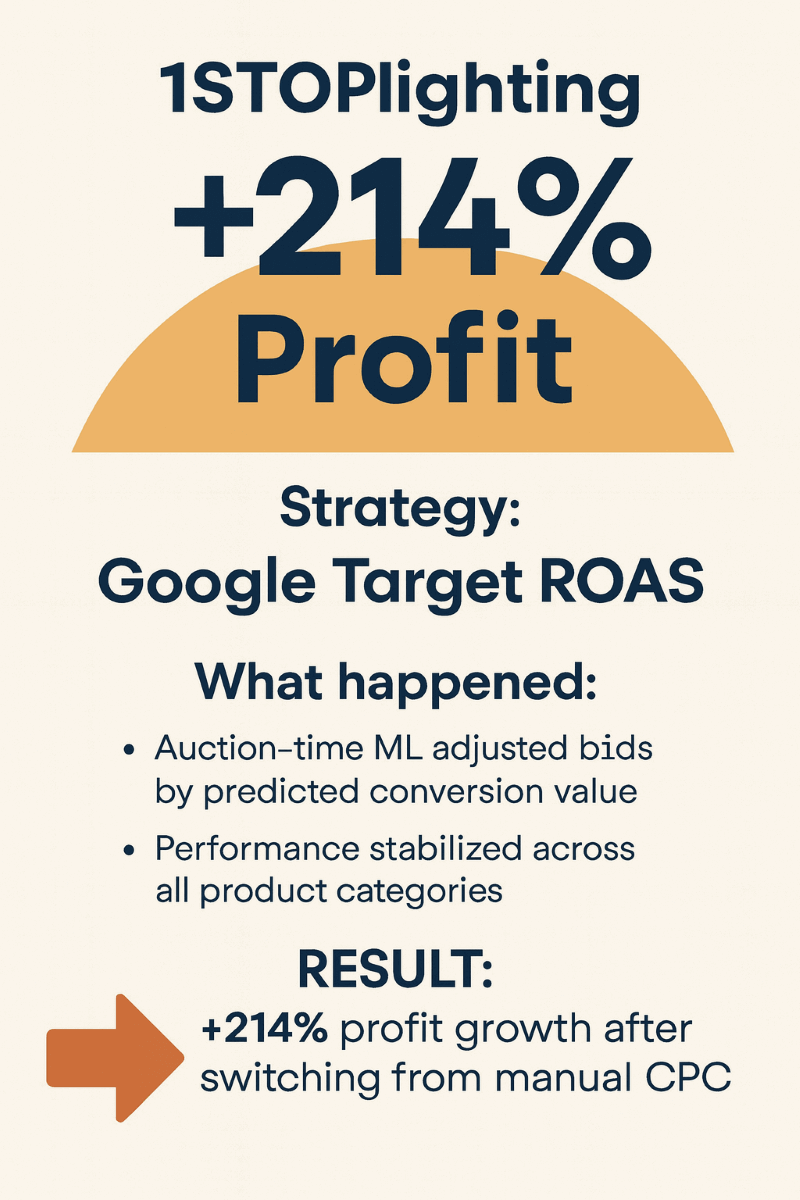
1STOPlighting, an online store, moved all its Shopping campaigns to Target ROAS, letting Google optimize bids at auction time based on predicted conversion value.
Result: +214% profit and higher efficiency across product categories – a clear win for value-based predictive bidding when strong historical data is available.
- Case study 2
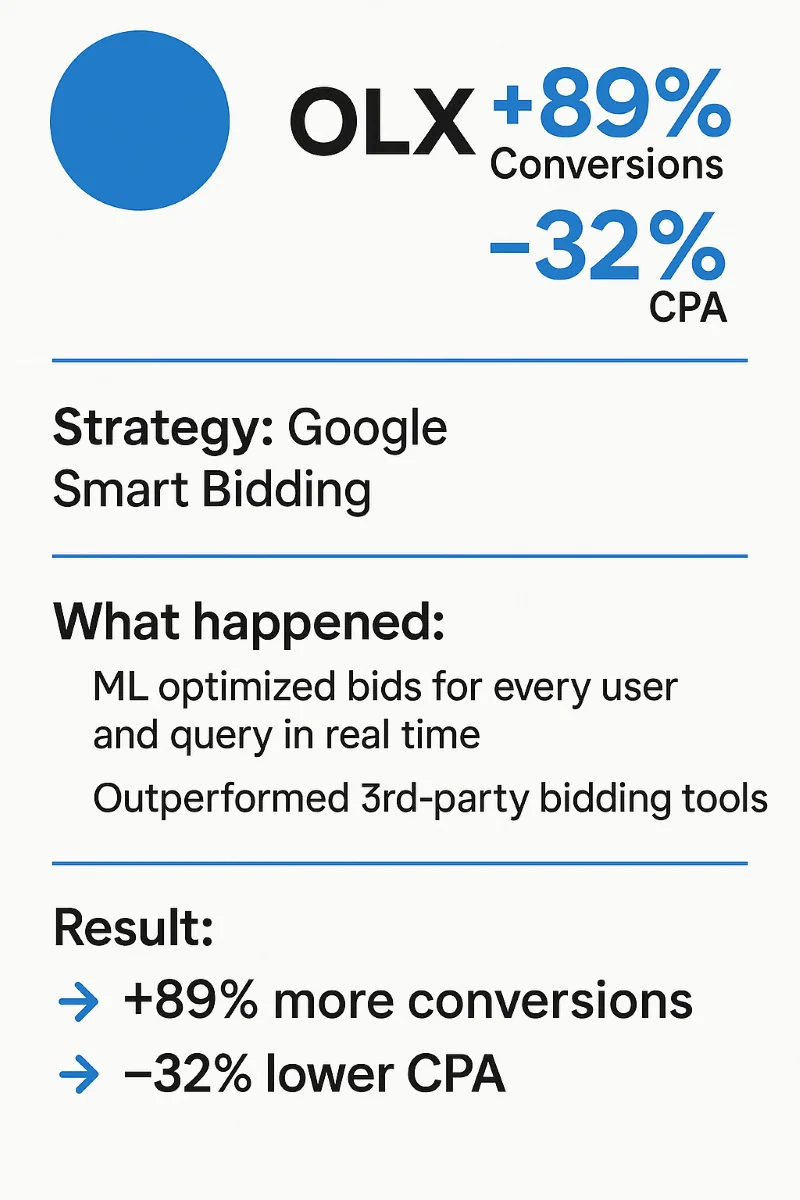
OLX, a marketplace, tested Google Smart Bidding against third-party tools. With auction-time ML adjusting bids for every user and query.
Result: +89% more conversions and -32% lower CPA in three weeks. This shows how predictive bidding outperforms manual and rule-based models at scale.
- Case study 3:
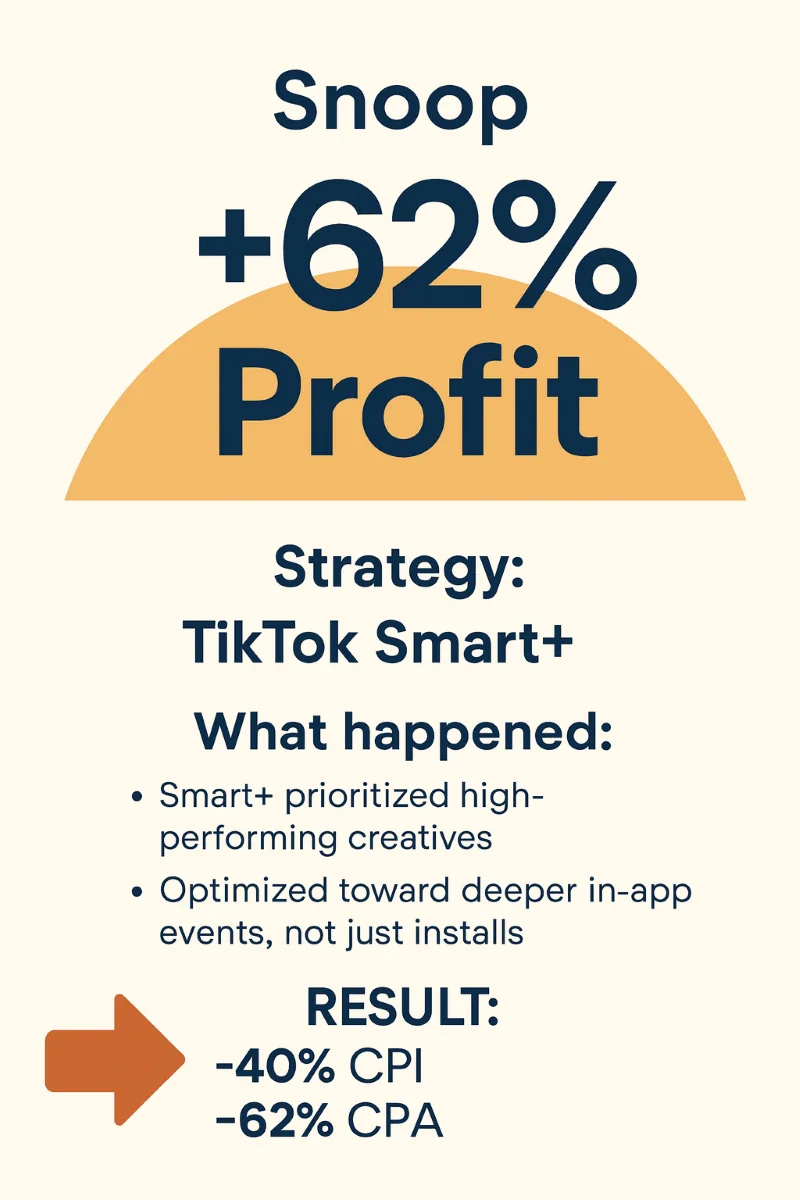
Snoop, a finance app, switched from manual TikTok campaigns to Smart+, TikTok’s fully automated ML-driven bidding. Smart+ optimized delivery toward deeper engagement events, not just installs.
Result: -40% CPI and -62% CPA for their core activation event – a bank account connection. A strong example of predictive bidding improving quality, not only volume.
These case studies help us answer the biggest question: when does predictive bidding work best?
When Do You Need Predictive Bidding?
In short, when you have enough data and stability. Here are more details:
- When you have stable funnels. Predictive bidding needs – excuse the tautology – predictable user behavior to make accurate forecasts.
There are case studies that prove it: for example, 1STOPlighting sells products – lamps, chandeliers, etc.- through a stable funnel: user – cart – purchase. They are unlikely to have sudden changes in CR, payout, or flow, so the algorithm can learn stable patterns from the past user behavior.
- When you have enough data volume. Predictive bidding requires a steady flow of conversions to learn effectively. For example, TikTok’s guidelines suggest having at least 50 conversions to pass the learning phase, and Google specialists recommend having about 30-50 per week.
Getting back to the case studies, here is proof: OLX is a marketplace with a huge user base, and it means a massive conversion flow. A perfect soil for predictive bidding to learn, right?

- When speed doesn’t matter that much. Predictive bidding is more about accurate forecasts rather than quick analysis.
The case studies don’t say how many days or weeks the testing took. However, all the mentioned businesses – a major lighting retailer, a substantial marketplace, and a significant fintech product – are focused on long-term and stable work.
Products like this don’t need to quickly understand if their offer works – they already know it. So, they focus on lowering the CPA and achieving increasingly larger volumes. This can work for large, established iGaming brands as well, but not for new, untested offers, such as fresh WOW-Nutra products.
Any Risks?
Sure – just like with anything in performance marketing.
Risk 1. Unstable offer
This can be anything that breaks an offer flow: a CPA network changes the offer payout, you shuffle different landing pages, or the CR is constantly different.
The result? The algorithm can’t properly learn as it simply doesn’t understand what’s going on to make the right predictions. This is especially common for trend-based offers: when things change too fast, the algorithm just can’t learn properly.
PropellerAds partner and an active participant of our Telegram Chat, nicknamed Poll:
I assume that for some trend-related eCom/Cash on Delivery products campaigns where conversion or sale happens outside the scope of algorithm data, the manual bid would perform better as the advertiser will have complete control over ad spend. For example, Matcha Tea-related products are in trend now, but they weren’t in trend 2 years ago. And, a manual bid would perform better for new verticals or new GEOs where the algorithm isn’t trained for it because there is a lack of data.
Risk 2. Poor tracking
As you already know, the algorithm learns from more than 100 signals. Still, it makes the final decision based on your conversions, and if your postback is incorrect, all the learning goes down the drain.
Suppose some leads didn’t arrive, or some arrived with a delay. The system simply misses good traffic to learn from its patterns.

Risk 3. You set the wrong goal
You want to try to save money and set a CPA goal of $1. Meanwhile, the normal CPA for your offer is $3.
What happens next? The algorithm thinks: ‘Okay, I can’t see any impressions that can meet this target. I won’t purchase traffic at all then.’
So, to make predictive bidding work correctly, you need to be sure your target – be it CPA, or ROAS, or whatever else – is close to reality.
Risk 4. It doesn’t risk
Or, in other words, it’s very cautious sometimes: when your bid cap is too low, to be precise. What’s the problem, though? It won’t overspend, and that’s exactly what we wanted, right? Still, it can miss a good portion of profit this way.
As Svetoslav, a media buyer and an active participant of our Telegram Chat, shared, the system might stop delivering during the traffic bursts. Why? Because a traffic spike changes the auction too quickly, depending on targeting, this can either raise or lower prices.
Meanwhile, the system needs to guarantee it never exceeds your limit — so it doesn’t take a risk.
Poll agrees that even with automation, sudden spikes in CPM or CPA are a signal to intervene:
I would trust any kind of algorithmic automation when the metrics would seem stable and within my control. If I see consistent data of conversions, CPM, and CPA for several days, then I can rely on it. I would step in manually if I notice any sudden change in metrics, or very low conversions, or a spike in CPM/CPA. My experience has been bad with Smart CPM on some platforms where the bid control went out of budget.

Predictive Bidding vs Other Optimization Models
Even the smartest algorithms aren’t a magic wand for everyone. Different platforms, goals, and budgets require different tools.
Let’s compare:
- When using huge ecosystems like Google or TikTok, advertisers and media buyers usually focus on scale, stable funnels, and long-term results. So, predictive bidding makes sense.
- Media buying teams that use ad networks often have completely different goals. They need quick testing, fast payouts, or strict CPA control. In these cases, simpler models can actually work better.
That’s why other optimization models haven’t disappeared. They’re still useful, still relevant, and sometimes even the best option. Let’s compare predictive bidding with 2 other popular models to show where each one fits.

Predictive Optimization
This is a pretty similar model to predictive bidding. However, predictive bidding is user-level: the system predicts how likely a specific user is to convert and adjusts the bid for that impression. This approach works as predictive bidding systems have deep knowledge of the offer, a stable conversion funnel, and rich data about individual users.
Meanwhile, predictive optimization operates on the traffic level. It identifies patterns across zones, formats, behavior trends, and historical performance from similar setups.
A good example is the PropellerAds smart models: CPA Goal, SmartCPM, SmartCPC. And they work best for:
- Short-cycle offers, such as iGaming, Social, or Nutra. Such offers change rapidly, require quick testing, and typically do not provide sufficient stable data for long-term predictive models.
- Unstable CR. Predictive optimization works better with unstable traffic because it doesn’t rely on predicting whether a specific user will convert. A decision is still made for every impression, but the system reacts faster by moving budget to the zones, formats, and segments that are converting right now.
- When you need to keep control of CPA. It checks which traffic segments are too expensive and shuts them down immediately.
Poll:
I mostly use the CPA Goal pricing model for my campaigns because I trust it. At the beginning of this year, one of my campaigns had very little competition for my offer + geo + device + browser combination, and my ROI was too high. Suddenly, I noticed a big spike in CPM and CPA and a reduction in ROI. I noticed negative ROI for many hours, and later it turned around by itself and became positive and profitable again. It continued for 3-4 days, I think. I made no changes to my campaign apart from increasing the bid price slightly. My win rate remained ~20% consistently.
Apart from that, many of my campaigns have been saved by automation through API when the offer gets paused or suspended on the network. Whenever it happens, my script pauses the campaign on PropellerAds using its API.

Rule-Based Optimization
This is optimization based on the harsh conditions set by a media buyer manually. It has a fully transparent logic like ‘If CR is less than X – switch the zone off’. And this is a must when:
- You need strict cost control. Rules instantly block zones or cut bids when CPA/CPC goes beyond your goal.
- Unstable data: Manual rules prevent the algorithm from making wrong forecasts based on the wrong signals.
- The offer changes frequently: you don’t need to retrain the system to fit the new patterns; it simply follows the rules, and that’s it.
- When smart algorithms become too cautious, manual rules can, for example, reopen zones when they become affordable again, or increase the bids and get more traffic.
| Predictive bidding | Predictive optimization | Rule-based optimization | |
| Prediction level | …a user level | …traffic zone level | Doesn’t predict |
| Signals | Behavior, search, app activity, interests, context, device, auction data, etc | CTR/CR history, zone performance, segment behavior, competition, device, etc | Metrics you define yourself: CR, CTR, spend, etc |
| Learning pace | Slow: days or weeks | Quicker – several days | Doesn’t learn, only reacts to set rules |
| Reaction to unstable traffic | Can spoil predictions | Reacts to changes quicker | Doesn’t care |

To Sum It All Up
Predictive bidding is one of the strongest and most modern tools that makes a huge difference when there are offers with huge data volumes. Still, it works only under the right conditions: stable funnels, clean tracking, enough data, and long-term goals.
So even as AI takes over the market, there’s still no universal solution. With so many AI tools available, the real win is to choose the one that fits you – and not the one that simply sounds the most advanced.
And that’s exactly why manual control still matters. As Poll puts it,
‘Every advertiser would like to have control over their campaigns. The ability to take corrective measures immediately when something goes bad in a campaign should be a fundamental right for an advertiser.
What happens if the AI/ML algorithm sets unrealistic goals for the campaign, making it underperform? What if the algorithm data is fed wrong?
Advertisers need to have control over every aspect of their campaigns.
Would people trust and drive a Tesla without any emergency brakes and no manual control on the driving wheel?’
Join our Telegram for more insights and share your ideas with fellow-affiliates!
Trends
View more posts