Dropshipping Ads: How to Create and Run Them for Your Store
Dropshipping ads are paid advertisements that promote products from a store where a supplier ships orders directly to customers. They combine product images, videos, or short messages with an offer and appear on social platforms, websites, and other advertising placements. Their purpose is to bring interested shoppers to the store.
Creating an ad starts with understanding what makes your product useful. From there, you can choose how to show it, write a clear message, and test whether that message brings people closer to buying.
This guide walks you through that process, with practical examples, advertising channels, and metrics to track after launch.
What Are Dropshipping Ads?
Dropshipping ads help a store introduce its products to potential customers. The fulfillment model happens behind the scenes: shoppers still need to understand what they are buying, how much it costs, and when it will arrive.
The ad creative is what they see—the image, video, and advertising text. Targeting determines who can see it, but even a carefully selected audience needs a reason to pay attention.
For example, a photo of a storage bag shows the item. A demonstration of the same bag fitting under a bed explains where it belongs and why someone might want it. That difference gives you something useful to test before making targeting increasingly complicated.
Your ad and product page should tell the same story. Show the actual product, describe its features accurately, and make delivery information easy to find.
For advice on connecting advertising with your wider store strategy, see our eCommerce advertising guide.
Types of Dropshipping Ad Formats
Before deciding where to advertise, consider how to present the product. A static image, short video, and carousel each give you a different amount of space to explain the offer.
The following dropshipping ad examples use a foldable storage bag as an illustrative product.
Static images
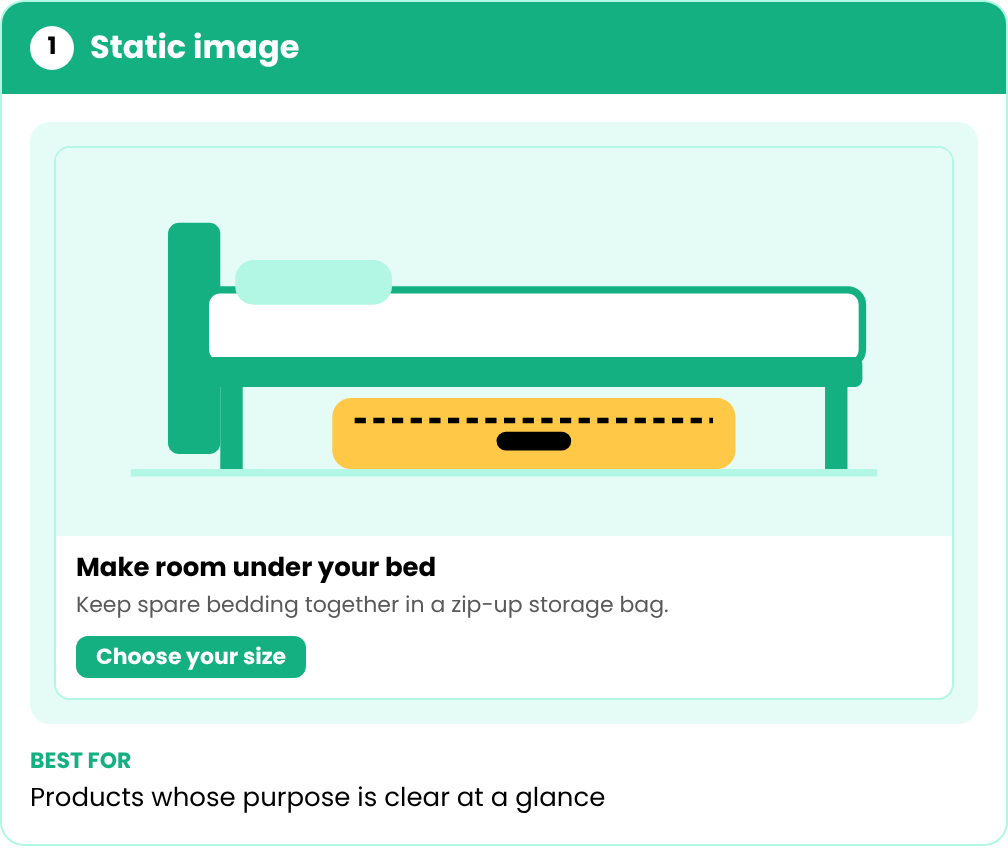
A static image suits products whose purpose is easy to understand at a glance. Use a clear product photo, a short benefit, and a call to action that matches the destination page.
For the storage bag, the image could show it filled and placed under a bed. The accompanying copy might read:
- Make room under your bed
- Keep spare bedding together in a zip-up storage bag
The shopper can immediately see the product’s purpose. The landing page should then provide the dimensions, materials, price, and delivery details.
Short videos and creator demonstrations
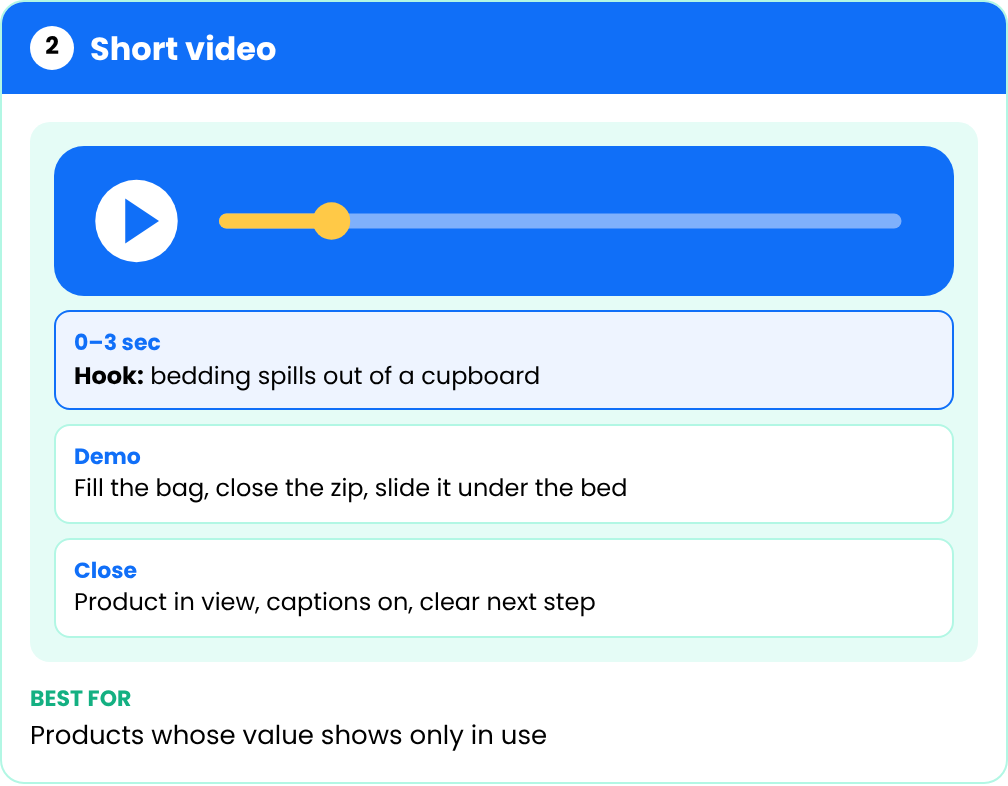
Video is useful when a product needs to be opened, adjusted, assembled, or used before its value becomes clear.
A storage-bag video could show someone placing folded bedding inside, closing the zip, and sliding the bag under a bed. This answers practical questions without relying on a long description.
User-generated content can provide a customer’s perspective. You can also commission a creator to demonstrate the product, but a paid demonstration should not pretend to be an independent customer review.
Keep the product visible, and make the main message clear through captions and sound.
Product carousels
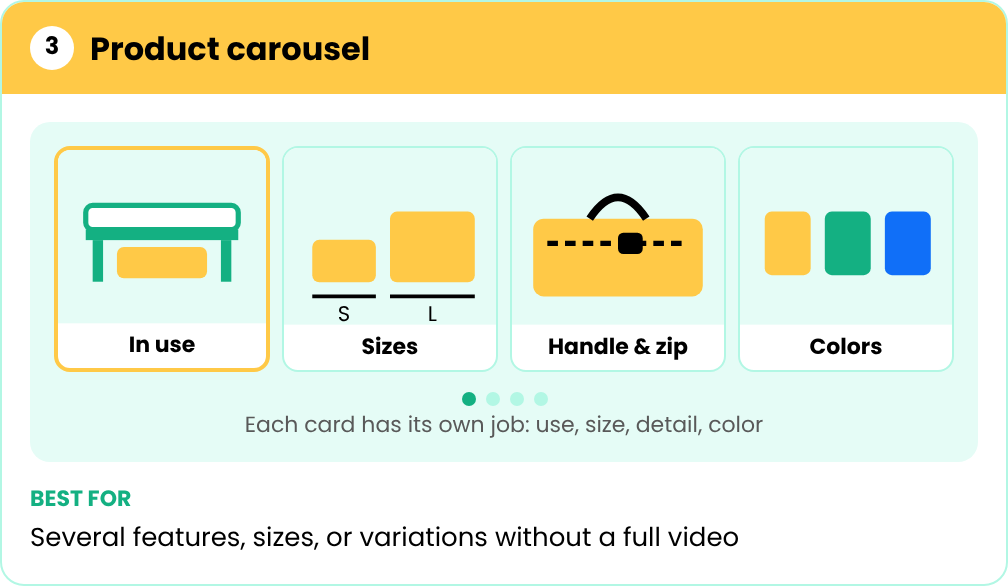
A carousel uses several cards to show different features, variations, or related products. It suits an offer that needs more than one image but doesn’t require a video.
For the storage bag, the cards could show:
- The bag in use under a bed
- Its dimensions and available sizes
- A close-up of the handle and zip
- The available colors
It’s also worth giving each card a purpose. If the cards show separate products, link each one to the matching product page where the placement supports it.
How to Create a Dropshipping Ad Creative: Step by Step
You do not need to start with a complicated production setup. Work through these six steps to turn a product idea into an ad you can test.
1. Choose the product and offer
Start with a product you can describe accurately and a supplier whose delivery arrangements you understand. Where possible, order a sample so you can inspect the item and create your own photos or footage.
Define the offer before writing the ad. This includes the product, price, any discount or bundle, and the conditions attached to the purchase.
Check that the product page answers the questions a shopper is likely to ask:
- What are the dimensions, materials, or compatibility requirements?
- What is included in the order?
- How much does delivery cost?
- What delivery timeframe can the supplier support?
- How do returns work?
An attractive ad cannot resolve a mismatch between the promise and the product. For more examples of building a promotion around an individual offer, see how to promote specific products.
2. Choose a creative type
Choose a format that matches what the shopper needs to understand.
A clear photo may be enough for a decorative item. A demonstration can explain a folding mechanism or adjustable feature. A carousel gives you room to show sizes, details, or a small collection.
Also consider the placement. A vertical social video, a notification-style ad, and a full landing page require different assets. Prepare the creative for the channel where it will appear instead of forcing the same file into every placement.
3. Write the headline, description, and call to action
Your ad copy should explain one main benefit and give the shopper a clear next step.
For the storage bag, the message could be:
- Headline: Put spare bedding in its place
- Description: Explore foldable storage bags sized for the space under your bed.
- Call to action: Choose your size
Keep the wording specific. “Choose your size” tells the shopper what they can do next, while a vague promise such as “Change your home forever” explains little about the product.
Only include discounts, delivery promises, or availability claims that match the store. If the ad promotes a particular variation, make that variation easy to find after the click.
4. Build a hook into the first three seconds
For video ads, use the opening to show why the product deserves attention. TikTok’s video advertising guide recommends introducing a hook within the first three seconds.
For example, for the storage bag, you could start with bedding spilling from a cupboard, then show the bag being filled. Another opening could show the filled bag sliding neatly under a bed.
A useful hook connects directly to what the product does. Follow it with a demonstration and a clear next step so the opening does not become an unrelated attention-grabber.
For a static image, apply the same principle: make the product and its main benefit easy to recognize immediately.
A relevant customer review or demonstration of the product can answer doubts that your own description leaves open.
Use feedback from someone who actually bought or used the product, and obtain permission where needed. Keep the original meaning when shortening a review.
If your store has no customer feedback yet, show the product in use, its measurements, or close-up details. Do not invent ratings, customer counts, or testimonials to fill the gap.
The aim is to help shoppers assess the offer, not simply to decorate the ad with stars.
6. Prepare two or three variations
Create a small set of variations with a clear reason for each change. You might test:
- A product demonstration against a product photo.
- Two different video openings.
- A practical headline against one focused on a specific use.
When testing a headline, keep the image and offer consistent where possible. This makes the result easier to interpret.
Before submitting the ads, check them on a phone. Read the captions, open the destination link, and confirm that the product page shows the same offer. Set up conversion tracking and a spending limit before the campaign starts.
Where to Run Dropshipping Ads
The right channel depends on your product, audience, creative, and available budget. Facebook ads through Meta and TikTok campaigns are options for reaching people in social feeds. Search advertising can reach people looking for a particular product or solution.
You can also reach audiences through external advertising platforms. These provide placements beyond the social advertising accounts you manage directly.
PropellerAds is a multisource advertising platform. Its formats include Paid Social Ads, Interactive Ads, Telegram Ads, Popunder Ads, Push Ads, and In-Page Push Ads.
Each format presents the offer differently. Some use a short message and image, while others introduce the offer through an interactive experience or open the destination page directly.
| Format | Suitable creative or destination | Audience type |
|---|---|---|
| Paid Social Ads | A landing page for traffic from social-feed placements, without managing separate social advertising accounts | Social-feed audiences reached through the platform’s supply partners |
| Interactive Ads | An offer introduced through platform-provided interactive flows, such as taps, swipes, or quizzes | Users who interact with the experience before reaching the offer |
| Telegram Ads | A short product message and supporting creative for Telegram Mini App placements | People using Telegram Mini Apps |
| Popunder Ads | A product or landing page that opens in a background window or tab | People browsing websites where the format is available |
| Push Ads | Short headline, description, and supporting image or icon | Users who have opted in to notifications; delivery can reach them when they are not browsing |
| In-Page Push Ads | A short message and image in a notification-style website placement | Website visitors, without requiring notification opt-in |
See how to launch these formats for your store.
When comparing formats, consider what happens after the initial interaction. A short notification needs a product page that quickly explains the offer. A Popunder Ads campaign makes the landing page especially important because that page presents the offer itself.
You can explore the eCommerce advertising platform to see how these options fit your store. Start with a defined product, target market, and measurement plan so you can assess the response.
How to Measure Dropshipping Ad Results
Before launching, choose the action you want to measure. For a store campaign, that will often be a completed purchase. Product views and cart additions can help explain the journey, but they should remain separate from sales.
Check that your tracking records the intended events correctly. Give each creative a recognizable name so you can connect the results to the version people saw.
Click-through rate: does the ad attract interest?
Click-through rate, or CTR, is the percentage of impressions that produce a click:
- CTR = clicks ÷ impressions × 100
Use it to compare how people respond to creative variations in similar conditions. A stronger CTR can indicate a more engaging message, but it does not show whether those visitors bought anything.
If clicks increase while purchases do not, check whether the ad creates expectations the product page fails to meet.
CPM: what does exposure cost?
CPM is the cost per 1,000 impressions:
- CPM = advertising spend ÷ impressions × 1,000
It helps you understand the cost of reaching an audience. However, a lower CPM does not automatically mean a lower cost per purchase.
Compare CPM alongside the quality of the visits and the actions people take after arriving.
Cost per conversion: what does the chosen action cost?
Cost per conversion shows how much advertising spend you used for each tracked action:
- Cost per conversion = advertising spend ÷ conversions
Define the conversion consistently. If one report counts purchases and another counts cart additions, their costs are not directly comparable.
For purchase campaigns, compare acquisition costs with the amount left after product costs, shipping, payment fees, discounts, and expected returns. Revenue alone does not show whether the campaign is sustainable.
Use the metrics together
The pattern across metrics is more useful than one isolated number.
If people see the ad but rarely click, review the message and creative. If they click but leave the product page, investigate the match between the ad and the offer, page performance, and delivery information. If they add to cart but do not buy, check the checkout and any costs introduced late in the process.

FAQ
There is no single best format for every product. Short videos can demonstrate how an item works, genuine customer or creator content can answer practical questions, and carousels can show variations or details. See Types of Dropshipping Ad Formats and the step-by-step creative guide to choose an approach to test.
No. Dropshipping remains an active fulfillment model, as discussed in Shopify’s 2026 assessment. However, access to a supplier does not make an offer competitive on its own: product quality, reliable fulfillment, useful creative, and acquisition costs all matter.
For advertising alone, $100 may fund a limited test, depending on the platform, audience, format, and campaign settings. A $50–$100 daily test budget would use that amount in one or two days; treat this as a planning example, not a universal recommendation or a promise of enough purchase data. Platform minimums also apply: TikTok’s budget guidance specifies campaign-level daily budgets above $50 and ad-group daily budgets above $20.
Choose a product and offer, select a creative type, and write the headline, description, and call to action. For video, introduce the product’s value within the first three seconds, then support the message with a demonstration or genuine social proof. Prepare two or three variations, check the landing page, and set up tracking before launch.
You can use Interactive Ads to engage users before they reach the offer, Telegram Ads to reach people within Telegram Mini Apps, Popunder Ads to open an offer in the background, Push Ads for short notifications, and In-Page Push Ads for notification-style website placements. Explore these formats through the eCommerce advertising platform.
Affiliate marketing lets partners promote a dropshipping store’s products in return for a commission on qualifying sales. The store handles the customer order and arranges fulfillment through its supplier. See our guide to eCommerce affiliate programs for more about the model.
CPA means cost per action: as a metric, it measures advertising spend per tracked action; as a payment model, it means paying for a qualifying action under the agreed terms. See our guide to CPA networks for eCommerce for the network model. Here, CPA refers to advertising, not a Certified Public Accountant.
Getting Started with Dropshipping Ads
Start with one product, a clear offer, and a small set of creative variations that show why the item is useful. Once your landing page and tracking are ready, choose where to launch and use the results to guide your next test.
Join our Telegram for more insights and share your ideas with fellow affiliates!