Plugging PropellerAds Into VN TikTok Shop: A New Funnel for Social Commerce Advertisers

Did you know that Vietnam is one of the fastest-growing GEOs in the Asian region? Maybe, you did! And if you have been thinking of including this GEO into your 2026 success list, here is one more insight: VN is also a strong social commerce ecosystem, this market alone is expected to reach about $5B in 2025 and keep growing double-digit through 2030.
From here, it gets even more interesting: platforms like TikTok and Facebook are steadily pulling users away from “classic” marketplaces and into content-driven shopping, with Vietnamese consumers increasingly buying via live streams, short videos, and in-app shops instead of traditional eCommerce sites.
On top of that, TikTok Shop itself is having a moment: in Vietnam, it’s one of the key growth engines of eCommerce, helping push national GMV (Gross Merchandise Value) up more than 40% year-on-year, with categories like fashion, beauty, FMCG (Fast-Moving Consumer Goods), and home leading the way.
So when Asian advertisers started sending PropellerAds traffic to Vietnamese TikTok Shop via Onclick campaigns (through TikTok’s Spark), that was a genius move. It was basically plugging high-intent performance traffic into the hottest social-commerce mall in the country.
In today’s practical guide, along with our Senior Account Strategist, Karlina Berzina, we will share some efficient strategies for approaching this brand-new and very promising funnel. We’ll start by observing Vietnam not as one market, but as dozens of micro-markets and move to implementing “wide-test to narrow-zone” tactics. But no spoilers! Let’s take it step by step.
What’s a TikTok Shop, Anyway?
Before we start, let’s make sure you know what that is and what it looks like. A TikTok Shop is TikTok’s built-in eCommerce feature that lets people discover, browse, and buy products without ever leaving the app. Shoppable videos, live streams, and a dedicated Shop tab all lead to the same place: an in-app product page with price, details, and checkout in a few taps.

In other words, it turns the For You feed into a full-fledged sales machine, leading users from trivial scrolling to a potential purchase in seconds.
Now, let’s move to our VN advertiser.
The Offer: Not a Hero Product, but a Whole Shopping Mall
To keep things flexible, the advertiser didn’t push one magic hero product. Instead, the TikTok Shop was structured more like a mini marketplace, with three big buckets:
- Beauty (skincare, makeup, tools)
- Clothing (fashion, accessories)
- Gadgets (small electronics, smart devices)
This multi-category setup mirrors how TikTok Shop actually works in Vietnam: beauty and fashion dominate, while gadgets help maintain a healthy AOV (Average Order Value) and appeal to impulse buyers scrolling.
Because of that, the goal of the campaign wasn’t to scale a particular product, but to find where and on what traffic the shop gets the best buyers. That meant we could evaluate zones, devices, and browsers first, and only then zoom in on specific product clusters.
And once you think like that, going wide first stops being scary and starts being a data-collection speedrun.
Phase 1, Wide Test: Vietnam as One Huge Sandbox
To start, the team launched a broad Onclick test on TikTok Shop VN with three main principles in mind:
- Mobile-only focus: Android + iOS, because that’s where almost all Vietnamese social-commerce behavior lives.
- Full-country coverage: all zones (districts/provinces) included, from big hubs like Hanoi to smaller cities.
- No rush in filtering: let the system explore browsers, zones, and OS combinations before making any decisions.
At this stage, the main goal is to learn fast, rather than earn fast. So the team watched metrics like:
- CTR and engagement
- Conversion rate (CR) and checkout completion
- Cost per checkout (CPCO)
- Refund/return risk by zone
- Day-to-day ROI stability
Internally, our impression-based dataset for Vietnam showed what we already suspected: Chrome + Safari dominate and easily capture around 80% of traffic, with social/in-app browsers like Facebook’s also relevant but smaller. That lines up with broader mobile usage trends in the country, where Android Chrome and iOS Safari are the default gateways for social-commerce journeys.

In other words, the wide test was aimed to learn which zones + browsers + OS combos behave like super-active buyers. Once that data landed, the real fun started.
Phase 2, Narrowing Down: Turning Vietnam into a Map of Green Zones
Once the first wave of data came in (roughly 7-14 days), the team stopped perceiving Vietnam as a huge single GEO, but started thinking of it as tiny profit islands on the Vietnam map.
The process looked like this:
- Zone-level analysis
Each zone (district/province) was evaluated by CTR, CVR, CPCO, refund risk, and ROI stability. High-sales zones but also with some refund rates were mostly deprioritized to protect ROI, while stable ones were promoted to the whitelist. - Building a whitelist
So, yes, instead of one big campaign with generic GEO targeting, the team built a whitelist of strong-performing zones. - Per-zone campaigns with custom bids
Every shortlisted zone got its own bid/rate and its own budget logic. Vietnamese TikTok traffic varies a lot between, say, an urban Gen-Z district glued to creators and an average-income area that clicks a lot but rarely buys. Per-zone bidding lets us cut the traffic that doesn’t meet expectations without accidentally killing the one that performs good.

You may think that managing multiple zone-level campaigns sounds like more work, and that’s true. But is it worth it? Absolutely, because over time, this structure typically:
- Removes about 20-40% of low-quality zones and saves your budget
- Smooths out daily CPA swings
- Makes scaling way less stressful and more conscious, because you know where the money is made
This is the strategy worth copying for your campaigns, and we don’t mind if you do!
The Browser and Device Angle: Chrome VS Safari
While zones were the main lever, browsers and OS also played a huge role in how Vietnamese users moved from click to TikTok Shop, and then – checkout.
From the test and our internal stats, three patterns emerged:
- Chrome = volume monster: particularly on Android, it delivered the bulk of impressions and conversions, so it became the primary testing playground.
- Safari = quiet but rich: iOS users often showed higher AOV and better long-term quality, even with smaller raw volume.
- Social browsers (Facebook, etc.) = wildcards: good engagement but more volatility, so we kept them in, watched carefully, and trimmed only when data made the case.
So in practice, the team ended up with segmented structures like:
- Dedicated campaigns for high-performing Chrome zones
- Dedicated campaigns for “premium” Safari zones
- Controlled testing budgets for Facebook browser traffic
That way, when you see performance shifts, you know whether a particular zone is dead already or a specific browser just started acting weird. Data is king!

Bonus Experiment with Social-Origin Traffic: Widening the Funnel
After stabilizing the main TikTok Shop funnel, the team added a second layer: a Social Traffic Optimization test. Instead of relying only on native TikTok Shop traffic, they started sending mobile social traffic (Facebook, Instagram, and other referrers) through SmartCPM, then used zone-level data to keep only the pockets that converted.
To keep things clean, the team set a few strict rules:
- Mobile-only
Only Android and iOS, the latest versions. This filtered out low-end devices and random desktop noise, and matched the reality of Vietnam’s mobile-first commerce. - High-impact browsers only
Chrome, Safari, and Facebook browser – no long-tail or obscure environments unless they proved themselves. - All-social wide test with SmartCPM
Using PropellerAds’ SmartCPM bidding, campaigns ran across multiple social-origin placements (Facebook feeds, Instagram stories/reels, and other social referrers) to discover three main things: which social pockets sent users who actually checked out, which zones worked best with social-origin traffic, and what the real price floor per zone looked like.
SmartCPM did the boring part – dynamic price discovery per zone – while the team focused on reading the patterns and whitelisting the profitable micro-zones.
Short-term, this kind of test usually gives you a clean cost baseline per zone and reveals some unexpectedly strong micro-pockets (like a particular city + browser combo that loves beauty gadgets). Mid-term, it adds a second, diversified funnel into the shop, which makes scaling safer and less dependent on a single traffic type.

How Does This Compare to Other Social-Commerce Funnels (Instagram, Pinterest, YouTube, Amazon)?
To put this TikTok Shop + PropellerAds strategy in context, it helps to look sideways at what other platforms are doing.
- Instagram Shops and Checkout
Instagram lets users discover and purchase products fully in-app (via product tags, Reels, Shops, and Checkout), which reduces friction and tends to boost conversion rates. - Pinterest Shopping
Product Pins and shoppable features let users browse inspirational boards and then click through to buy from merchant sites – think of it as “mood board > product page” in one tap. - YouTube Shopping
Creators can tag products in videos and Shorts, with a shopping button or sticker that sends viewers straight to a product list or merchant store. - Amazon’s social-style feed
Amazon launched a TikTok-like shoppable video feed inside their mobile app called Inspire and then shut it down in a while, which shows that simply copying the format without deep creator culture and algorithmic discovery isn’t enough.
All of these share one idea: less distance between content and checkout. TikTok Shop just pushes this to the extreme in Vietnam – with a feed that is already entertainment-first and a huge base of creators, affiliates, and influencers selling everything from lipsticks to sneakers.
In this setup, PropellerAds works as an external performance engine that drives fresh, targeted users from multiple traffic sources straight into the TikTok Shop in Vietnam. Instead of depending on one generic stream of traffic, the team uses zone-level whitelists, browser and OS segmentation, and SmartCPM bidding to push more volume into the zones and environments that actually convert.
While Instagram Shops, Pinterest Shopping, YouTube Shopping, and other formats show that social commerce is the direction, the TikTok Shop Vietnam + PropellerAds setup demonstrates how a data-driven, zone-based traffic strategy can turn that trend into a controllable performance funnel.
What Can You Use from This Strategy
To wrap the whole story into something actionable, here are the key steps to take and lessons you can use:
- Treat diverse countries like a cluster of micro-markets, not one big GEO
Vietnam has dozens of zones with different cultural specifics, income, and buying habits. This way, segmentation and zone-level whitelisting and per-zone campaigns are the difference between chaos and controllable scaling. - Run intentionally wide tests, but with a clear plan
Going broad across devices, browsers, and zones works when you know exactly what you’re trying to learn (best combinations, lucrative/non-lucrative pockets, price floors) and when you’re ready to cut what doesn’t work. - Segment browsers and OS like they’re separate audiences
Chrome vs Safari, vs social browsers will behave differently on TikTok Shop. Give them dedicated budgets and bids so one doesn’t quietly kill the other. - Combine native social-commerce strength with outside traffic
Let TikTok creators, live streams, and affiliates do their thing, but don’t rely only on them. External performance traffic (like PropellerAds’ Onclick + SmartCPM) can feed your best zones and stabilize volume while you keep optimizing.

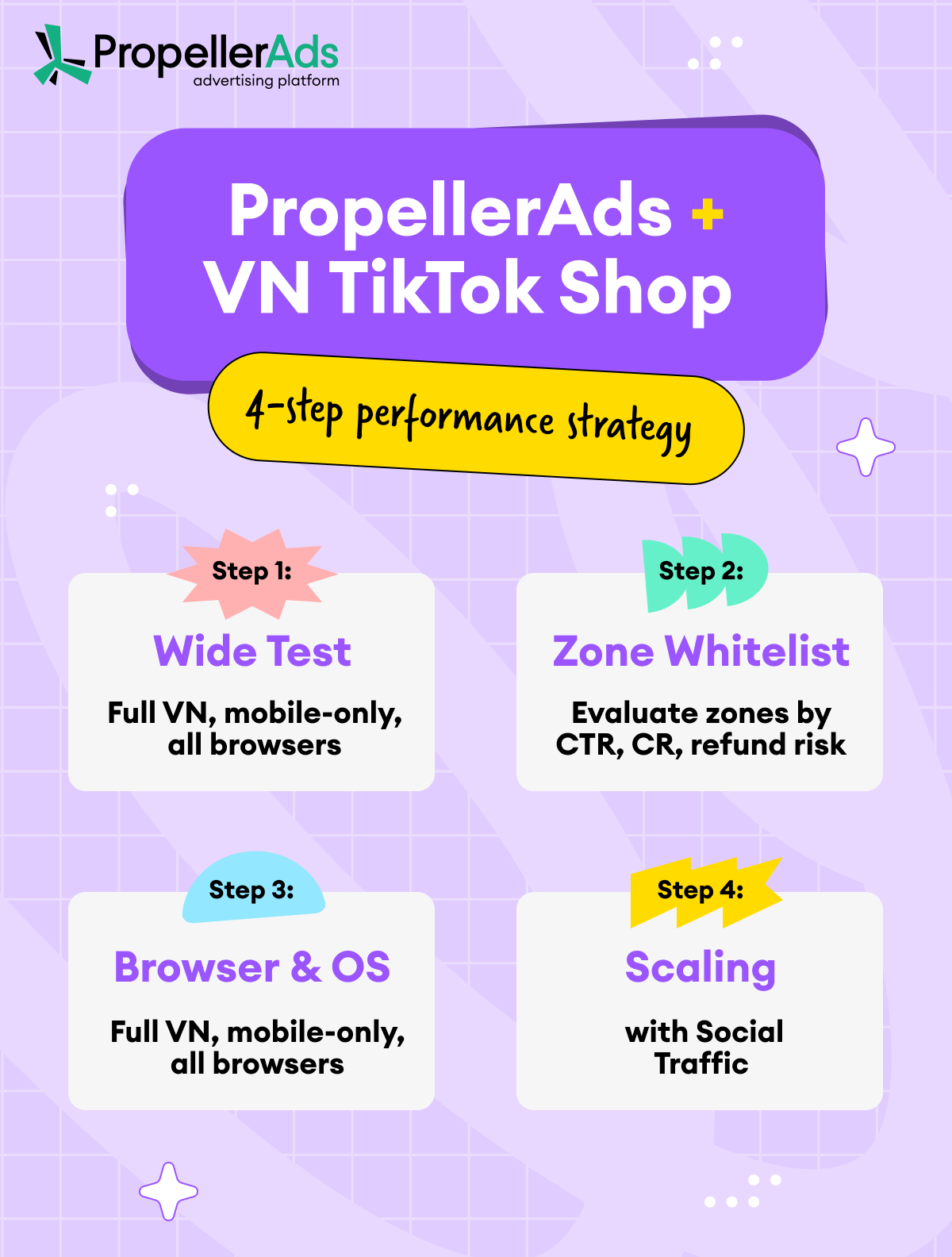
When you put all of that together, you go far beyond TikTok Shop ads, you build a repeatable funnel framework: wide exploration, then – zone-level whitelisting and browser/OS segmentation, social-origin expansion, and finally – controlled scaling.
Final Thoughts
So, if you start super wide, listen to what zones, browsers, and devices are telling you, and promote the winners to their own campaigns with custom bids, you have all chances to earn big on TikTok Shop, especially in Vietnam. This funnel idea can help you stop perceiving TikTok Shop as a volatile hype train and turn it into a calm, predictable performance channel (just with a lot more funny videos and trending sounds in the background). Grab it and good luck!
Trends
View more posts