Why Push and Pop Traffic Perform Where Social Ads Don’t?
Same Users, Different Outcomes… Again?
You’ve probably seen this before. Same offer, same funnel, same GEO… but the results just don’t line up. Social behaves one way, while Push and Pop suddenly bring cheaper traffic with better conversions.
So what’s going on, really?
The thing is, it’s not really about traffic quality; it’s about the context, and the way each source puts the user in a completely different state before they even see your ad.
Let’s break that down and look at where Push and Pop actually make more sense.
The Problem with Looking at Traffic as “Just Users”
It’s very easy to fall into this trap. A click is a click, and a user is a user.
If the funnel works, it should work everywhere… right? Not quite.
The moment a user lands on your page, they’re not coming in neutral. They’re coming in with a mindset that was shaped before they even saw your ad (which depends entirely on where they came from).
Someone scrolling through their feeds or Telegram channels is not thinking the same way as someone seeing a push notification. And neither of them behaves like a user who just landed on a page through a Pop.
That difference might seem subtle at first, but in performance terms, it changes everything: how fast users click, how much they trust what they see, how long they stay, and whether they convert at all. So instead of thinking about traffic as “users,” it makes more sense to think about it as users in a specific state.
Push & Pop: Different Entry Points, Different Advantages
Now, if we flip the perspective for a second, Push and Pop work very differently from Social – not just in format, but in how they enter the user’s attention.
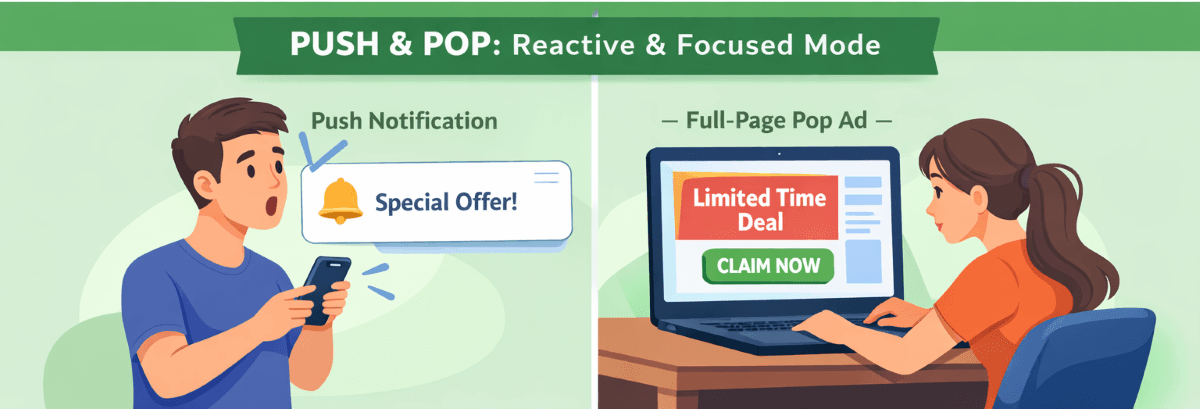
A push notification doesn’t sit inside a feed waiting to be noticed. It appears outside of it, right on the device. It interrupts whatever the user is doing and creates a small, focused moment.

Think of yourself on a Monday evening… You’re on your phone, half-focused, jumping between Instagram, messages, and maybe a couple of reels. You’re not really looking for anything – just passing time. Now imagine a push notification appears: “Limited-time offer available today.” For a second, your attention shifts and is therefore no longer passive (because one way or another, you react).
That reaction is important. It’s not driven by comparison or deep evaluation. It’s driven by curiosity: “What’s this?” – and that alone shortens the path to the first click.
Pop works differently, but the effect is just as interesting.
Instead of interrupting you with a message, it changes the environment entirely. You land directly on the advertiser’s page, without needing to “choose” your ad in a crowded space.
There’s no feed, no competing content around it, and no distraction sitting one swipe away. For a brief moment, your funnel becomes the main focus (and this is where the difference really becomes clear).
If we think back to the idea of user states from earlier, social keeps the user in a passive, scrolling mode. Push shifts them into a reactive state. Pop often catches them in a more task-oriented mindset, where they’re ready to process what’s in front of them.
These are small shifts, but they change behavior in very real ways. Push and Pop don’t compete for attention in crowded feeds but rather create their own separate moment of attention. Henceforth, that’s exactly why they can perform so differently under the same conditions.
Where Push & Pop Actually Perform Better Than Social
Up until now, this might still sound a bit abstract. Different user states, different environments… makes sense – but where does it actually show up in real campaigns?
Once you start looking at performance across verticals, GEOs, and use cases, a pattern appears very quickly: Push and Pop don’t just behave differently but simply fit certain scenarios better.
It Starts with the Type of Offer You’re Running
Some offers, like mobile or desktop software, don’t need a long introduction because their value is clear almost immediately: faster device, safer browsing, or cleaner system. There’s no emotional build-up or storytelling required as the user just needs to understand their benefit and take action. In this kind of setup, direct exposure works.
Push notifications deliver that quick spark of curiosity, while Pop goes even further by placing the user directly into the funnel (without distractions). The path from impression to action becomes very short.
The same logic applies to iGaming and giveaways. These verticals are not built on slow decision-making as their success relies on the users’ impulse, curiosity, and (let’s face it) greed. Hence, the exposed user doesn’t need to compare five options or research deeply as they react to what’s right in front of them.
That’s why Pop often works well for acquisition here, while Push becomes effective for bringing users back and re-engaging them.
Social traffic offers, on the contrary, often run into friction – not just because of moderation or compliance, but mostly because of the environment itself. Users aren’t opening their feed with the intention to make a decision or take action.
They’re scrolling, watching whatever catches their eye, and moving on just as quickly. So when your ad appears, it has to interrupt that flow, hold attention for long enough, and give the user a reason to care (all within a very short time frame).
At the same time, everything around it feels native and engaging, which makes anything that looks like an ad stand out in a different way. Not necessarily in a good or bad sense, but in a way that naturally makes people pause and question it a bit more. So even before the user reaches your funnel, there’s already an extra layer you have to penetrate.
So it’s not that Social traffic doesn’t work, but it just takes more effort to get the user into the right mindset (occasionally making it less time-efficient).
Short Path vs Long Path
Then There’s the GEO Factor
Another layer that often gets overlooked is geography. If you’ve worked across different markets, you’ve probably noticed that user behavior shifts quite a bit depending on the region.
It tends to be argued that in Tier 2 and Tier 3 GEOs, the advertising environment is generally less competitive, and reactions to direct offers are often quicker. In these markets, Push and Pop can scale efficiently because the barrier to engagement is lower.
Tier 2 and Tier 3 GEOs are typically associated with lower competition and lower advertising costs, which makes them easier to enter, test, and scale compared to more saturated regions like the US or CA. In practice, that means you don’t need to over-explain; just presenting the value clearly is often enough to drive action.
In Tier 1, however, things start to shift a little bit. Users are more accustomed to advertising, more selective, and generally more sensitive to trust signals. Here, the environment that Social creates (e.g., native-looking ads, storytelling, and visual context) becomes an advantage rather than a limitation, thereby changing the balance of things.
Push and Pop still work, but Social often becomes stronger when brand perception plays a bigger role in the decision.
Tier 2 / Tier 3 GEOs
-
Lower CPM/CPC Lower traffic costs make testing easier and faster.
-
Less ad saturation Users often face fewer competing ad messages.
-
Higher responsiveness to direct offers Clear value propositions can convert with less nurturing.
Tier 1 GEOs
-
Strong brand-driven behavior Users often respond better to familiar brands and platforms.
-
Higher trust in native ads Context and credibility matter more in mature markets.
-
Selective audiences Decision-making is often slower and more filtered.
Main Takeaways
- Both Push & Pop = speed and clarity
They work best when decisions are made quickly, and the message doesn’t need much explanation.
- Pop = volume and testing
It brings in traffic fast and helps you understand what works (and what doesn’t) without relying too much on the algorithms.
- Push = re-engagement layer
It lets you come back to the users directly, shortening the path between first interaction and conversion.
- Social = context and perception
It performs better when users need time to understand and trust you before taking action.
So in the end, the difference isn’t really just about performance, but about function. Each source operates under its own logic, creates a different mindset, and fits into a different part of the user journey.
Bonus Part: Expert Insights by Viktoriia Demskaia, Account Strategist at PropellerAds
A: Results can vary significantly, and it primarily depends on the offer and the conversion flow.
For simple actions like lead generation, mobile software, giveaways, Push/Pop traffic outperforms in terms of volume and cost: CPM/CPC here are significantly lower than on Facebook or TikTok, especially in Tier 2/3 GEOs. It’s also crucial to remember the cost of infrastructure and its preparation for launching ad campaigns (as moderation on social media is many times stricter than on push/pop ad networks).
However, for even more complex offers, Push/Pop networks show strong performance thanks to scale and speed: within 1-2 days, you can drive the volume that would take a week on social media due to moderation. This gives a huge advantage in terms of testing speed and finding a winning setup for any type of offer.
A: Firstly, when you need a large volume of traffic in a short period of time (and without dedicating a huge budget), push/pop networks can do it, and it is much cheaper than social media.
Secondly, when you’re promoting verticals that are under strict moderation, iGaming, or Finance, in these cases, social media ad accounts tend to get banned quickly, while Push/Pop remains stable.
Thirdly, when you need to quickly test a new offer or GEO, Push/Pop provides enough volume to make decisions within hours, not days.
All in all, if you’re working with Tier 2/3 GEOs, Push/Pop is often the only source that can deliver the required reach at a reasonable cost.
A: If an offer gains traction on Push/Pop traffic, it becomes clear within the first 24 hours. On social media, however, it takes at least 3 days for basic optimization and conversion evaluation. This means you can identify performing sources faster and either fully buy them out or secure a strong position in the auction while competitors on social media are still testing.
When scaling, Push/Pop also has an advantage in terms of stability: increasing the budget doesn’t push the campaign into a “re-learning” phase, as it happens on social media (where the algorithm essentially starts over).
Additionally, Push/Pop networks give you far more manual optimization control. You can adjust sites/placements, formats, browsers, audiences, user activities, and time slots yourself, instead of relying on a non-transparent algorithm.
Finally, the inventory is transparent: you see real volumes and can plan scaling. No need to guess why auction costs suddenly doubled.
Q: Where do advertisers get meaningful data faster?
A: Definitely in Push/Pop traffic. With the same budget, you get significantly more clicks and events. This means statistically significant results come faster and are more reliable.
At the same time, the data is immediately actionable: even at the testing stage, you can see which sources/placements/zones, GEOs, OS, devices, and browsers perform well. Essentially, there’s no need to wait for an algorithm to interpret it for you.
The low cost of traffic also means a low cost of mistakes. You can test many hypotheses at the same time within a reasonable budget (whereas on social media, every failed test costs both money and time).
As a result, Push/Pop doesn’t just provide fast data… It delivers cheap, high-volume, and immediately actionable insights that benefit your decision-making.
Q: What’s the biggest mistake advertisers make when comparing Social and Push/Pop?
A: The biggest mistake is when you compare these sources as if they are the same by nature. On social media, you essentially have one main lever that influences performance – the creative. In push/pop networks, there are dozens of levers: sources, formats, bids, time slots, OS, GEOs, and frequency.
Those who don’t use them often conclude that “it doesn’t work”, whilst in reality, they’re just not using the tool correctly.
The second mistake is when you directly transfer creatives from social media: formats, triggers, and user psychology are fundamentally different here. What works well in a social media feed does not mean it will work the same way in a push notification.
The third mistake is when you have the same expectations and metrics that you had with social media: these are different tools with different performance evaluation logic. Unlike social media, where it’s almost impossible to get real support, most Push/Pop networks offer live support and account managers who can help set up campaigns correctly from the very start.
The Real Constraints of Social Traffic
To be clear, this isn’t about saying that social traffic doesn’t work. It clearly does — and in many cases, it’s a key part of the mix. As always, though, it comes with a set of structural limitations that become noticeable once you start pushing for scale and consistency.
One of the first things you run into is rising costs
With Social traffic, you’re often paying for access to someone else’s audience. That means pricing is tied to the creator, their reach, their engagement, and sometimes simply their positioning. As demand grows, so do placement costs, and performance can vary depending on how well the integration lands with the audience.

At the same time, results are closely tied to the content itself. If the chosen strategy works, performance can be strong. If it doesn’t, there’s very little room to adjust without reworking the entire plan.
Then there’s moderation and compliance – but in a slightly different form
Certain verticals (e.g., finance, iGaming, or giveaway offers) don’t easily blend into the creator(s)’ content without some effort. You usually have to reframe the message so it fits their tone, making it sound less aggressive and more “content-like”. Naturally, the more you do that, the less direct the value becomes.
Spoiler: Even when everything is approved and live, performance isn’t entirely in your hands
You’re relying on how the creator delivers the message, how the audience reacts to it, and how well the integration actually lands in that specific context. Exactly the same offer can perform differently depending on timing and its format. That makes outcomes harder to predict, and overall performance becomes a test of trial and error and luck.
Why Push & Pop Feel “Easier” ( & What That Actually Means)
Now, if we go back to talking about user behavior, the difference starts to become clearer, doesn’t it?
Social traffic puts users into a high cognitive load environment. They’re scrolling, consuming content, constantly filtering what deserves attention and what doesn’t. Your message is just one of many competing signals.
Push and Pop work under different conditions. They don’t live inside that constant stream of content. They create a separate moment of attention, and because of that, the level of resistance is lower. Not because the user is fundamentally different, but because the context within which the user encounters your ad is simpler.
The Tradeoff: Resistance vs Exposure
What you’re really dealing with here is a tradeoff between how much resistance a user has and how directly you can reach them. In simple words, the more crowded and content-heavy the environment is, the higher the resistance. When the exposure is more direct, reactions tend to happen faster.
Why Push & Pop Feel Easier in Some Cases
The tradeoff: resistance vs exposure
Social
Push
Pop
So What Do You Actually Do With All Of That?
Once you start looking at traffic this way, the question shifts. It’s no longer about choosing the “best” source, but about understanding how each one fits into the overall structure. In practice (and as we’ve already written before), the strongest campaigns don’t rely on a single channel. They’re built as a sequence, where each source plays a specific role at a specific stage.
- Pop is often where things begin (i.e., test ideas and validate strategy). Since feedback comes quickly, it becomes easier to understand whether the funnel is working or not.
- Push naturally follows as a second layer. It allows you to reconnect with users who have already shown some level of interest, bringing them back into the funnel without starting from zero. In that sense, it helps maintain momentum rather than create it.
- Social sits in a different position altogether. It’s less about immediate action and more about preparation. This is where the product is introduced, explained, and framed in a way that builds understanding before the user even reaches the funnel.
Verdict:
Push and Pop don’t outperform Social because they are inherently better. They outperform it when they are used in the right context (i.e., where speed, clarity, and direct exposure matter more than storytelling or perception).
When these pieces are aligned, the system starts to feel less fragmented. Instead of separate traffic sources competing with each other, they begin to complement one another – each one handling a different part of the same journey.
If you’re looking to structure that kind of system more deliberately, combining Push, Pop, and Social traffic through PropellerAds can be a practical way to test, scale, and connect these different stages without overcomplicating the setup.
Join our Telegram for more insights and share your ideas with fellow-affiliates!