Meta and Google Ads Are Getting Harder: When and How Diversifying Traffic Might Help?
Affiliate chats have been boiling for a while now: ‘Facebook bans everything’; Google nuked another account’; Nothing survives longer than a few days’.
The complaints are mixed with practical hacks for more stable launches that work, but only until the next day. Meanwhile, everyone keeps running Meta and Google campaigns: good traffic is still good traffic.
Lately, though, the pressure feels different. Accounts burn faster than you can warm them up, and the cleanest ads die without clear reasons. So, relying on Facebook or Google alone starts to feel less safe, and the real question is no longer how to bypass the next ban.
It’s this: Can you still safely rely on Facebook or Google, or is traffic diversification now a must?
Below, we break down what’s really happening with Meta and Google today, why bans have become a platform-wide reality (not just bad luck), and what affiliates can actually do about it. Real ban stories and plenty of media buyer takes included!
Why Meta and Google Have Become a Struggle for Many?
Our research shows that Meta and Google bans are not just specific cases: they are common stories, told so often, that we even managed to divide them into several categories. So, story time!
Various Types of Account Bans
It’s about Facebook and Google’s notorious bans that seem to come out of nowhere and are now almost routine. Such account bans can hit even if you have no campaigns, and all the explanation you usually get is the formal ‘policy violation’.
Reddit users complain about that frequently, and here are just a couple of examples from a single thread:
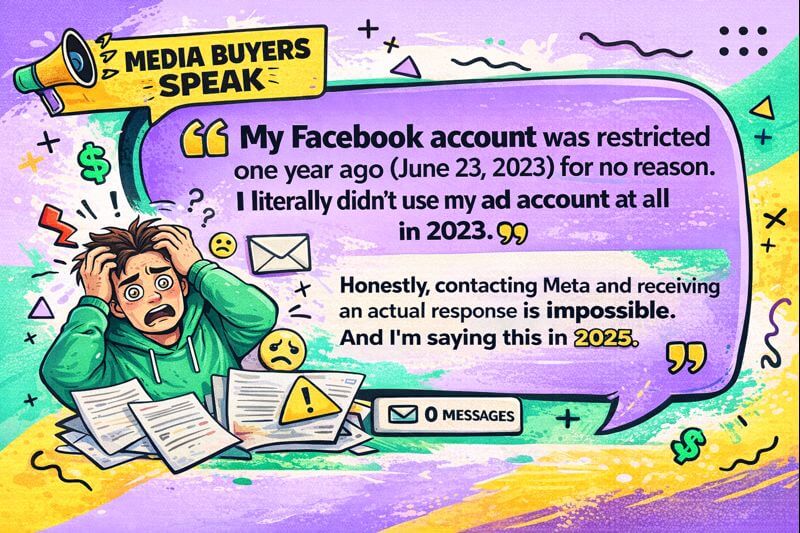
This might happen because of your account’s reputation, or a link to another account that already has a bad reputation. As a media buyer nicknamed TeamLead, the owner of the Google1x TeamLead channel, explains it, today it’s even less about outright bans and more about rising traffic cost.
In fact, Google and Facebook have always looked at account reputation. In the past, they just weren’t very good at connecting banned accounts with new ones: there were too many advertisers. Now, this doesn’t always result in bans. Instead, it usually shows up as higher costs across all metrics.
We see this in real campaigns. Reusing the same setup, even with small changes like new metadata, domains, or refreshed creatives, still makes traffic more expensive. But when everything is fully replaced, and only the idea remains the same, performance returns to normal. In some cases, the same setup even runs cheaper on new accounts than on old ones.
Retroactive Rejections
Your ad can run for like a month, and it performs perfectly: it might even be one of the best-performing ads in your whole setup. And then it happens: the ‘Rejected’ status without any clear reason.
Here is what users share:
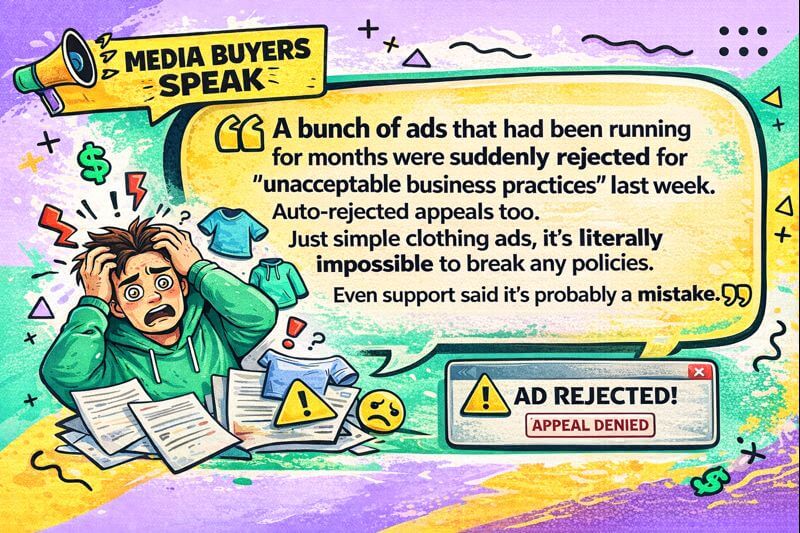
So, just because your creative passed moderation yesterday doesn’t mean it will be approved tomorrow.
Special Categories Chaos
Meta doesn’t allow discrimination in advertising. That’s why ads related to Employment or Housing fall under special rules: for example, you can’t target a job ad to specific genders or age groups.
That’s why such ads are reviewed more strictly and often get rejected by mistake.
Here is a case a Reddit user shared:

False Promises That Don’t Exist
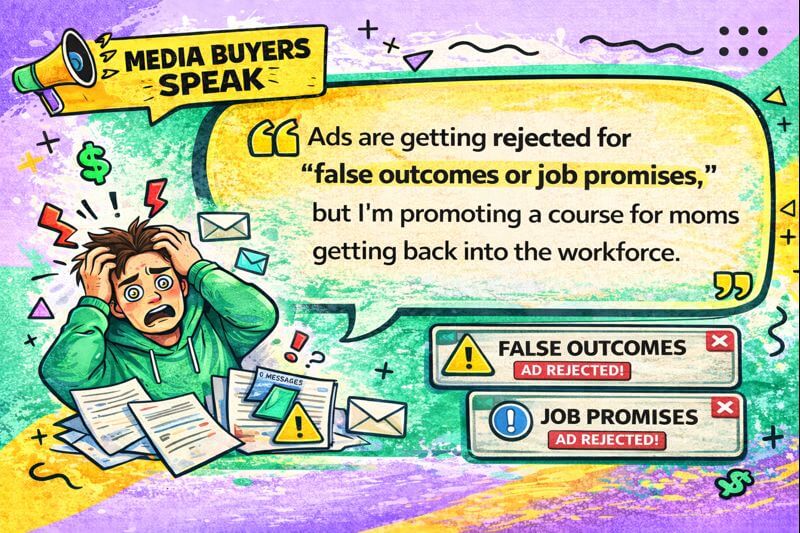
No, it doesn’t look like AI is taking over the world anytime soon. At least not the one running Meta’s ad moderation. Buyers complain that the algorithm often misclassifies content, assuming it makes certain ‘promises’.
Here’s a real case to illustrate this:
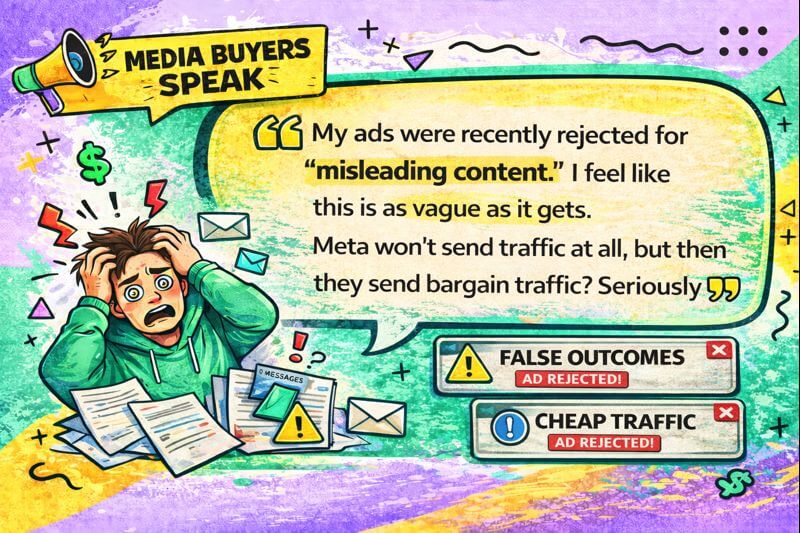
Misleading Content That Doesn’t Mislead
As the name suggests, it’s when your ads get rejected with a ‘Misleading content’ flag. The biggest issue is not knowing where the problem is or who you supposedly misled. And how do you fix something that wasn’t broken?
Just one example:
Whitehat Rejections
This category covers rejections that barely make sense at all. Your totally white-hat ad from a risk-free vertical without any triggers can be rejected because of… yes, you don’t know the reason why. Dennis, a solo media buyer and the owner of the Zombie Traffic channel, shared:
‘The most absurd rejection I’ve had? A white ad for Morshinskaya water wrapped into an NBA-related creative was rejected, though it was a fully white-hat offer.’
So, What’s Happening, After All?
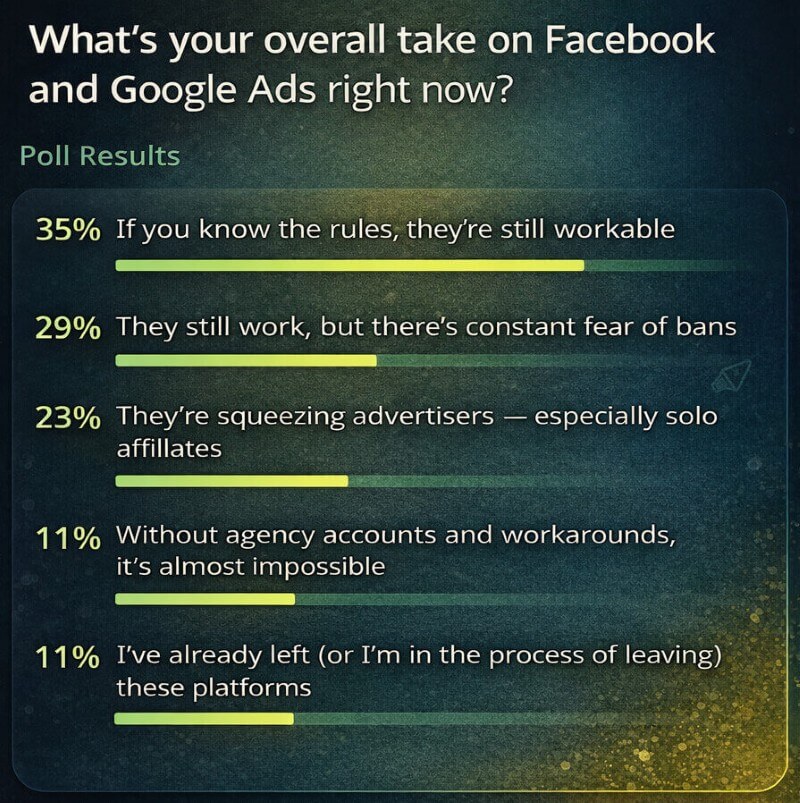
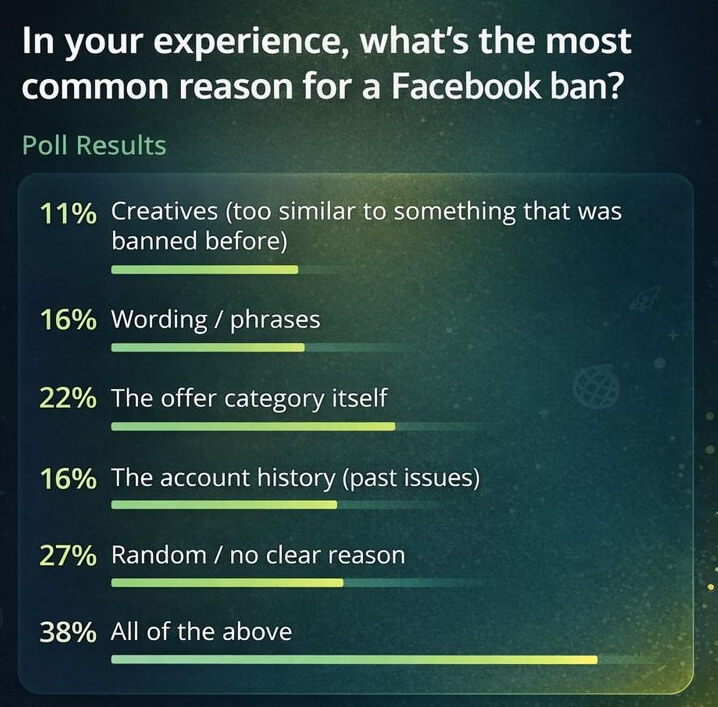
All these cases show a clear pattern. Rejection rates have increased even for fully whitehat ads, and overall work becomes less predictable. Ads are often rejected because AI misreads visuals or cultural context, flags ‘promises’ that aren’t actually there, or applies vague reasons only to approve the same ads an hour later without any changes – or not approve at all.
Here’s what a survey in our Telegram chat showed:

And here’s the saddest thing we saw in one of the threads:
‘At this point, you really have just two options: reach out to support or move on. There are no reliable tricks to get a proper support response – at least for now.’
Interestingly, buyers interpret this shift differently. For example, as a Primax Agency representative claims, the situation even feels easier than before:
‘Earlier, there were more bans and storms. This year feels calmer, but only if you understand how the whole setup works, not just the ads.’
Meanwhile, TeamLead strongly disagrees:
‘Yes, it has definitely become harder to work, and the situation is likely to keep getting worse year after year. This is largely because AI is becoming part of everyday workflows: we already use it to process huge amounts of data, ideas, and signals. The same technologies are now being built into security systems, including moderation. As a result, affiliates will likely need to find more sophisticated ways to adapt, if that remains possible at all.’
So what should advertisers do now? There’s not much they can do in terms of fixing creatives, since many of these issues simply aren’t fixable at the ad level. A more realistic option is to become less dependent on a single platform – a strategy we call traffic diversification.
When Traffic Diversification is Your Way Out
No, we are not telling you to drop your familiar source right away! Diversification doesn’t mean abandoning Facebook or Google, and none of the buyers we spoke to suggested doing that.
In fact, it’s about expanding your traffic sources and expanding your options. And here’s when it makes the most sense (let’s be honest – almost always):
You work with different verticals
Different verticals behave differently across platforms. As noted by Poll, an active participant in our Telegram chat, some verticals naturally perform better on social media, while others benefit from alternative traffic sources.
Teamlead also adds: We do use other traffic sources, though they don’t exactly replace the main one; they work more as a complement. At the same time, they help us stay flexible, since different platforms require different creative approaches. You can often adapt and transfer the same setup, for example, from in-app traffic to Facebook or Google, adjusting it to new conditions.

You want to avoid all-eggs-in-one-basket risk
Even when appeals work, constant rejections slow down testing, scaling, and decision-making.
Teamlead: Relying only on Google and Facebook is risky. At any moment, a new update, regulation, or platform change can limit or completely pause traffic. That directly affects a company’s overall economics, which is why it’s important to always have several traffic sources in your mix.
Using multiple sources has always been a way to reduce risk – when everything depends on one platform, you’re far more vulnerable. That’s why teams keep expanding their source pool, adding platforms like Google, Facebook, Taboola, Bing, and others. Each has its own auction dynamics, user behavior, and algorithm logic, which help reach different audiences.
It’s no secret that on Facebook, you’re selling more directly – you have to reach a large audience and actively capture attention. On Google, users are usually searching for the solution themselves and stumble upon your offer. Still, it can take time (and spend) before the algorithm finds the right users. With several sources in your mix, though, you can scale a working setup much faster and more efficiently.
Dennis:
Yes, we do diversify, and not as a future plan, but in parallel. This way, we’re not tied to a single ad account and can ride out any storm without putting the business on pause.

You want more predictability
As Dennis puts it, Facebook feels predictable if you’re in its rhythm. As Teamlead adds, when a media buyer sticks with one platform for a long time, they learn it inside and out. If they’re not just blindly spending but actually analyzing, they understand how to work with the platform, how to spend the budget efficiently, how to test, and so on.
So, this predictability comes from experience, not from platform stability – and diversification gives you a safety net and room to adapt.

You need to reduce cost inflation risk
As we mentioned earlier, the issue often doesn’t show up as bans but as rising CPMs, CPCs, and total costs, all driven by account history, hidden links, or past launches.
Using additional traffic sources helps compare performance and economics across platforms, determine whether the issue lies with the offer or the platform, and identify cheaper, more efficient traffic opportunities.

You’re just starting out
For beginners, it’s especially important not to get stuck with a single source. For example, here’s what a Primax Agency representative advises beginners:
‘It makes sense to first focus on one traffic source and really understand it. But at the same time, you should already be preparing a second one – at least at the level of basic understanding and early tests. Relying on a single source without a Plan B is a mistake.’
What’s more, many media buyers point out that Facebook can be especially hard to handle solo. So, it may be more practical to pair it with another source for newcomers or even start with a different platform. Just look at what Dennis has to say:
‘For novices, I’d only recommend starting out as part of a team. You have about a 90% chance of burning through the whole budget as an inexperienced solo buyer. And the budget needs to be solid enough: at least $5k for Nutra, and about $10k for iGaming’.
So, you see? For beginners, diversification is about lowering unnecessary risk.

To Sum It Up
So, in short, here’s what we’ve learned. Facebook and Google are becoming increasingly challenging traffic sources, and especially tough for solo beginners. At the same time, even experienced teams and long-time Facebook advocates recommend having an additional source.
And if you’re wondering what kind of additional source to start with, here is the one to consider:
PropellerAds offers multiple ad formats, works across most verticals, and is easy to plug into an existing setup. Plus, there’s real human support, so if something goes wrong, you won’t end up stuck in an endless support loop.
Join our Telegram for more insights and share your ideas with fellow affiliates!