How To Increase Website Traffic With 6 Simple Methods

Launching a website is relatively easy. Getting consistent traffic, however, is a completely different challenge.
Whether you run an affiliate project, an eCommerce store, a media platform, or a brand website, traffic determines growth. Without visitors, there are no leads, conversions, or revenue.
Organic search remains one of the primary ways users discover websites online. Large-scale traffic analyses show that nearly half of global website visits originate from organic search, making it one of the most important acquisition channels for businesses and publishers.
Academic research also supports this pattern. A large-scale analysis of the web ecosystem based on SimilarWeb traffic data across more than 250,000 websites found that a significant share of internet traffic is concentrated around a small number of digital platforms, including search engines. The study highlights that search engines act as a major discovery layer of the web, with users frequently relying on search queries to navigate directly to content, products, and services.
At the same time, competition for visibility continues to increase. Search engines now prioritize expert-level content, technical performance, and user experience signals, including Core Web Vitals, engagement metrics, and topical authority.
This means that simply publishing content is no longer enough. Websites that want to grow traffic sustainably need a systematic approach that combines content strategy, search optimization, audience engagement, and data analysis.
In this guide, we’ll break down six proven organic strategies to increase website traffic for free, explain the economics behind different traffic sources, and show how marketers can build sustainable traffic growth in 2026.
Technical Prerequisites: Audit Your Current Traffic Setup
Before applying any traffic-growth strategy, you need a clear understanding of how your website currently performs.
Many websites fail to grow traffic, not because of weak marketing strategies, but because they lack a proper analytics infrastructure.
Without accurate data, it becomes impossible to measure Organic Search performance, Bounce Rate, or Conversion Rate (CR).
Set Up Core Analytics Tools
To properly measure traffic and user behavior, your website should be connected to several analytics platforms.
The most essential tools include:
- Google Analytics 4 (GA4) – tracks traffic sources, user behavior, and conversions
- Google Search Console (GSC) – monitors Organic Search performance and keyword visibility
- Heatmap tools such as Microsoft Clarity or Hotjar – identify UX issues that increase Bounce Rate
These tools help answer critical questions:
- Where does your traffic come from?
- Which pages generate conversions?
- Which landing pages cause users to leave?
Google’s official documentation also emphasizes the importance of technical performance signals such as indexing and structured data.
Establish Baseline Metrics
Before implementing any traffic strategy, record your current baseline metrics.
These numbers will help you measure progress and determine whether your strategies actually improve traffic performance.
| Metric | Why It Matters |
|---|---|
| Organic Search Traffic | Indicates search visibility |
| Bounce Rate | Shows landing page relevance |
| Conversion Rate (CR) | Measures business impact |
| Average Session Duration | Signals engagement quality |
| Customer Acquisition Cost (CAC) | Determines profitability |
Tracking CAC per channel is especially important for businesses planning to scale traffic. While some channels can generate large volumes of visitors, they may also become inefficient if the cost of acquiring each customer exceeds the revenue generated.
Number of New Customers — customers acquired through those marketing efforts.
By calculating CAC separately for channels such as Organic Search, paid advertising, referral traffic, or social media, marketers can identify which sources bring the most profitable users.
For example, organic traffic typically has a lower CAC over time because content continues to attract visitors without additional advertising spend. Paid campaigns, on the other hand, often deliver faster results but increase acquisition costs as competition grows.
Understanding CAC at the channel level allows marketers to make better strategic decisions when scaling traffic. Instead of simply increasing budgets across all channels, businesses can prioritize the sources that deliver the best balance between traffic volume, Conversion Rate (CR), and acquisition cost.
In practice, this approach helps prevent one of the most common growth mistakes: scaling traffic that looks impressive in analytics but fails to generate sustainable revenue.
Audit Your Traffic Sources
The next step is identifying where your traffic currently comes from.
Most websites receive visitors from several main channels:
- Organic Search
- Paid advertising
- Referral traffic
- Social media
- Direct traffic
This distribution helps identify traffic dependencies and growth opportunities. For example, if most visits come from paid campaigns while Organic Search contributes little traffic, the website may be overly dependent on advertising budgets. Conversely, strong organic traffic often indicates sustainable visibility in search results.
The Economics of Traffic Acquisition
Driving traffic is not just about visibility. It is about efficiency and return on investment (ROI).
Because each traffic source has different costs and conversion dynamics, marketers need to evaluate them based on Customer Acquisition Cost and long-term ROI.
Average CPA & Conversion Rates by Traffic Source
Traffic acquisition costs vary significantly depending on geographic targeting, vertical competition, audience quality, and ad format. For example, campaigns targeting Tier-1 markets such as the US or Western Europe typically have significantly higher CPC than campaigns in Tier-2 or Tier-3 regions.
The table below summarizes typical benchmark ranges observed across affiliate marketing, lead generation, and eCommerce campaigns.
| Traffic Source | Common Formats | Avg CPC / Entry Bid | Conversion Rate (CVR) | Customer Acquisition Cost (CAC) | Best Use Case |
|---|---|---|---|---|---|
| Organic Search | SEO, blog content | $0 | 2–5% | Low | Long-term traffic growth |
| Paid Search | Search ads | $1–$6 (Tier-1) / $0.30–$2 (Tier-2) | 3–7% | Medium–High | High-intent traffic |
| Social Media Ads | Feed ads, video ads | $0.50–$3 (Tier-1) / $0.20–$1.5 (Tier-2) | 1–3% | Medium | Audience targeting and brand awareness |
| Display & Pop Traffic | Popunders, banners, interstitials | $0.50–$3 CPM equivalent | 0.5–2% | Medium | Traffic scaling and retargeting |
| Push Notification Traffic | Push, In-Page Push | from ~$0.01–$0.05+ depending on GEO | 1–4% | Low–Medium | Affiliate campaigns, lead generation |
| Messaging Traffic | Telegram ads, channel placements | $0.10–$0.50+ CPC equivalent | 1–5% | Medium | Community-driven traffic |
Data source: aggregated benchmarks from performance marketing campaigns across affiliate, eCommerce, and lead-generation verticals (Q4 2025).
Organic traffic typically delivers the lowest long-term Customer Acquisition Cost because content continues attracting visitors without ongoing advertising spend. Paid channels generate results faster but often increase acquisition costs as competition grows.
Performance formats such as push notifications and pop traffic are commonly used by affiliates and media buyers because they allow campaigns to scale quickly while maintaining relatively competitive acquisition costs in Tier-2 and emerging markets.
Traffic Source vs. Time to Scale
Not all traffic sources grow at the same speed. Some channels require months of preparation, while others can start delivering visitors almost immediately after campaign launch.
The table below compares how quickly different traffic sources can start generating measurable results.
| Traffic Source | Typical Time to First Results | Scalability | Main Limitation |
|---|---|---|---|
| Organic Search (SEO) | 3–6 months | High (long-term) | Requires content and authority building |
| Paid Search Ads | 1–7 days | Medium–High | High competition and rising CPC |
| Social Media Ads | 1–7 days | Medium | Audience fatigue and ad costs |
| Display & Pop Traffic | Same day | High | Requires strong creatives and targeting |
| Push Notification Traffic | Same day | High | Performance depends on offer relevance |
| Messaging Traffic (Telegram) | 1–3 days | Medium | Depends on the channel audience quality |
This comparison highlights a key trade-off in traffic acquisition. Organic channels such as SEO provide sustainable traffic growth but require significant time to develop. Paid channels, including search, social, push notifications, and pop traffic, can generate visitors almost immediately but typically involve higher acquisition costs.
As a result, many marketers combine both approaches: organic traffic for long-term sustainability and paid traffic for faster scaling and testing new offers.
Content Type vs. Traffic Retention
Traffic volume alone does not determine the success of a page. What matters more is how long visitors stay on the page and whether they continue interacting with the site.
One of the key indicators of content performance is Bounce Rate, which measures the percentage of users who leave a page without taking another action. While bounce rate varies across industries and traffic sources, it often reflects how well the content matches user search intent.
Different content formats tend to perform differently because they serve different purposes in the user journey.
| Content Type | Typical Bounce Rate | Engagement Pattern | Best Use Case |
|---|---|---|---|
| Long-form guides | 45–55% | Users spend more time reading and scrolling | SEO traffic and educational content |
| Listicles | 55–65% | Fast scanning and partial reading | Top-of-funnel discovery |
| News articles | 65–75% | Quick information consumption | Timely updates and announcements |
| Case studies | 40–50% | Higher engagement and deeper reading | B2B and product credibility |
| Tutorials / how-to content | 35–50% | Users follow steps and revisit content | Problem-solving and evergreen traffic |
These differences are largely explained by user intent. Visitors searching for tutorials or detailed guides usually expect in-depth explanations and spend more time on the page. In contrast, users reading news or list-based content often consume information quickly and leave once they find the key takeaway.
For SEO-driven pages, formats such as tutorials, case studies, and long-form guides tend to generate stronger engagement signals. Higher engagement often correlates with longer session duration, better internal navigation, and improved Conversion Rate, all of which can support sustainable Organic Search growth.
Another engagement signal often discussed in SEO is dwell time – the amount of time a user spends on a page before returning to search results. Pages that answer the query clearly and keep users engaged tend to generate longer dwell times.
The opposite behavior is sometimes referred to as pogo-sticking, when users quickly return to the search results and choose another page. This pattern usually indicates that the content did not satisfy the search intent.
While search engines do not publicly disclose all ranking signals, user engagement metrics such as time on page, internal navigation, and repeat visits are commonly used to evaluate content quality and relevance.
For this reason, structuring content around clear answers, helpful visuals, and logical page navigation often improves both user experience and long-term organic visibility.

6 Organic Strategies to Increase Website Traffic
Sustainable traffic growth rarely comes from a single tactic. The following six organic strategies outline the core methods marketers use to attract and grow website traffic over time.
1. Content Marketing: Build Evergreen Traffic Assets
Content marketing remains one of the most scalable ways to grow organic website traffic, but the way it works has changed significantly in recent years.
Search engines no longer reward websites that publish large volumes of generic blog posts. Instead, modern search algorithms prioritize topical authority, depth of expertise, and usefulness of the content.
This means that a single well-researched article can generate more long-term traffic than dozens of short posts that only briefly touch on a topic.
One of the most effective approaches is building evergreen content assets – pages designed to stay relevant and attract search traffic for months or even years.
Common evergreen formats include:
- Comprehensive guides explaining a topic from start to finish
- Step-by-step tutorials solving specific problems
- Industry research or data reports
- Case studies demonstrating real campaign results
Unlike news content, which usually generates short traffic spikes, evergreen pages often become consistent traffic drivers. As these pages accumulate backlinks and internal links, they gradually gain stronger visibility in Organic Search.
Another critical part of content strategy is targeting Long-tail Keywords.
Broad keywords such as “digital marketing” or “website traffic” are extremely competitive and often dominated by large authority websites. Long-tail queries, however, are more specific and better aligned with user intent.
For example, instead of targeting digital marketing, a more effective approach may be targeting queries like: digital marketing strategies for affiliate marketers.
Long-tail keywords typically provide several advantages:
- Lower competition in search results
- Stronger topical relevance
- Higher conversion intent
From an SEO perspective, long-tail queries also help websites build topical coverage within a niche. When multiple related pages target different long-tail queries, search engines begin to recognize the site as a reliable source on that topic.
Over time, this process strengthens the website’s Domain Authority, making it easier to rank for broader and more competitive keywords.
2. SEO Mechanics: Technical SEO vs Content SEO
SEO is often described as a single discipline, but in practice, it operates on two complementary layers: technical infrastructure and content relevance.
Both are required for sustainable organic traffic growth. Even the best content will struggle to rank if search engines cannot properly crawl and index the site, while technically optimized pages without useful content rarely attract consistent search traffic.
Large-scale SEO studies analyzing millions of search results show that the top ranking position in Google receives the majority of clicks. For example, an analysis of 4 million Google search results found that the #1 organic result receives an average 27.6% click-through rate, while lower positions receive significantly fewer clicks. Other studies report similar patterns, with the top three search results capturing the majority of clicks on a search results page.
Technical SEO
Technical SEO focuses on how easily search engines can discover, crawl, and evaluate your website.
At its core, technical optimization ensures that search engines can access your content and understand how pages are structured.
Key technical elements include:
- Page loading speed and overall site performance
- Mobile usability, since most web traffic now comes from mobile devices
- Crawlability and indexing, including proper sitemap and robots.txt configuration
- Structured data markup, which helps search engines interpret page content
Core Web Vitals, Google’s performance metrics for user experience
Core Web Vitals measure how quickly a page loads, how responsive it is to user interaction, and how stable its layout remains during loading. Pages that perform poorly on these metrics often experience reduced visibility in search results.
Technical SEO does not usually generate traffic directly, but it creates the infrastructure that allows content to rank and scale in search engines.

Content SEO
Content SEO focuses on aligning your pages with what users are actually searching for.
Instead of targeting only high-volume keywords, modern SEO strategies prioritize search intent and topical relevance.
Effective content optimization typically includes:
- Targeting Long-tail Keywords that reflect specific user queries
- Optimizing titles, headings, and metadata for clarity and relevance
- Building internal linking structures that connect related topics
- Earning high-quality backlinks from authoritative websites
Backlinks remain one of the strongest indicators of credibility for search engines. When reputable websites link to your content, they signal that the page provides valuable information, which helps strengthen Domain Authority over time.
Why Both Layers Matter
Technical SEO and Content SEO reinforce each other.
Technical optimization ensures that pages load quickly and are easily indexed, while content optimization ensures that those pages actually satisfy user queries.
Websites that combine both approaches tend to build stronger Organic Search visibility, because search engines can both access the content efficiently and recognize its relevance for specific queries.
The table below summarizes the key differences between these two SEO layers.
| SEO Layer | Primary Goal | Key Signals | Typical Tasks |
|---|---|---|---|
| Technical SEO | Ensure search engines can crawl and index pages efficiently | Core Web Vitals, mobile usability, crawlability | Improve page speed, fix indexing issues, and implement structured data |
| Content SEO | Match pages with search intent and relevant keywords | Keyword relevance, backlinks, topical authority | Create optimized content, target long-tail keywords, and build internal links |
In other words, technical SEO creates the infrastructure for search visibility, while content SEO determines whether a page is relevant enough to rank for a specific query.
3. Social & Referral Strategy: Community-Driven Traffic
Social platforms are no longer used only for brand promotion. Increasingly, they function as content discovery channels, helping users find articles, guides, and products outside traditional search engines.
At the same time, referral traffic from external platforms can significantly amplify your content’s reach. When users share links to your pages in communities or social feeds, those pages can attract new audiences and additional backlinks.
Recent changes in Google’s ranking systems have also increased the visibility of community-driven platforms such as Reddit and Quora in search results. As a result, discussions and community recommendations increasingly influence how users discover websites.

Community Platforms and Discussion Forums
Platforms built around user discussions often generate high-intent referral traffic, especially when users are actively looking for solutions or recommendations.
Common sources include:
- Reddit threads discussing specific tools or strategies
- Quora answers linking to detailed guides
- Niche forums related to affiliate marketing, SaaS, or eCommerce
- LinkedIn professional communities
When participating in these communities, the goal should not be direct promotion but providing useful insights and answering questions. Links to your website work best when they naturally expand on the topic being discussed.

Content Repurposing for Social Platforms
Another effective approach is adapting your existing content to different social formats.
For example:
- Turning a blog post into a LinkedIn carousel or thread
- Summarizing key insights from an article into a Twitter/X thread
- Converting tutorials into short-form video content
This strategy allows the same content asset to generate traffic from multiple platforms.

Referral Signals and SEO
Referral traffic can also indirectly support Organic Search visibility.
When high-quality websites link to your content, those links become backlinks, which remain one of the strongest signals used by search engines to evaluate credibility and authority.
Over time, these links contribute to stronger Domain Authority, helping pages rank for competitive queries.
Social vs Referral Traffic Comparison
| Traffic Type | Main Source | Typical User Intent | Best Use Case |
|---|---|---|---|
| Social Traffic | Social media feeds and ads | Discovery and engagement | Content distribution and brand awareness |
| Referral Traffic | External websites and communities | Information seeking | Driving targeted visitors and backlinks |
For many websites, the most effective approach is combining search visibility with community discovery. SEO brings users actively searching for information, while social and referral channels help introduce content to new audiences who may not have discovered it through search alone.
4. Email Marketing: Turn Visitors into Returning Traffic
Effective email campaigns usually focus on sending users back to relevant content on your website.
Common tactics used by marketers:
- Audience segmentation based on interests, previous behavior, or content preferences
- Content-driven newsletters highlighting recent articles, guides, or updates
- Editorial digests summarizing valuable insights from your blog
- Re-engagement campaigns targeting inactive subscribers
For example, a weekly newsletter can highlight several recently published articles, encouraging readers to return to the site and explore new content.
Email Campaign Types and Their Impact on Traffic
Different email formats serve different goals within a traffic strategy.
| Email Campaign Type | Main Goal | Typical Use Case | Traffic Impact |
|---|---|---|---|
| Newsletter | Promote new content | Weekly or monthly blog updates | Drives repeat visits |
| Re-engagement campaign | Reactivate inactive subscribers | Sending reminders or new content | Recovers lost traffic |
| Content digest | Curate useful insights | Highlighting top articles or guides | Encourages deeper site exploration |
| Product or feature updates | Announce changes or releases | SaaS or platform updates | Generates targeted traffic |
Email as a Retargeting Channel
Email also functions as a powerful retargeting mechanism. When users visit a website but leave without taking further action, follow-up emails can remind them about:
- Content they previously viewed
- Unfinished purchases
- Related guides or tutorials
By bringing users back to the website, email campaigns help improve repeat visits, session depth, and long-term audience loyalty.
Over time, this creates a stable base of returning visitors who regularly engage with your content and drive consistent traffic growth.
5. PR & Digital Mentions
Public relations is often underestimated as a traffic acquisition channel. In practice, however, media mentions and industry coverage can generate both referral traffic and valuable SEO signals.
When reputable publications mention your company or link to your content, those references act as high-quality backlinks. Search engines interpret such links as credibility signals, which can strengthen a website’s Domain Authority and improve its ability to rank in Organic Search.
Beyond SEO impact, media coverage can also introduce your brand to entirely new audiences, driving direct and referral traffic from readers who discover your website through articles, interviews, or industry reports.
Digital PR Strategies That Drive Traffic
Modern PR strategies increasingly overlap with content marketing and SEO. Instead of focusing only on brand announcements, companies often create content designed specifically to attract media coverage.
Common digital PR approaches include:
- Publishing original research or industry reports that journalists can cite
- Releasing data-driven insights based on internal analytics or campaign results
Announcing major product launches, partnerships, or platform updates - Providing expert commentary on industry trends for media outlets
Content backed by unique data or insights tends to attract significantly more media attention than standard press releases.
PR Content Types and Their SEO Impact
Different PR assets generate different types of traffic and SEO signals. The table below summarizes how various PR formats contribute to website visibility.
| PR Asset | SEO Benefit | Traffic Impact | Typical Use Case |
|---|---|---|---|
| Industry research | High-quality backlinks from media | High | Data-driven reports and surveys |
| Data insights / analytics reports | Media citations and mentions | Medium–High | Publishing market trends or campaign statistics |
| Product announcements | Brand mentions and referral links | Medium | Launching new features or services |
| Expert commentary | Authority signals and niche coverage | Medium | Providing insights for industry publications |
Press Distribution and Media Outreach
Press distribution services can help amplify announcements and increase the chances of media pickup.
Platforms such as Newswire, EIN Presswire, and similar services distribute press releases to journalists, bloggers, and news aggregators.
However, the most effective PR strategies typically combine distribution with direct outreach to relevant journalists and industry publications, ensuring that the story reaches audiences already interested in the topic.
Over time, consistent media mentions help build brand visibility, referral traffic, and stronger backlink profiles, which can positively influence long-term organic search performance.
6. Strategic Paid Traffic as an Accelerator
Although this guide focuses on organic traffic strategies, paid advertising can significantly accelerate traffic growth while SEO efforts are still gaining traction.
Organic search typically requires several months before pages begin ranking consistently. Paid traffic, in contrast, allows marketers to generate visitors immediately, making it useful for testing new landing pages, validating offers, and identifying high-performing audiences.
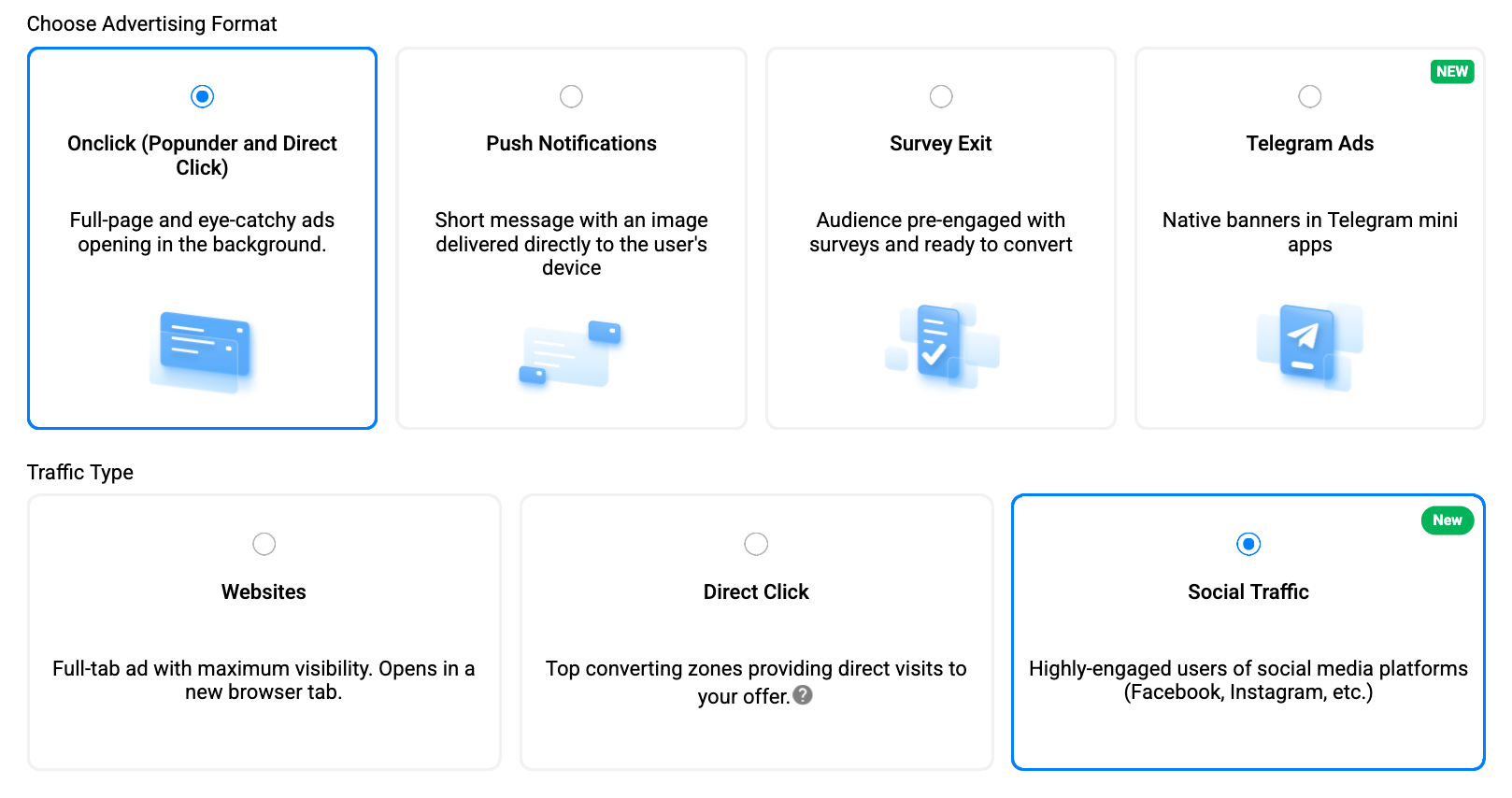
For many companies, paid campaigns serve as a testing environment. Marketers can quickly experiment with messaging, targeting, and creatives before investing in long-term content strategies.

Common Paid Traffic Pricing Models
Paid advertising platforms typically use several pricing models depending on campaign objectives.
| Pricing Model | How It Works | Typical Traffic Sources | Best Use Case |
|---|---|---|---|
| CPC (Cost per Click) | Advertisers pay for each click | Search ads, native ads | Capturing high-intent traffic |
| CPM (Cost per 1,000 impressions) | Payment is based on impressions | Display ads, pop traffic, push ads | Brand awareness and traffic scaling |
| CPA (Cost per Acquisition) | Advertisers pay only for conversions | Affiliate networks, performance campaigns | Lead generation and sales |
Each model supports different campaign goals. CPC campaigns are commonly used when targeting users actively searching for information or products, while CPM models are typically applied to high-volume traffic formats such as display, popunder, and push notifications.
Performance-focused campaigns often rely on CPA optimization, where advertisers track Conversion Rate (CR) and adjust bidding strategies to maintain profitable acquisition costs.
Advertising Cost — total amount spent on advertising and traffic acquisition.
Expert Insight
The relationship between SEO and paid traffic is often misunderstood. To clarify how these channels work together in practice, we asked our expert, Anna Avramova, Performance Team Lead at PropellerAds, to share her insights.
- Can paid traffic accelerate SEO growth?
If there were a single factor that reliably accelerated SEO growth, it would probably be the ultimate shortcut to search rankings.
In my experience over 15+ years, the hypothesis that paid traffic directly boosts SEO performance has never been consistently confirmed. Running ads alone does not improve organic rankings.
However, there are situations in which it may appear that paid traffic is influencing SEO. When marketers optimize landing pages for PPC – improving relevance, clarity of the offer, or user experience – those changes can also improve behavioral signals such as engagement and time on page. These adjustments may positively affect SEO performance, and organic traffic may grow alongside paid campaigns. But the relationship is indirect: buying ads does not automatically generate organic rankings.
- How do performance marketers typically combine these channels in practice?
In practice, performance teams often combine these channels in complementary ways. One common scenario is using organic traffic to seed retargeting audiences. A user may arrive through an informational or loosely related organic query, visit the site, and later be reached through display or social retargeting campaigns.
Strong organic visibility can also support market expansion. For example, SEO may generate baseline traffic in regions where paid campaigns have not yet been launched, helping validate demand before scaling PPC activity.
Ultimately, SEO and paid traffic tend to work best not as substitutes, but as parallel acquisition channels that reinforce each other within a broader growth strategy.
How Traffic Growth Works: A Simple Traffic Formula
Understanding the mechanics behind traffic acquisition helps marketers identify where growth opportunities actually lie.
At a basic level, website traffic is influenced by two primary factors: how often your content is shown to users and how many of those users decide to click.
This relationship can be simplified into the following formula:
CTR (Click-Through Rate) — the percentage of users who click after seeing the content.
Where:
| Variable | Meaning |
|---|---|
| Impressions | Number of times your content, ad, or search result is displayed to users |
| CTR (Click-Through Rate) | Percentage of users who click after seeing the content |
| Traffic | The resulting number of visitors reaching your website |
For example, if a page appears 50,000 times in search results and receives a 3% click-through rate, it will generate approximately 1,500 visits.
How Marketers Increase Traffic in Practice
Traffic growth usually happens by improving one of the two variables in the formula.
Increasing impressions typically involves:
- Publishing more content targeting additional keywords
- Improving search rankings to appear more frequently in results
- Expanding paid campaigns to reach larger audiences
Improving CTR, on the other hand, often requires optimizing how content appears to users.

Common tactics include:
- Writing stronger page titles and meta descriptions
- Improving ad creatives and visuals
- Targeting more relevant keywords and audiences
Example: How Small Improvements Can Increase Traffic
The relationship between impressions and click-through rate becomes clearer when we look at simplified scenarios. Even small improvements in either metric can significantly increase overall traffic.
| Scenario | Impressions | CTR | Resulting Traffic |
|---|---|---|---|
| Baseline performance | 50,000 | 2% | 1,000 visits |
| Higher visibility | 80,000 | 2% | 1,600 visits |
| Improved CTR | 50,000 | 4% | 2,000 visits |
| Both improvements combined | 80,000 | 4% | 3,200 visits |
Want Faster Results?
Organic traffic takes time to grow. Want instant results instead of waiting for SEO?
Check out our guide:
Anti-Patterns: How Marketers Burn Their Traffic Budget
Growing website traffic is not only about applying the right strategies. Many marketing budgets are lost because teams scale the wrong channels, ignore data signals, or focus on vanity metrics instead of meaningful performance indicators.
Below are several common mistakes that can quickly undermine traffic growth efforts.
Buying Low-Quality or Bot Traffic
Some traffic providers advertise extremely cheap traffic generated by automated bots or low-quality networks. While this traffic can temporarily inflate visitor numbers, it rarely produces meaningful engagement.
Typical symptoms include:
- Very high Bounce Rate
- Near-zero Conversion Rate
- Distorted analytics data
- Short session durations
In addition to wasting advertising budgets, artificial traffic can also make it harder to evaluate real campaign performance. Search engines may detect unnatural traffic patterns as well, which can negatively affect visibility and trust signals.

Ignoring Mobile User Experience
Mobile usability has become a critical factor in both search rankings and user engagement. Today, more than half of global web traffic comes from mobile devices, which means most visitors will interact with your site on smartphones.
If a website loads slowly or displays poorly on smaller screens, users tend to abandon the page quickly. This leads to:
- Higher Bounce Rate
- Shorter session duration
- Lower Conversion Rate (CVR)
Search engines also evaluate mobile usability as part of their ranking systems, meaning poor mobile performance can reduce organic visibility.
Keyword Stuffing and Over-Optimization
Earlier SEO practices often relied on repeating keywords as many times as possible within a page. Modern search algorithms, however, are designed to evaluate context, topical relevance, and natural language.
Overusing keywords or artificially inserting them into content can signal low-quality pages and harm user experience.
Instead of improving rankings, keyword stuffing may lead to:
- Reduced readability
- Weaker engagement metrics
- Lower search visibility over time
Scaling Traffic Before Validating Conversion
Another common mistake is increasing traffic volume before confirming that landing pages or funnels actually convert.
For example, advertisers may scale paid campaigns aggressively while the website still suffers from poor messaging, weak calls-to-action, or slow page performance.
In such cases, more traffic simply increases CAC without improving revenue.
Successful traffic strategies usually follow the opposite approach: first optimize conversion performance, then scale traffic sources that already show positive results.
FAQ
What is the best way to increase website traffic?
The most effective way to increase website traffic is to combine several channels. SEO improves your visibility in search results, while social media and paid advertising can bring visitors faster. Publishing useful, well-structured content helps attract users who are actively searching for information online.
How can I increase website traffic quickly?
If you need faster results, paid advertising and social media promotion are usually the most effective options. Paid campaigns can start generating traffic almost immediately, while social platforms help your content reach new audiences and drive additional visitors to your website.
How long does it take to increase organic website traffic?
Organic traffic growth typically takes time. In most cases, noticeable improvements from SEO appear within a few months, as search engines need time to crawl, index, and evaluate new content. Consistently publishing high-quality articles and optimizing pages can gradually increase your visibility and traffic.
What type of content attracts the most website traffic?
Content that answers common questions or solves specific problems often attracts the most traffic. How-to guides, tutorials, and practical industry insights tend to perform well because they provide clear value and match user search intent.
Can I increase website traffic without paying for ads?
Yes, it is possible to grow website traffic without paid advertising. Many websites rely on SEO, content marketing, and social distribution to attract visitors. While these methods take longer to deliver results, they can generate steady organic traffic and support long-term growth.
Final Thoughts
Increasing website traffic rarely comes from a single tactic. Sustainable growth usually results from combining several strategies, including strong content, technical SEO, community engagement, email retention, and targeted traffic acquisition.
While organic traffic takes time to build, it remains one of the most cost-efficient and scalable channels over the long term. Websites that consistently improve visibility, engagement, and conversion performance are far more likely to achieve stable and predictable traffic growth.
Come join us on Telegram for more insights and communications with fellow affiliates!
Disclaimer: Traffic results vary depending on market conditions, vertical, and audience targeting. Past performance does not guarantee future ROI. Advertising and traffic acquisition involve financial risk.