Telegram Ads Platform 2026: The Engineering Guide to Setup, CPM & Targeting

This post is also available in:
 PT
PT  ES
ES
Telegram Ads has quietly developed into a distinct advertising ecosystem that operates very differently from traditional social media platforms. While most ad networks rely on algorithmic targeting and user tracking, Telegram is built around deterministic placement: you decide where your ads appear by selecting channels, not by inferring audiences from behavioral data.
This structural difference makes Telegram particularly relevant for performance marketers, affiliates, and Web3 projects that need predictable traffic rather than algorithm-driven distribution.
Unlike cluttered feeds on other platforms, Telegram’s interface remains minimal, and ads appear as native elements inside channels. This creates a controlled environment where visibility depends less on competing creatives and more on how precisely you place your message.
Understanding the format is only part of the picture – the real value becomes clear when looking at how it performs within complete user acquisition flows.
TL;DR
- Telegram Ads runs on a CPM model, but pricing varies widely depending on GEO, channel competition, and audience demand
- Tier-1 traffic is more expensive, but often delivers stronger intent and conversion potential
- Telegram does not use behavioral tracking; performance depends on channel selection and contextual relevance
- Sponsored Messages are limited to 160 characters, so clarity and message–audience fit are critical
- Most campaign failures come from poor GEO structure, weak channel targeting, and underbidding CPM
- Telegram should be treated as an ecosystem (channels, bots, Mini Apps), not just a traffic source
- Strong campaigns rely on context alignment, not aggressive creatives or algorithmic optimization
Technical Prerequisites
Before launching campaigns, advertisers need to understand that Telegram Ads requires a specific technical setup tied to its blockchain infrastructure. Access to the platform is not entirely frictionless: account verification is typically handled through Fragment, Telegram’s official marketplace, where identities are validated, and usernames can be acquired via auction. This step is essential because it connects advertising activity to a verified entity within the Telegram ecosystem.
Campaign funding is also fundamentally different from traditional ad platforms. Instead of fiat-based billing, Telegram Ads operates on the TON blockchain, meaning advertisers must set up a compatible wallet and maintain a balance in Toncoin (TON).
Because the advertising system depends on this currency, budget planning is directly influenced by TON volatility. In practice, this introduces an additional layer of financial consideration that does not exist in fiat-only ad networks.
Once access is granted, campaigns can be managed either through a personal account or an organization-level structure. For teams and scaling operations, the latter is more practical, as it allows clearer budget allocation and operational control.

The Economics of Telegram Ads
Talking about Telegram Ads in terms of “cheap” or “expensive” is misleading. In reality, costs are highly uneven and depend on GEO, competition within specific channels, and audience demand.
From a media buying perspective, Telegram behaves like a supply-constrained environment: inventory is limited to public channels, and high-demand audiences quickly drive CPM up.
Below is a simplified benchmark based on aggregated campaign data:
| GEO | Telegram CPM Rates |
|---|---|
| Arabic-speaking countries | 1.5 TON (~€2.63–€3.00) |
| Kazakhstan | 0.2–0.7 TON (~€0.35–€1.40) |
| Brazil | 1.5 TON (~€2.63–€3.00) |
| Spain | 3–4 TON (~€5.25–€8.00) |
| English-speaking countries | 2–2.5 TON (~€3.50–€5.00) |
| France | 1.5–2 TON (~€2.63–€4.00) |
| Italy | 1.3–1.6 TON (~€2.28–€3.20) |
Based on aggregated Telegram Ads campaign data across multiple GEOs, reflecting average CPM ranges observed during Q1 2025.
Actual rates may vary depending on vertical, channel competition, audience targeting, and bidding strategy.
This distribution explains why Telegram Ads cannot be evaluated purely on CPM. Higher-cost traffic in Tier-1 GEOs may still deliver better results if conversion rates and user intent are stronger.
At the same time, lower CPM in Tier-3 regions does not automatically translate into profitability – additional filtering, localization, and funnel adjustments are often required.
An additional factor that cannot be ignored is the dependency on Toncoin. Since CPM bids are placed in TON, fluctuations in the token’s value can directly affect campaign costs. As a result, advertisers need to monitor both media performance and underlying currency dynamics when scaling campaigns.

What affects CPM
CPM in Telegram Ads is not random: it is driven by supply, demand, and audience concentration within specific channels. The table below outlines the key factors that influence pricing.
| Factor | What Happens | Impact on CPM |
|---|---|---|
| Channel Quality | High-engagement channels with active audiences attract more advertisers | Higher CPM due to competition for premium placements |
| Vertical Demand | Niches like iGaming and finance concentrate high budgets | CPM increases significantly in competitive verticals |
| GEO Tier | Tier-1 audiences have higher purchasing power and advertiser demand | Consistently higher CPM compared to Tier-2 and Tier-3 regions |
| Audience Saturation | Limited inventory in popular channels leads to repeated competition | CPM rises as more advertisers target the same audience |
| Bidding Strategy | Higher bids increase auction participation and impression share | Direct impact on CPM and traffic volume |
Expert insight
“When planning Telegram Ads budgets, the key mistake is underfunding the testing phase. Even for simple flows like subscriptions, you still need enough volume to see stable patterns. As a rule of thumb, take your minimum daily budget and run it for at least 7 days, otherwise you won’t understand how traffic behaves across different days.”
– Victoria Demskaya, Account Strategist at PropellerAds
What is the minimum budget for Telegram Ads?
The official minimum budget to launch Telegram Ads through a direct account is €2,000,000. However, businesses can bypass this high entry barrier by partnering with official Telegram advertising agencies, which allow you to launch campaigns with a minimum initial deposit ranging from €3,000 to €5,000.
Step-by-step Campaign Configuration and Ad Mechanics
Setting up Telegram Ads campaigns requires understanding how targeting and ad formats actually work under the hood. Unlike traditional ad platforms, Telegram operates with stricter creative rules and a more limited, but highly contextual targeting system.
Targeting Mechanics: User Interests vs. Channel Targeting
Telegram Ads targeting works differently from most performance marketing platforms. Instead of relying on detailed behavioral tracking, advertisers operate within a channel-based ecosystem, where audience intent is inferred from the content users actively consume.
There are two primary approaches:
Channel Targeting
This is the most precise and commonly used method.
Advertisers select specific public channels where ads will appear. In practice, this means targeting users based on real, observable interests, reflected in the content they follow.
For example:
- Financial channels → Users already interested in trading
- iGaming channels → High-intent iGaming audience
- Tech channels → Users interested in mobile software
Channel targeting is highly effective for intent-driven campaigns, but it also creates competition. High-quality channels with engaged audiences tend to become more expensive due to bidding pressure.
Interest-Based Targeting
Telegram also offers broader targeting based on general audience categories. However, this method is less precise, as it relies on aggregated signals rather than direct content consumption.
In real life, interest-based targeting is typically used:
- To expand reach during scaling
- To discover new audience segments
- During the testing phase of new verticals
Most experienced advertisers start with specific channels to validate performance, and only then expand using broader targeting once a working funnel is identified.
How does targeting work on the Telegram Ads Platform?
Telegram Ads targeting is strictly context-based and privacy-focused, meaning it targets channels, not individual users. Advertisers can target audiences based on user language, broad channel topics, or specifically selected public channels with over 1,000 subscribers, while excluding specific domains or competitors.
The “Sponsored Message” Format: Key Limitations
Telegram Ads uses a single native format – Sponsored Messages, which come with strict creative constraints.
Character Limit
Ad copy is limited to 160 characters, which forces advertisers to focus on the core value proposition.
This changes the creative approach:
- No long explanations
- No storytelling
- Only clear, direct messaging
No Clickbait Policy
Telegram enforces strict content rules that prohibit:
- Misleading claims
- Exaggerated promises
- Classic clickbait patterns
As a result, ad copy must rely on clarity, relevance, and contextual fit, rather than curiosity-driven hooks.
What are the strict moderation rules for Telegram ad texts?
Telegram Ads moderation strictly prohibits clickbait, misleading financial claims, gambling, unverified medical products, and adult content. Ads are limited to 160 characters and must use natural formatting without excessive emojis, imperative calls to action, or capitalization of entire words.

What This Means in Practice
Because of these constraints, Telegram Ads works differently from traditional display or native formats. There’s no space for long copy, aggressive hooks, or attention-grabbing tricks – everything depends on how well the message fits the environment where it appears.
This shifts the focus from “grabbing attention” to being immediately relevant. Sponsored Messages appear inside content that users already trust, so anything that feels out of place is quickly ignored.
As a result, effective creatives tend to be:
- Concise and focused on a clear value proposition
- Aligned with the content and expectations of the channel’s audience
- Consistent with the tone and style of the platform
Rather than interrupting the user, successful campaigns work by blending into the context and delivering a message that already makes sense to the audience.

How to Run Ads on Telegram: Effective Steps
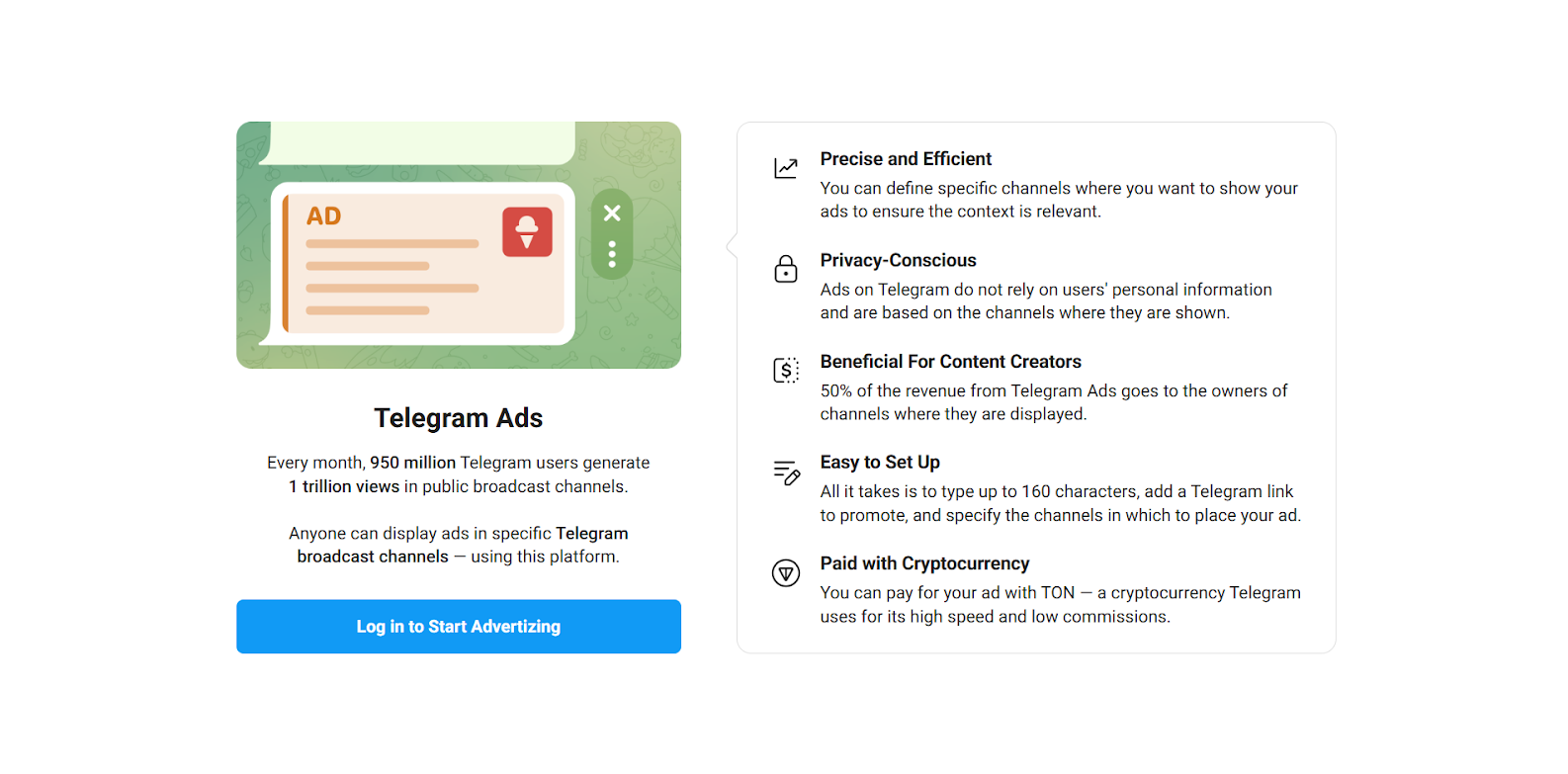
Setting up Telegram Ads requires a few technical steps, primarily related to account access and campaign structure.
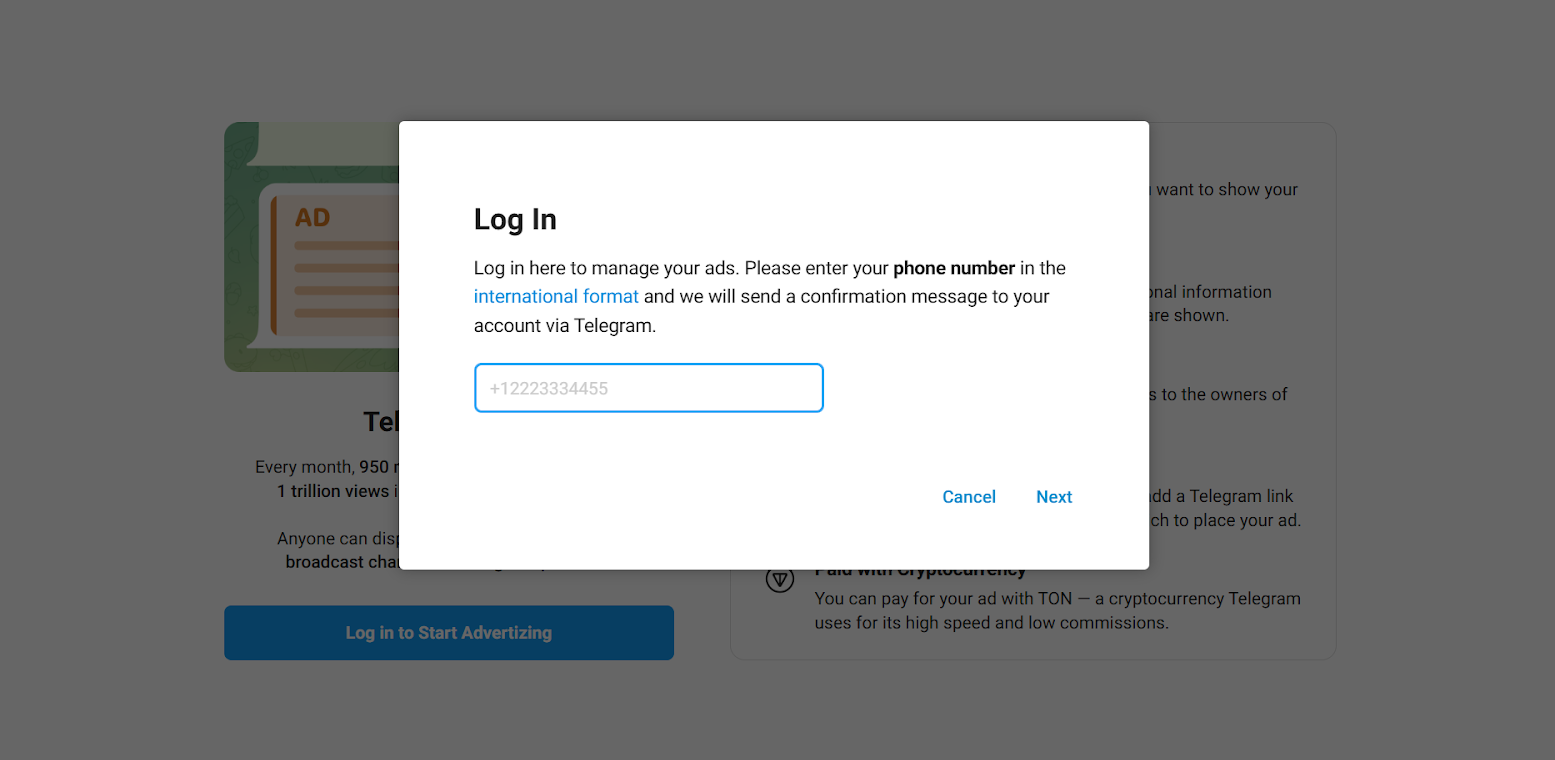
- First, advertisers need to access the official Telegram Ads platform and log in using the phone number linked to their Telegram account. Verification is completed directly within the platform, after which access to the advertising interface is granted.
- Once inside, the campaign must be created either under a personal account or an organization structure. The latter is typically used for team setups or when managing ads on behalf of channels or businesses, as it provides clearer control over budgets and permissions.

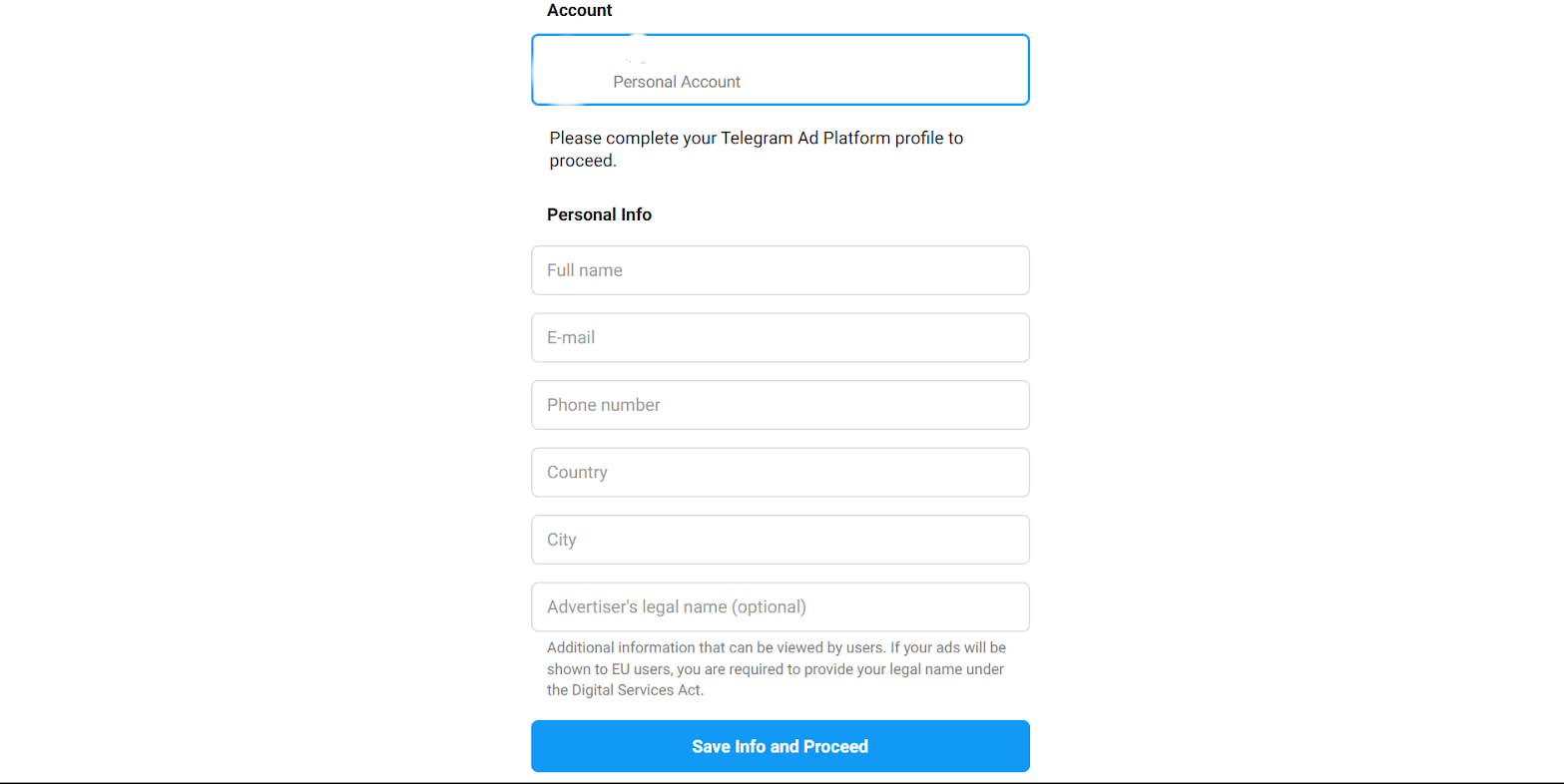
- Before launching campaigns, advertisers are required to complete basic account information. This step is part of Telegram’s verification process and is necessary to proceed with campaign creation.
- Ad setup itself is relatively straightforward: after clicking “Create a new ad,” advertisers define the core parameters, including the ad title, message text (limited to 160 characters), and the destination URL, which can lead to a channel, bot, or specific post.
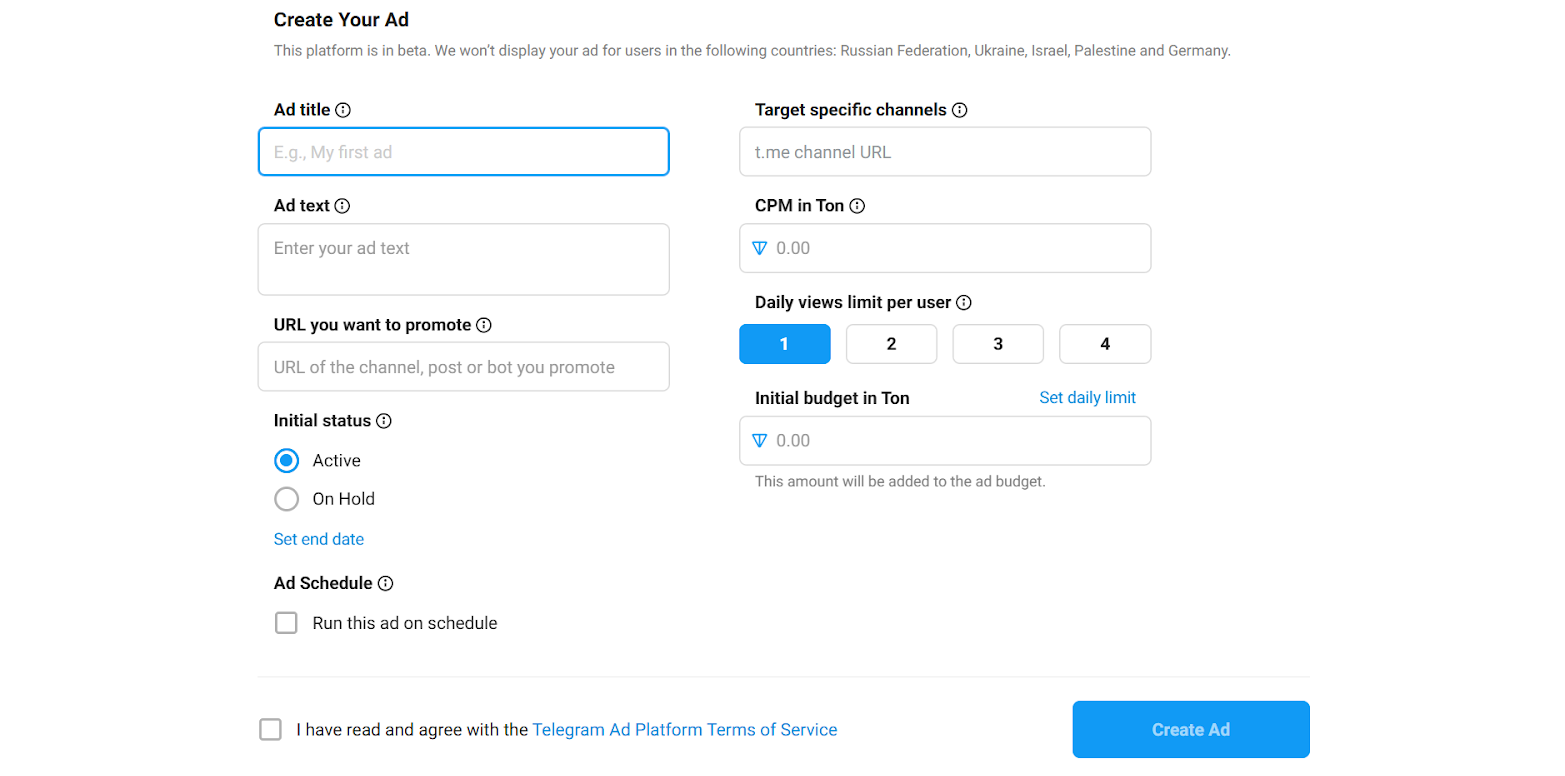
Telegram uses Cost-Per-Mille (CPM) pricing, so you pay for every 1,000 views your ad racks up. The minimum CPM for a sponsored message is 0.1 Toncoin ($0.5).
Anti-Patterns: How Campaigns Fail
Most inefficiencies in Telegram Ads do not come from the platform itself, but from incorrect assumptions carried over from other ad networks.
- Overly broad GEO targeting
A common issue is overly broad GEO targeting. Mixing Tier-1, Tier-2, and Tier-3 countries in a single campaign leads to uneven CPM distribution and fragmented performance data. As a result, it becomes difficult to identify which segments are actually driving results, making optimization unreliable.
- Wrong audience
Another frequent mistake is ignoring Telegram’s audience composition. The platform has a strong concentration of finance and Web3 users. Campaigns that don’t account for this, or rely on loosely relevant channels, often struggle with low engagement. Treating Telegram as a generic social platform usually leads to inefficient spending.
- Poor channel selection
Channel selection is another critical factor. Broad or random placements reduce control over traffic quality and make performance inconsistent. More structured approaches, such as targeting competitor channels or building whitelists, tend to deliver more stable CTR and conversion rates.
- Too low CPM
Bidding strategy also plays a key role. Setting CPM too low in competitive niches limits auction participation, resulting in low impression volume and insufficient data for optimization.
- Weak creatives
Finally, the text-only format of Sponsored Messages leaves no room to compensate for weak creatives. If the message is unclear or too generic, users simply ignore it, leading to low CTR and poor overall performance.

Policy and Ecosystem Context
Many of the issues described above are not just tactical mistakes – they stem from a misunderstanding of how Telegram Ads actually works as a platform.
Recent updates to Telegram’s advertising policies have introduced stricter requirements around advertiser verification and content compliance. These changes aim to improve transparency and reduce low-quality or misleading promotions, while preserving the platform’s core principle of user privacy.
Unlike major ad networks, Telegram does not rely on invasive tracking or behavioral profiling. There are no third-party cookies or algorithmic personalization layers. This makes the platform structurally simpler, but also shifts more responsibility onto advertisers, targeting precision comes from channel selection and contextual relevance, not from automated optimization.
This shift toward privacy also changes how targeting works in practice. Without access to granular user-level data, advertisers can no longer rely on algorithmic optimization to define their audience.
Academic research points to the same pattern. As Bleier & Eisenbeiss observe:
“Reduced access to user data shifts the burden of targeting from algorithms to advertiser strategy.”
In the context of Telegram Ads, this translates into a more manual approach: performance depends on how accurately advertisers select channels and align messaging with the surrounding content, rather than on automated targeting systems.
This is also why Telegram Ads should be considered within the broader platform ecosystem rather than as a standalone traffic source. User interaction is shaped not only by ads, but by channels, bots, and Mini Apps that define the overall experience.
Research supports this approach. As Lambrecht & Tucker note:
“Consumers respond more positively when ads are integrated into a broader platform experience.”
This reinforces the idea that campaign performance on Telegram often depends not just on the ad itself, but on how well it fits into the surrounding ecosystem.
For a deeper understanding of how in-app experiences complement ad traffic, see the Telegram Mini Apps guide.

FAQ: Telegram Ads in 2026
To wrap things up, here are the most common questions advertisers ask when evaluating Telegram Ads: from pricing to targeting and overall performance.
How much do Telegram Ads cost?
CPM varies significantly depending on GEO, channel competition, and audience demand. Tier-1 markets can reach $8–$15+, while Tier-3 regions may range from $2–$5. However, profitability depends more on conversion rate and EPC than on CPM alone.
Why are Telegram Ads expensive in some niches?
High-demand verticals like iGaming and finance concentrate budgets in a limited number of channels. This creates bidding pressure and increases CPM, especially in high-quality placements.
How does targeting work without user tracking?
Telegram Ads relies on channel-based targeting rather than behavioral data. Advertisers reach users based on the content they consume, making contextual relevance more important than algorithmic optimization.
Are Telegram Ads effective without personalization?
Yes – when the message matches the channel context. Research shows that ads aligned with surrounding content perform better than generic placements.
What is the biggest mistake in Telegram Ads campaigns?
Poor channel selection and mixing unrelated GEOs. These issues distort performance data and make optimization unreliable.
Conclusion
Telegram Ads in 2026 represent a fundamentally different approach to digital advertising. It replaces algorithmic targeting with direct placement, visual creatives with concise messaging, and opaque optimization with transparent CPM bidding. This makes it less forgiving for beginners, but significantly more predictable for experienced advertisers.
Success on the platform depends on three factors: selecting the right channels, managing CPM strategically, and understanding the broader Telegram ecosystem. When these elements are aligned, Telegram Ads becomes a scalable and efficient traffic source with relatively low competition and high audience engagement.
Disclaimer: CPM rates depend on TON value fluctuations. Crypto-related payments and assets may carry financial risks.
Come join us on Telegram for more insights and communications with fellow affiliates!
Trends
View more posts