Paid Traffic for iGaming: How Media & SEO Agencies Scale Clients Without Hitting a Ceiling

Promoting iGaming has never been a walk in the park. You have to find the right audience, build a converting funnel, keep costs in check, and constantly refresh creatives that burn out like there’s no tomorrow – all while staying compliant. Ah, yes, and stay ahead of the pack on top of that, because the competition is brutal.
Just look at the numbers: The global online iGaming market is moderately concentrated: the top five operators hold roughly 45% of market share, leaving over half of the market divided among hundreds of brands – all competing for the same players, the same GEOs, and the same traditional traffic sources.
No wonder so many iGaming brands choose to delegate the honorary mission of attracting new players to affiliates and marketing/SEO agencies.
Over the years, top iGaming marketing agencies, especially those working with the biggest brands, have built a complete promotion playbook that goes far beyond SEO and performance marketing.
Paid traffic has become a core part of the mix: it lets agencies scale clients fast, enter new GEOs on demand, and keep volumes flowing when organic growth alone simply can’t keep up with client KPIs.
And that’s where PropellerAds steps in: with years of expertise running iGaming campaigns and massive global traffic volumes at prices that won’t blow up your client’s media budget.
Read on to see how SEO agencies actually scale their clients with PropellerAds: what volumes they pull, how they structure the funnel, and where paid traffic plugs in at every stage.
Hop onto the traffic train!
Why Most Paid Traffic Sources Aren’t Built for iGaming: What to Look For Instead
So what does it actually take for an agency to scale an iGaming client through paid traffic?
Spoiler: it’s not about throwing more budget at the problem.
A handful of specific factors separate an “okay” traffic partner, the one that just gets you some traffic, from a real growth machine that keeps bringing in fresh audiences.
We talked to 4 agency clients who work with the Tier-1 markets about what they value most and what actually drives their choice of traffic source for iGaming campaigns. Here’s what came back.
Factor #1: Speed
Sure, iGaming brands run their business-as-usual campaigns to keep a steady stream of new leads coming in. But let’s be honest here, major sporting events are what really drive the industry.
And that’s where it gets intense. One morning, you’re launching pre-match awareness campaigns. By half-time, you’re rolling out last-chance “who’s going to win” creatives. By the final whistle – boom, the window has closed.
At this very moment, the line between organic and paid becomes obvious. Organic social and SEO are real long-term investments – they build the brand and the search authority any iGaming operator needs over months and years.
But when a championship match or a viral moment hits the timeline, organic growth can’t keep up. You can’t push an SEO page into Google’s top 5 the morning of a Champions League final (it’s hard to achieve even in a few months), and your organic following won’t grow tenfold in three hours.
That’s the gap paid traffic fills: you can buy the volume you need, from the GEO you need, fast and predictably. And on the platforms built for this kind of pressure, the speed runs even deeper – smart bidding handles real-time auctions, and AI-driven campaign draft tools (Say Hello to NIKO) let you spin up new creative angles in minutes instead of hours.
iGaming campaigns live or die by the speed at which you can drive traffic. You don’t have weeks, you don’t even have days – you have hours. In those hours, your campaign needs to pull every impression your bid can buy.
Fun fact: An SEO strategy everyone talks about
This year, at affiliate conferences, the same SEO play kept coming up: agencies buying a few hours of massive paid traffic to a single URL, hoping Google reads the sudden engagement spike as “viral content” and lifts the page in rankings. The SEO experts we polled are divided – some say they’ve seen it work in real campaigns, others have never heard of it, and a few are sure Google’s filters strip out the signal before it lands. Worth being aware of. Worth testing carefully before staking a client’s SEO budget on it.
At PropellerAds, we know speed is everything in iGaming, and we’re built to match it. Here’s how one of our agency partners drove millions of impressions in a single day:
Factor #2: Moderation
And, as you can guess, you don’t get that speed unless your traffic source can match it on both fronts: moderation and volume.
Let’s talk about moderation first. Even the biggest traffic source is useless if your campaign sits in review for two days while the window has already closed.
And remember the competitive picture from earlier: hundreds of operators chasing the same players in the same GEOs. During major events, the fight escalates. New users come online specifically because of the match or the trending moment, and that fresh, already-engaged audience is the prize every iGaming brand wants to reach first. Whoever clears moderation fastest gets to touch those users first, retarget them first, and convert them first. If your campaign is still “in review” while a competitor’s is already running, the prime audience is gone before you launch.
That’s why every agency should assess, realistically, how long it actually takes to get a campaign live. And the answer differs wildly from platform to platform.
Numbers above reflect average ad review times. Mainstream platforms also add a separate certification or pre-approval step, which can extend the path from “campaign ready” to “campaign live” from hours to weeks.
Now, you can probably guess where PropellerAds lands on the chart above. We’re among the fastest on the market: most iGaming campaigns clear moderation in 2–3 minutes.
But “fast” isn’t the whole story. Every campaign still passes proper safety and compliance checks, designed to protect end users, our partners’ brands, and the wider ecosystem we work in. We’ve simply built our review pipeline to deliver both without compromise on either.
Factor #3: Volume
Here’s another non-negotiable that every – and we mean every – agency we talked to named. They want as many impressions as their budget can buy. From every single GEO on their client’s list.
| Country | Impressions | CPM |
|---|---|---|
| United States | 5,966,119 | $2.80 |
| United Kingdom | 3,205,776 | $2.56 |
| France | 2,018,539 | $1.33 |
| Netherlands | 1,856,924 | $8.29 |
| Germany | 1,632,047 | $1.71 |
| Australia | 901,771 | $3.80 |
| Sweden | 511,081 | $4.14 |
Timeframe: 30/05 – 5/06
And it’s not hard to see why. When a major event drops across three different countries on the same weekend (World Cup, we are looking at you), you can’t afford a traffic source that runs out of inventory right when you need it most.
Limited volume means limited scale, and that in turn means one of two things: you miss the revenue your campaign was supposed to get, or worse, you lose the client to an agency that can actually deliver. Ouch!
This is the moment to look more closely at PropellerAds.
Julia Larionova, Head of Marketing at PropellerAds, adds:
“We serve billions of impressions every day across 195+ GEOs: Tier-1, Tier-2, and Tier-3 with stable volumes even in markets where most platforms quietly underdeliver. Whatever GEO is on your client’s roadmap, the traffic is already there, waiting to be unlocked. In a hypothetical situation where a specific traffic segment starts running short, PropellerAds specialists are ready to bring in additional partners or turn to trusted traffic providers to keep supplying the right audience and at the required pace, and ensure scaling doesn’t stop. We treat our clients as true partners and are ready to go the extra mile – and we have all the resources to do so – to keep our partnership mutually beneficial.”
And volume isn’t just about how many impressions you can get in an hour; it’s also about what Target URL you can use. In other words, where you can drive all this traffic.
Mainstream platforms force iGaming agencies to jump through hoops regarding the very structures iGaming funnels rely on. Meta requires written permission for affiliate or aggregator landing pages, even when no iGaming occurs on those pages. Google requires per-domain certification and explicitly rejects certifications for sites the advertiser doesn’t directly own, effectively killing the classic affiliate review setup. And Telegram links, while not formally banned, are disproportionately flagged on Meta due to historic abuse. To be clear, none of this means we wave iGaming campaigns through. PropellerAds runs full brand-safety and compliance checks on every campaign, just with AI-assisted moderation applying the same kind of standards you’d expect from any major platform.
So, when you have volume and the flexibility to target the URLs you need – that’s when you can hope for real results.
Factor #4: Tracking & Optimization
Even billions of impressions and thousands of leads mean little unless you can track every event in the funnel, and actually understand what’s working.
iGaming funnels are never single-event. Registration is just the start; the real money lies behind first-time deposits (FTDs) and second deposits.

To optimize for any of that, agencies need hybrid tracking – postbacks that fire not only on signup but on every downstream revenue event, so the optimization engine can learn what’s actually driving revenue, not just what’s getting clicks.
At PropellerAds, agencies get full S2S postback tracking on every event that matters: registration, FTD, second deposit, and custom milestones. Layer on CPA Goal, and PropellerAds’ algorithm starts learning what audience slices actually convert further down the funnel, not just the ones that look good at the top.
The result is straightforward: agencies stop scaling on assumptions and start scaling on proof and real-world data they collect.
If anyone has a clear view of what agencies actually need from a traffic source, it’s the people who hear it directly. Here’s Oleksandr Shovkun, Sales Team Lead in PropellerAds’ Account Management team, on what comes up most often in those conversations:
“From what I see, most iGaming agencies don’t want anything super exotic. They need massive global volume, including Tier-1 CPMs, so they can buy enough to get results. We currently average around $1.20 CPM in our Tier-1 iGaming GEOs. They need traffic that’s already proven on iGaming offers, not adapted from another vertical. They need social formats with a policy built around iGaming from day one, not platforms where compliance is a constant fight. And when an agency DM us in the morning, they want traffic by noon (or by a certain time), not next week. That combination is what keeps agencies scaling with us, not just running tests and moving on.”
Scaling an iGaming client through paid traffic really comes down to these five things working together: speed, moderation, volume, flexibility, and tracking.
The problem with most traffic sources is that they’re decent at one or two but noticeably weaker on the rest, which is fine for other verticals but pretty much fatal for iGaming.
Sporting events won’t wait for ad reviews to clear, Tier-3 GEOs need the same coverage as Tier-1, and you can’t optimize for FTDs if your tracking stops at registration. That’s why the agencies actually scaling iGaming tend to stick with partners that cover all five at once, and that’s the gap PropellerAds was created to close.

How to Use Paid Traffic at Every Stage of the Funnel
The 4 factors above explain why your traffic source choice matters at the strategic level. But the practical question that every iGaming client eventually asks the agency is simpler: how does paid traffic actually translate into leads and deposits, stage by stage of the funnel?
Below is how iGaming agencies structure paid traffic across the funnel, and how PropellerAds fits into each stage.
Top of the Funnel: Awareness
In iGaming, the awareness stage doesn’t look like a slow brand-building exercise. When you scale to a new GEO or promote a new offer or bonus before a major event, the goal is to flood the right audience with impressions quickly and build a top-of-funnel pool you can retarget later.
This is where PropellerAds becomes your work-horse.
Usually, agencies focused on iGaming use the following formula:
- Popunder for high-volume initial reach: cheap, fast to scale, and the easiest way to assess which audience segments can potentially bring leads.
- Telegram Ads to target audiences specifically interested in iGaming. Read our breakdown of Telegram traffic for iGaming.
- Social Traffic Type – popunder inventory pre-filtered to users who arrived from Facebook and Instagram (and other Social media platforms). You get the engagement profile of a social audience without having to fight Meta’s iGaming certification process.
- Push Notifications for repeat exposure on users who’ve shown interest before.
Tatiana Sochiva, Marketing Manager at PropellerAds:
“PropellerAds Popunder is our absolute go-to for iGaming: direct traffic to the site, massive volumes, and one of the lowest prices on the market. And if you need to go further, we have formats for every partner’s need, from broad reach to targeting the highest-converting audiences.”
Where you send that traffic depends on the specifics of the GEO and the brand. The four destinations that come up most often in agency setups:
- Direct to the brand’s homepage – the default in roughly 90% of campaigns Oleksandr sees, used when the creative-GEO combo is already proven.
- To an affiliate review portal that ranks the operator favorably. It’s a strong move because users still want third-party validation before clicking through.
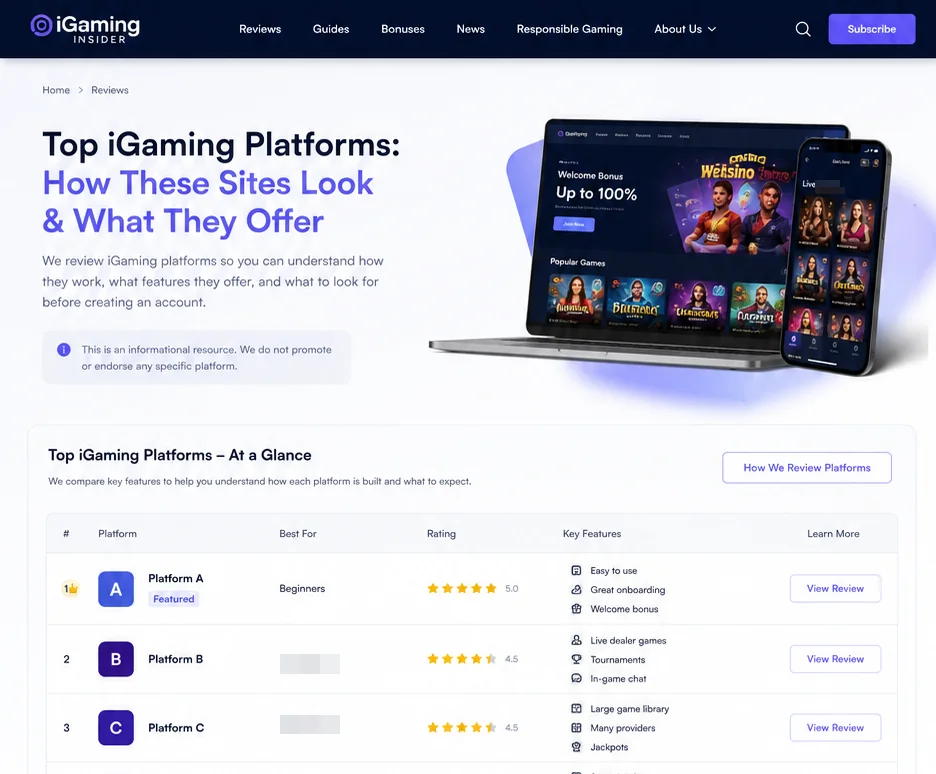
Here’s what a typical iGaming review site looks like – AI-generated, but you get the idea.
- To a pre-lander with a bonus or quiz that primes the user before the main site.
- To a Telegram community or channel, which acts as a wider top-of-funnel source – cheaper to fill, lower FTD rate per click, so make sure your retargeting setup is ready before scaling here.
Turning impressions into intent: Consideration
This is the stage most iGaming campaigns don’t use enough. Brands burn top-of-funnel budget grabbing impressions, and then don’t do anything about the people who clicked but didn’t register.
The mechanics are simple: you collect a custom audience from anyone who visited your review site, pre-lander, or landing page, exclude users who have already converted, and launch a separate retargeting campaign, typically with Push or In-page push (IPP), against that warm pool.
The same logic works the other way: anyone who clicked your push ad but didn’t follow through into the funnel gets re-touched with a different angle or bonus offer.
Alisa Opykhtina, Account Strategist at PropellerAds, shares her favorite move:
“Tactical move that consistently works in matchday campaigns: retarget registered but not yet topped-up audience specifically for last-chance re-engagement. Users who clicked your pre-match awareness ad without top up convert noticeably better when you re-push them with a “last hour” creative shortly before kick-off. This is the moment retargeting earns its budget.”
Optimizing for: Conversion
Once warm traffic is feeding into the conversion stage, it’s time to start optimizing your ad campaign.
If the client pays the agency on CPL, optimizing toward registrations is the obvious play. CPA Goal is built for this: set a target CPA, fire postbacks on the registration event, and smart optimization starts redistributing budget toward the audience slices that are hitting your target.
But for clients who are more about FTD economics (which are most of iGaming brands), you should be optimizing against the deposit event, not registration. Same CPA Goal model, but the postback fires on FTD instead of signup.
This is where multi-event tracking works best: if your algorithm only sees registration events, it will happily scale audience pockets that register cheaply but never deposit. With proper S2S postbacks on both registration and FTD, the algorithm learns what actually pays.
Rough conversion ranges to anchor expectations – these vary heavily by GEO, operator brand, and creative, but they’re the average numbers that we, at PropellerAds, usually see:
- Click → registration CR: ~6–10% on cold traffic, ~15–20%+ on warm retargeting
- Registration → FTD CR: ~20–25% depending on GEO and operator UX
- Click → FTD (full funnel): ~1–2% cold, ~2–5% on retargeted
Oleksandr shares:
“A more advanced approach is to structure buying in stages.
Start with a CPA Goal on registrations to collect data and build a whitelist of converting zones. Then double down only on zones that generate FTDs – by increasing CPA Goal bids or switching to more aggressive models like SmartCPM/CPM or SmartCPC/CPC with higher rates.
In short: first find where deposits happen, then scale those exact zones as hard as possible.”
Final: Re-engagement & LTV
We all know that acquisition is expensive (and getting more so) across all major traffic sources.
Long-term player value is where iGaming profit really is, especially if you work on a revenue share. The agencies that have scaled iGaming clients for years treat re-engagement as a separate funnel stage. And they are right.
Three things to set up on PropellerAds for this stage:
- Build LTV audiences from your own postback data. Everyone with an FTD goes into a “depositor” segment. Everyone with a second or third deposit is placed in a “high-value” segment. These are the audiences worth re-engaging when the brand drops a new bonus, a new sport, or a new product line.
- Exclude already-converted users from your acquisition campaigns. Sounds obvious, but a surprising number of agencies don’t bother, and they keep paying for impressions on players who are already in the operator’s CRM. Push your converted-user audience into PropellerAds as an exclusion list, and every top-of-funnel dollar starts going to genuinely new users.
- Launch new products on existing depositors first. The cheapest conversion in iGaming is the player who already trusts the brand. When your operator client releases a new sportsbook expansion or new eSports, for example, run a separate campaign targeting your “depositor” audience exclusively with the new-product creative.
Talking about scaling, if you really want your funnel to deliver leads and deposits, make sure the 4 stages of your funnel are connected:
- The traffic you pay for in awareness becomes the audience you retarget.
- The depositors you track in conversion become the segment you can reach out to when there’s a new bonus or product.
- The postbacks from registrations and FTDs continue to improve optimization for the next round of campaigns.
In other words, treat the funnel as a single connected system rather than 4 independent campaigns.
So, What Actually Works
The agencies that scale iGaming aren’t doing anything magical. They figured out two things early. First, you need a solid funnel where every stage connects and feeds the next. Second, you need the right mix of channels feeding that funnel, and paid traffic alone isn’t it.
Real growth in iGaming today comes from the combo: free traffic (SEO and social), PR for credibility and link velocity, and paid traffic to scale the parts of the funnel that need volume. Each piece covers what the others can’t.
And the same is true one level deeper: inside paid traffic itself. The five factors we talked about earlier (speed, moderation, volume, flexibility, and tracking) only work when they show up together.
Here’s what we mean. If moderation is fast but volume is low, you’ll win the matchday and lose the month. If volume is high but your postbacks stop at registration, you’ll scale audiences who sign up but never deposit, and you won’t know why.
If your retargeting is sharp but no one built an audience pool in awareness, there’s nobody to retarget. As we discussed, none of these stages works on its own.
Recognize this issue?
Maybe you need PropellerAds.
Moderation in minutes, not days, which sounds boring until you’re trying to push an urgent campaign live an hour before the game starts, and your previous network is still “in review.”
Volume that doesn’t quietly thin out the moment you leave Tier-1 or India. And postbacks on every event that actually matters: signup, FTD, second deposit, so the algorithm learns from players who deposit, not from clicks that just looked good in a dashboard.
If you’re working with an iGaming client right now and want to see whether this fits, pick one GEO, set up the postbacks with us, and run a small test. Two weeks later, both sides will know if it works for you. Let’s test?
Join our Telegram for more insights and share your ideas with fellow affiliates!