Why the Same User Converts Differently Across Traffic Sources?
Same Offer, Different Results – Why?
Every media buyer has experienced this at least once. You launch the same offer with the same landing page and in the same GEO, but performance differs significantly depending on the traffic source. In some cases, conversion rate can vary 2–3x, even though nothing in the funnel has changed.
If traffic is just users, why do those users behave differently?
The short answer is that traffic is never JUST traffic. It is users in a specific psychological state that is shaped by the environment they come from. When we ignore this, we treat all clicks as identical (and that is exactly where performance gaps begin!).
Wait, wait, wait… Before you think we’re trying to pull you into psychological mind games, let’s break it down together.
Conversion Is Context: Attention, Cognitive Load & User State
Let’s simplify it. Search traffic usually reflects intent. The user is actively looking for something and evaluating options. Social traffic is passive; users are consuming content, not necessarily looking to solve a problem. Push traffic triggers a reactive response, whereas pop traffic appears when users are focused on accessing content quickly.
The same user behaves differently in each scenario.
That shift affects patience, trust, comparison behavior, and willingness to complete a form or make a deposit. In performance terms, we can summarize it like this:
Conversion = Offer × Context Fit.
Elementary, my dear Watson!
When the offer aligns with the user’s mental state, conversion increases. When it clashes with that state, friction appears.
If we zoom out for a moment, this shift in behavior is not just a marketing theory. Short-form platforms like TikTok, Instagram Reels, and YouTube Shorts have trained users to process information quickly and move on just as fast.
Back in 2024, research conducted by DataReportal highlighted that the average internet user spends over 2 hours a day on social media, often jumping between several content streams in one session. In this setting, attention resets all the time, making the context where an ad appears very important. Henceforth, the platform doesn’t just bring traffic, but also influences the mindset when the message is received.
In a world where attention resets every few seconds, the environment in which your ad appears becomes critical. Context is no longer a supporting factor; it is the condition under which conversion either survives or collapses.
Three Types of Attention
To make this practical, we can divide online attention patterns into three broad categories. These patterns exist across the web but become particularly visible in paid traffic environments.:
- Active attention (Search) – the user is focused and goal-oriented.
- Passive attention (Social feeds) – the user is consuming content with no immediate intent.
- Reactive attention (Push and Pop) – the user is responding to an interruption or a trigger.
Or if we are to break this down further:
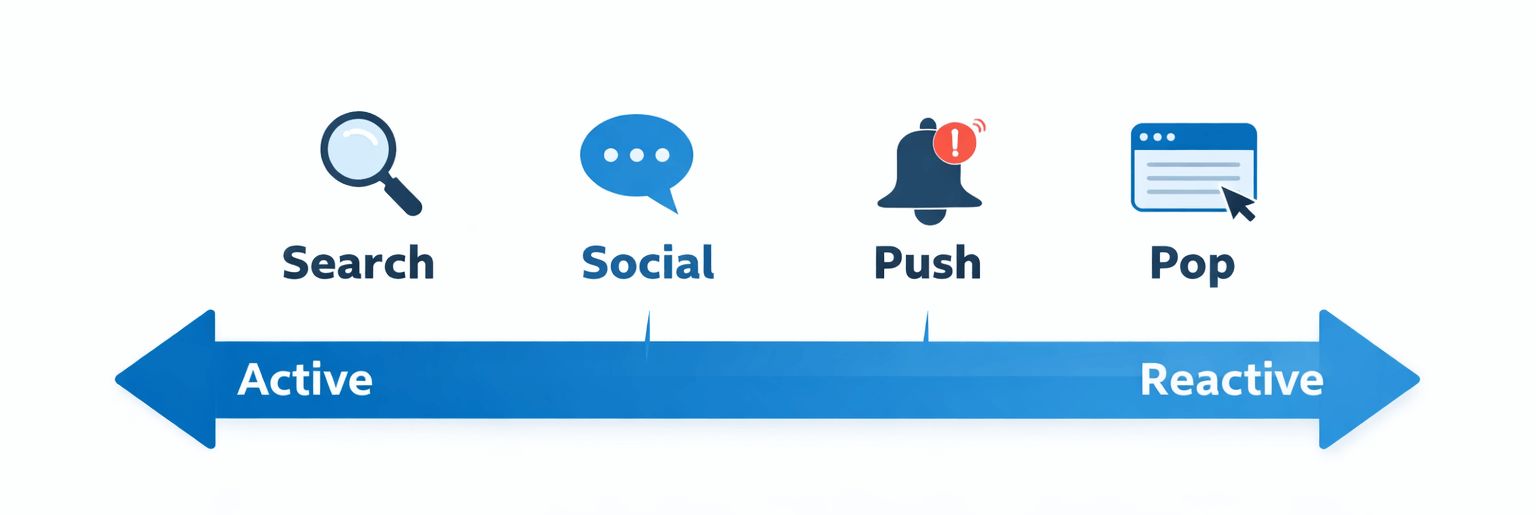
Close attention does not automatically mean better ROI. In fact, search users often have higher skepticism and compare multiple offers before converting. At the same time, reactive traffic is not “low quality” by default – it simply requires shorter funnels and clearer value propositions.
The mistake many advertisers make is applying one funnel logic to every source. The same pre-lander and long explanation page may work on search, but underperform on push.
That does not necessarily mean that push traffic is low-quality. What it most likely means is that the structure does not match the user’s current state.

How Traffic Sources Shape User Behavior
Given the above-mentioned, let’s just face it already…
Traffic sources don’t just bring users. They bring users in very different states of mind. This means that the more mentally overloaded a user is, the harder it becomes to convert them.
This is where the idea of an “Ad Resistance Threshold” becomes relevant highlighting that every environment has a baseline resistance to advertising.
Social Traffic
Social feeds are crowded and noisy. Imagine yourself scrolling through Instagram or TikTok on your way home… Every few seconds, you see a new video or a meme that makes your brain move quickly and forces you to decide almost instantly whether something is worth your attention. In this environment, ads compete with dozens of other stimuli!
Over time, users learn to filter them out automatically – a phenomenon often referred to as banner blindness. Kara Pernice’s research shows that ignoring advertising-like elements is largely a learned behavior. Now you know why!

Search Traffic
Search traffic creates a completely different situation where the user already has a goal. You might be searching for something like “best VPN for streaming” or “online iGaming bonus comparison.” Instead of scrolling passively, you begin evaluating options: opening several tabs, reading reviews, comparing prices, checking credibility signals, etc.
This comparison mindset naturally increases skepticism and slows down the decision process, which is why search traffic often requires clearer value propositions and more detailed landing pages.
Push traffic
Push traffic, by contrast, interrupts the user’s flow instead of responding to an explicit query. Imagine yourself reading the news or watching a video when a push notification appears: “Limited-time bonus available today.”
At that moment, you are not comparing five alternatives. You are reacting to a single stimulus. Decisions tend to be quicker and more instinctive, which shortens the path to the first click (but also means the message needs to be simple and straightforward).
We can visualize everything we mentioned above like this:
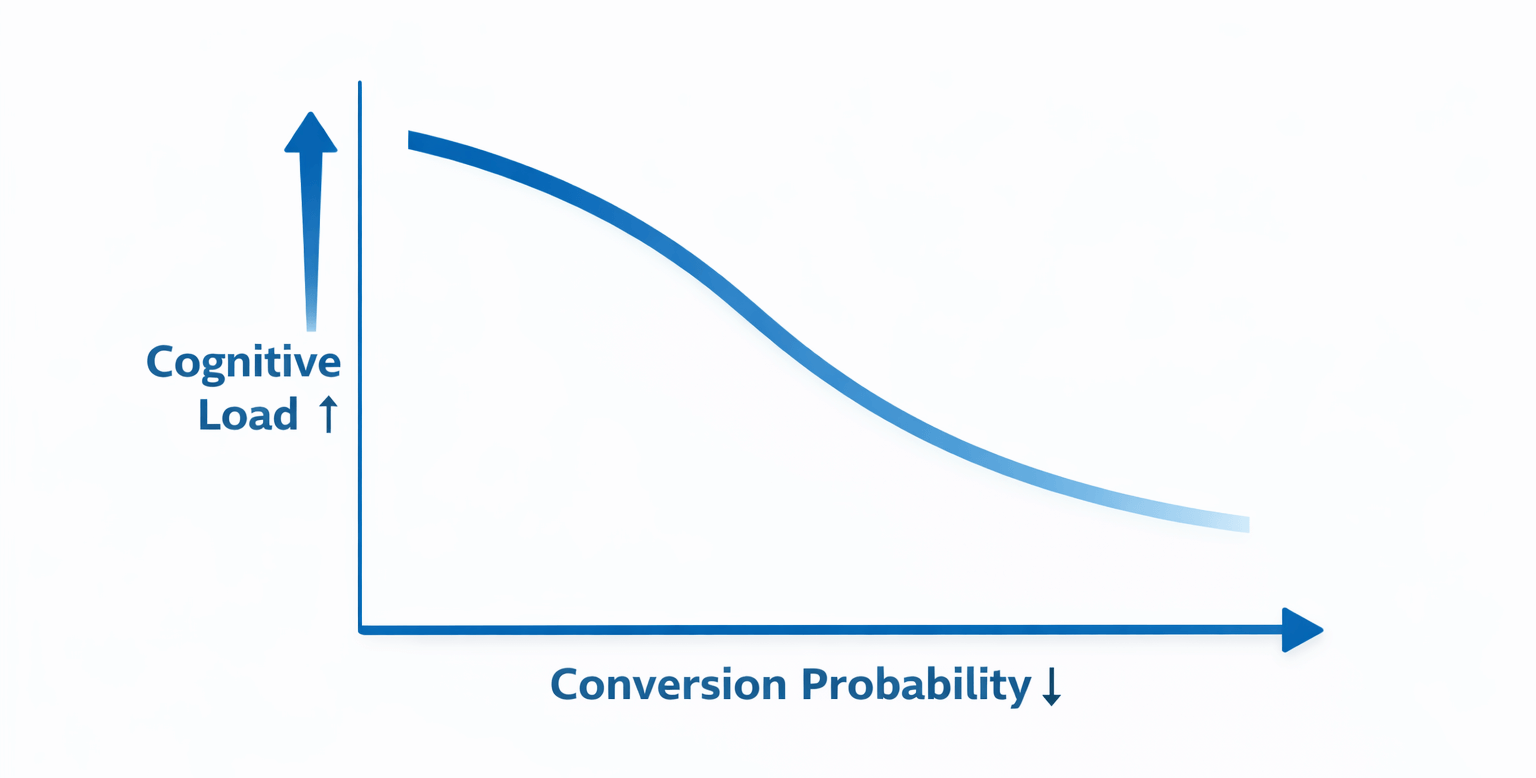
As cognitive load increases, so does resistance, which is precisely why underperformance is so often misdiagnosed as “bad traffic” (when the real issue lies in structural misalignment).
In many cases, the problem is not the quality of users but the mismatch between format and context: a long, complex funnel placed into a reactive environment will inevitably create friction, just as a vague, curiosity-driven angle will falter in a setting where users expect clarity and comparison.
Verdict: Performance drops rarely mean the traffic is bad – it usually means the format and the environment are out of sync.
Why Single-Source Strategies Break (and What Diversification Fixes)
If traffic behaves differently depending on context, what happens when you rely on only one source? Short answer: You increase fragility.
Remember that old saying our math teachers used to tell us — never put all your eggs in one basket?
Single-source strategies are exposed to auction inflation, policy changes, algorithm updates, and audience saturation. The more optimized a campaign becomes on one platform, the more dependent it becomes on that platform’s internal mechanics.
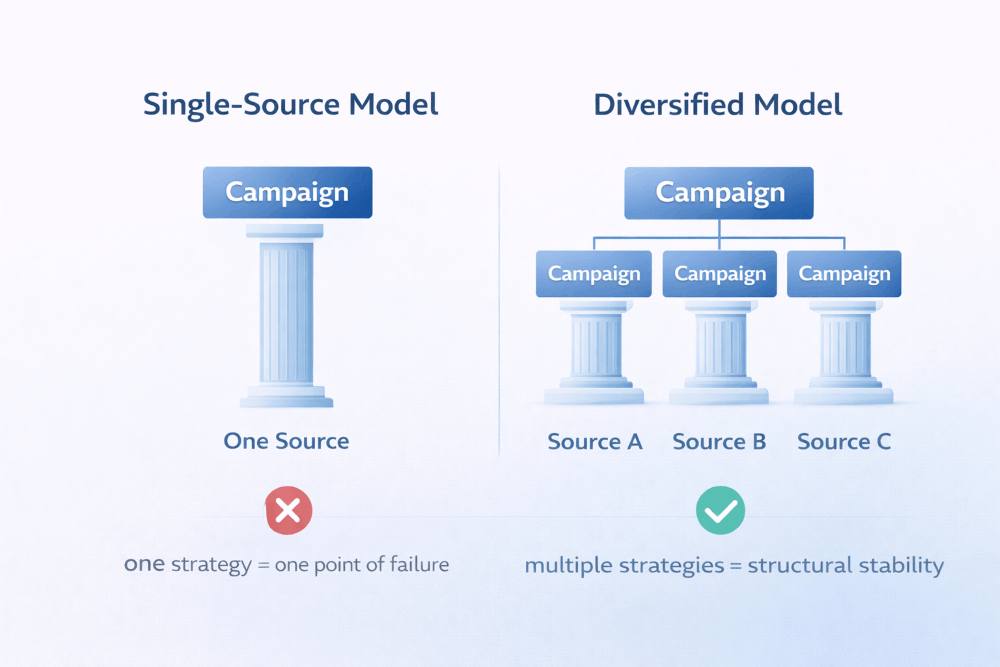
When CPMs rise, or policies shift, margins shrink quickly. If the whole budget is concentrated in one environment, there is no structural buffer.
Diversification is not only about risk management. It is also about performance structure. Different sources capture users in different mental states. When combined strategically, they can stabilize blended CPA and increase total volume without overexposing one channel.
Instead of relying on a single pillar, diversification creates multiple support points for the same acquisition strategy. It’s always better to be safe than sorry, right?
Practical Framework: How to Diversify Without Killing ROI
Diversification does not mean launching randomly on every available network. It’s just like a business plan, and it requires structure.
Step 1: Audit your spending
What percentage of your total budget is allocated to one source? If the majority of your acquisition depends on one channel, you are structurally exposed.
Step 2: Identify attention mismatch
Is your funnel aligned with the user state of your current source? If you are running long, complex funnels on reactive traffic, adjustments may be needed. If you are running aggressive, short funnels on high-skeptic search traffic, expectations may (and probably will) need to be changed.
Step 3: Add a complementary source
If you are heavily invested in social traffic, consider testing push or pop to capture users in a different attention mode. If you rely primarily on search, test reactive formats for faster volume expansion.
Step 4: Track blended metrics
Do not evaluate sources only by the isolated conversion rate. Look at blended CPA, overall ROI, and stability over time. A lower-CR source can still improve total profitability if it scales more efficiently or reduces volatility.
Don’t Buy Clicks, Start Buying Context
Traffic isn’t homogeneous. Every source shapes a different mindset, sets a different level of resistance, and produces its own conversion pattern. Once you account for that, performance stops feeling random and starts looking structural.
Strong media buyers don’t just tweak bids or refresh creatives…They think about the moment of exposure. They don’t ask, “How do I push CR higher?” in isolation. They ask whether the offer actually fits the user state that the channel creates.
That shift changes budget decisions. It reframes diversification from a backup plan into a deliberate performance move. When sources are combined intentionally, they don’t just spread risk – they build a more stable, scalable acquisition system.
If you’re looking to structure that system more deliberately, diversified traffic strategies with PropellerAds are a practical place to start.

Interview with Anna Avramova, Performance Team Lead at Propeller
Anyone who has tested the same offer across multiple traffic sources knows that the results rarely look the same. Conversion rates shift, sometimes slightly, sometimes enough to change the whole strategy. Stability behaves differently, too. Some channels settle quickly, while others fluctuate as auctions heat up or algorithms adjust.
So we asked Anna Avramova, Performance Team Lead at PropellerAds, to share what this looks like in real campaigns.
Performance: When running the same offer across multiple sources, how much does CR usually vary?
It is impossible to give a universal percentage or range in response to this question.
On a new source, the conversion rate can turn out to be either significantly higher or significantly lower compared to an already established channel. Sometimes we successfully reach a fresh audience that has never interacted with the offer before – and in those cases, CR may be unexpectedly high at the start.
In other situations, conversion may initially be lower because the algorithms need time to learn and the audience needs time to “warm up.” Creatives that perform well on one source may simply not be as effective on another. This is not the fault of the source – it reflects its specific characteristics.
It’s also important to understand that even within the same traffic source, CR can fluctuate substantially depending on seasonality, competition, frequency, and auction changes.
There are no fixed constants here – only accumulated empirical experience tied to a specific offer, audience, and traffic source.
Performance: Which source stabilizes fastest?
The source that stabilizes fastest is the one that receives a sufficient volume of high-quality data for algorithmic learning.
Accurate tracking and timely transmission of conversion signals to the platform play a crucial role. If the algorithm receives real performance signals, it can more quickly identify effective audience segments and optimize delivery.
It is equally important to set the targeting range correctly. A reach that is too broad can lead to inefficient budget spending and “signal dilution.” Whereas a range that is too narrow will limit the volume of data and slow down the learning process.
Therefore, stabilization is not so much about choosing the “right” source, but about being prepared to give the campaign enough time, budget, and proper calibration at launch. These principles apply equally across platforms.
Performance: Where do you observe the highest volatility?
For example, with broad targeting and CPM buying, traffic volume may remain stable, but its quality – and therefore conversion – can fluctuate significantly. In this case, the algorithm is not directly optimizing for the target action, which makes performance less predictable.
Higher volatility is also typical for new campaigns in the learning phase, during overheated auction periods, and in campaigns based on experimental inventory.
In other words, volatility is a result of the chosen buying strategy and the campaign’s lifecycle stage – not an inherent property of any specific platform.
For example, users acquired through search advertising often demonstrate higher retention. These users already had formed demand and were actively looking for a way to satisfy it.
At the same time, traffic from reach-based social campaigns or push formats may show lower LTV (Lifetime Value).
However, LTV is largely determined by the user experience after the first conversion. You can launch a perfectly optimized campaign and generate inexpensive conversions, but if the product does not meet expectations or the service operates inconsistently, users will not stay with the brand – regardless of where they came from.
User Quality: Which channel brings more “impulse” users?
Impulse-driven behavior is more common in channels dominated by display formats – social networks, push notifications, popunder and popup placements, as well as broad programmatic inventory.
In these environments, advertising “catches up” with the user and interrupts their current content consumption scenario. The decision to click or convert is often spontaneous, without a pre-formed demand.
However, impulsiveness is not necessarily a disadvantage. In certain verticals, it provides fast volume and allows efficient scaling, provided that the product and follow-up communication are structured correctly.

Scaling: Have you experienced sharp performance drops due to reliance on a single source?
Yes, I have encountered such cases before. Even when a source is stable for a long period, over time, audience saturation, increased auction competition, algorithm changes, or platform policy updates can lead to serious performance declines within just a few days.
That is why it is advisable to build a portfolio of advertising channels in advance, gradually testing and scaling alternative sources. This is safer than searching for a replacement once the performance graph has already started to fall.

Scaling: What changed after diversification?
When multiple traffic sources are involved, it is no longer enough to simply monitor total conversions. It becomes necessary to segment data more thoroughly: to track each channel’s contribution, understand where performance has stabilized and where testing is still ongoing, and correctly account for audience overlap.
In such cases, a more advanced analytical approach may be required – including Bayesian models or marketing mix modeling, if data volumes allow.
Over time, it often becomes clear that the best results come not from a single “hero channel,” but from a combination of sources that reinforce each other.
Diversification is not only about reducing risk but also about building a sustainable growth system.
Budget: If you had to allocate the advertising budget today, how would you divide it?
I follow a three-component model:
At the same time, it is important to monitor performance regularly and remain ready to reallocate funds – strengthening channels that gain momentum and reducing exposure where efficiency begins to decline.
Planning a budget is important.
But strong performance begins where planning is combined with flexibility and a willingness to adjust decisions based on data.
Join our Telegram for more insights and share your ideas with fellow-affiliates!