Live Commerce Playbooks That Work on Douyin, TikTok Shop & Shopee Live
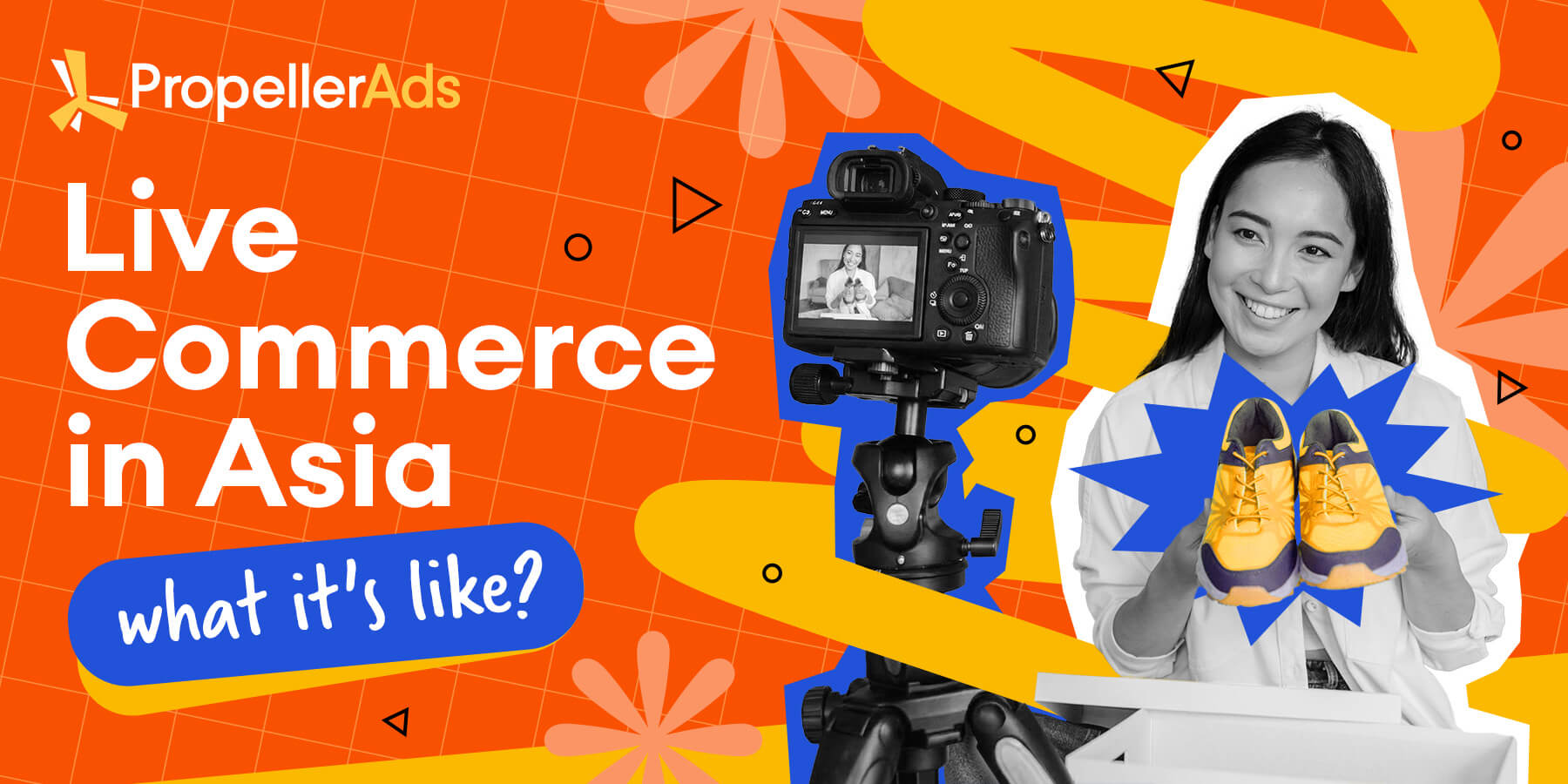
The ‘home shopping’ brings a pretty dated mental image, right? A static camera, a too-enthusiastic host, and a 20-minute monologue about some weird frying pan. Kinda relic of a pre-internet era, duh.
Meanwhile, Live Commerce in Asia doesn’t think so. The same TV shopping model, reimagined for today’s biggest apps, now attracts billions of users and brings millions in revenue.
In this post, we’ll explain what Live Commerce is, why it has conquered Asia but struggles in the West, and how to solve its flaws with the help of PropellerAds.
What is Live Commerce, And What’s So Good About It?
In a nutshell, this is a live stream, where a host demonstrates, reviews, and sells a product in real time. Looks exactly like the good old home shopping, but with a huge difference, which is seamless integration.
Here is how it happens in general (we’ll take a look at some details a bit further):
- A host demonstrates a product during a live stream
- The product cards are embedded directly into the interface
- A user clicks the button in the same frame and completes the purchase without even leaving the stream
Just an example of how it looks in Doyuin:
So, the main advantage of live commerce is its minimal friction. In traditional e-commerce, users often drop off after navigating multiple steps and redirects before completing a purchase. Live commerce works differently: even without initial purchase intent, it can create demand in real time and convert it instantly.
Just a couple of stats to support this take:
- Traditional affiliate campaigns typically convert at around 1–3%
- Live commerce can reach conversion rates of up to 30%
This means that live commerce can be up to 10 times more efficient than traditional marketing.
There are two major types of live commerce, based on the platform’s core function.
Content-driven live commerce
The point of this model is that a stream is hosted on a social or entertainment platform – like TikTok or Douyin – with integrated e-commerce as an additional feature. So, a user comes across the stream thanks to algorithms – yes, just by scrolling through the feed – gets interested, interacts (clicks, comments, or adds a product to the cart), and ends up with an impulse purchase.
The friction is minimal: the product featured in the stream is sold directly within the platform.
Algorithm-driven discovery → Engagement → Click → Instant Checkout → Purchase
According to the Qingdao Menaul School research, this model enables purchases to happen without prior intent, so it creates a demand – even when a user didn’t mean to buy anything when they opened their Douyin app.
E-commerce-driven live commerce
Here, it works the other way around: a user comes to an e-commerce platform – like Shopee – with purchase intent. A stream within the platform helps them choose a product and boost their confidence in their selection, leading to higher conversion rates.
The rest of the funnel is similar: the purchase also occurs on the same platform, without needing to switch to another site.
Intent → Engagement → Click → Instant Checkout → Purchase
What are the Live Commerce Giants?
When people talk about live commerce in Asia, it’s usually all about Douyin and Taobao. Fair enough, they do dominate the space.
But they are not the only important players – there are many more content- and ecommerce-driven platforms that generate views and sales.
Beyond the big names, there are also a few interesting side players.
For example, Xiaohongshu (RED), a lifestyle and social commerce platform, is developing live shopping. It’s smaller than Douyin, but very strong in categories like beauty, fashion, and premium products. Pinduoduo, a group buying marketplace, also experiments with livestream selling.

Why Live Commerce Booms in Asia but Lags in the West?
Live commerce is already the norm across Asia. Meanwhile, in Europe and the US, it still hasn’t taken off in the same way. An obvious question: wait, did something like Amazon just fail to build a proper live commerce experience?
Not really.
Speaking about Amazon again, it didn’t fail – it has Amazon Live. Also, Instagram introduced live shopping, but quietly shut it down in 2023, though: the format failed to gain traction. There are similar features on platforms like VK, YouTube, and others: the same mechanics, the same features, everything’s in place… but then you look at the numbers.
And the numbers say the following:
- In China, live commerce has grown into a ~$700 billion market, while in the US it’s still sitting at around $17 billion.
- Taobao Live drives tens of billions in sales every year, with some streams making over $1 billion in a single session. Amazon Live, on the other hand, doesn’t even share comparable numbers.
- Douyin generates around $480B+ in GMV (Gross Merchandise Value, the total value of all goods sold through a platform within a certain timeframe). TikTok is still far behind: its entire TikTok Shop GMV is around $60–66 billion globally.
So what’s going on? Why does live commerce feel completely natural in Asia, while Western markets are still stuck with classic influencer ads and traditional marketplaces?
There are three main reasons for that.
The role of KOLs (Key Opinion Leaders)
KOLs are Key Opinion Leaders – and they are not quite the same as Western influencers. What’s the difference? Let’s take a simple example:
- Kylie Jenner is a classic influencer. She shows her lifestyle on her social media, natively shares various products, and promotes her own brand. However, she doesn’t persuade you to purchase any bag or lipstick right away, but builds trust gradually.
- Li Jiaqi (李佳琦), aka Lipstick King, is a KOL. His format is completely different: he tests beauty products during a live stream, and actively drives viewers to purchase in real time. Just a couple of facts: in 2018, he held the Guinness World Record for most lipstick applications within 30 seconds, and in 2021, he generated $1,7 billion in sales during a single 12-hour stream. So it’s a different kind of influencing, right?
While influencers do a nice job for brand awareness, KOLs are about immediate, almost direct sales in real time. Their content heavily helps users make a final decision and pick the best product from the tons of choices.
In the traditional sense, a KOL is someone with deep expertise in the products they sell – and this is often the case. For example, Li Jiaqi is a former L’Oréal beauty consultant. However, as the research shows, expertise plays just a partial role in building trust between a KOL and their audience. Interactivity, attractiveness, and emotional connection often decide much more when making purchase decisions.
Western users don’t have such a habit of trusting streamers as much as Asians trust KOLs – and this is one of the big reasons why Taobao Live is more successful than Amazon Live.
Fun fact: Pretty naturally, AI hosts have become the next big trend. But research shows they still can’t match human streamers. The main problem appears when something goes wrong – for example, if a product isn’t what people expected or something doesn’t work as promised. Unlike real people, AI can’t properly explain or fix the situation, so users lose trust and leave. Even L’Oréal and Philips have experimented with AI streamers, but later returned to human hosts.
Highly-Structured Ecosystem
While European influencers mainly improvise or follow simple scripts from brands, there is a whole system behind each Asian KOL called MCN (Multi-Channel Network). In simple words, it’s like an agency that does most of the work in the background:
- finds and trains KOLs
- signs contracts with brands
- chooses the items to sell
- analyzes statistics
Each stream is not just a fun improvisation: it’s built around a strict script following so-called SOPs – standardized operating procedures. The SOPs consider every little detail that may affect sales; for example, research shows that even the number of products presented in a stream can impact GMV and audience growth.
Fun fact: SOPs need to stay compliant as the platforms have pretty harsh rules. A good example is Zheng Xiang Xiang, who went viral by selling huge volumes of ultra-cheap products. Her manner was pretty…let’s call it unusual: she just showed items one after another, like just for a second, with barely any explanation. Douyin stepped in and introduced a rule: streamers must clearly present and explain products.
In contrast, live commerce in the US and Europe is still largely creator-driven and less systematized, which makes performance less predictable.
User behavior
Research on platforms like Douyin shows that the live commerce system in Asia has developed a distinct user purchasing behavior. Unlike Western consumers, Asian live commerce viewers rely heavily on trusted streamers when making purchase decisions – and this is the final piece of the puzzle explaining why live commerce works so well in Asia.

As one of our respondents shared,
‘Sometimes when I see something really appealing on my feed – food, everyday items (like laundry detergent), beauty products, or stylish clothes—I’ll place an order. Sometimes I’ll also buy things from a product page I like because I like a particular streamer. Also, I won’t buy products promoted by a streamer I don’t like, but I will purchase them if it’s recommended by my favorite streamer.’
Where Live Commerce Falls Short and How to Solve It With Multi-Channel Strategies
Live commerce is great at turning attention into sales, but it’s not perfect. First, it only works while the stream is live, so timing really matters. Second, on content-driven platforms, much depends on the algorithm: it decides who sees your stream. Because of that, reach can be unpredictable and hard to scale consistently.
To overcome these challenges and make performance more stable, live commerce needs some – let’s call it an upgrade. The problem is obvious:
You need a steady flow of users before, during, and after live sessions.
And here are the ready solutions we suggest at PropellerAds.
1. Pre-stream traffic generation
The idea: Warming up the audience before the live stream and attracting already engaged users.
Formats: Push Notifications, In-Page Push, Interactive ads
The strategy:
- Launch traffic via PropellerAds Push or In-Page Push
- Warm up users with creatives highlighting discounts or upcoming offers
- Drive traffic directly to the live stream page
- Bring users into the stream already prepared to engage and purchase
2. Live stream amplification (real-time scaling)
The idea: Boosting the stream’s performance when it’s already showing good results.
Formats: Popunder, Telegram Ads
The strategy:
- Launch the live stream
- Monitor engagement and sales in real time
- Inject additional Popunder traffic during peak performance
3. Post-stream retargeting
The idea: Keeping the audience after the stream is over and getting the most out of it.
Formats: Push Notifications, In-Page Push
The strategy:
- Collect the live stream audience
- Launch Push Notifications/In-Page Push retargeting campaigns
- Bring users back to the offer or product page
- Drive delayed conversions
4. Always-on traffic
The idea: Creating a constant traffic flow outside the streaming sessions.
Formats: Push Notifications, In-Page Push, Popunder
The strategy:
- Launch continuous traffic via PropellerAds (Push, In-Page Push, Popunder)
- Drive users to a product page, landing page, or funnel (not just live streams)
- Build interest and demand even when no stream is running
- Collect audience data and retarget to prepare users for future streams
- Convert users either directly or later during live stream sessions
To Wrap It All Up
Live commerce is already a powerful sales engine in Asia, but you can scale this performance even further. By adding paid traffic, you can reach the right audience at the right moment, and keep conversions going beyond the live session itself.
Join our Telegram for more insights and share your ideas with fellow-affiliates!