Let’s Bust the Myth: Is Cheap Traffic Really Low Quality?
The short answer is no.
But if that’s true, why do so many media buyers still believe that a higher price automatically means higher quality?
Let’s break down the myth that expensive traffic equals better leads, and look at what really drives performance.
What is Cheap Traffic and Where Does it Come From?
‘Cheap’ sounds pretty abstract. So before we go further, let’s define what we actually mean by cheap traffic in this article.
If a traffic source is consistently 2-10 times cheaper than Google or Meta across the same core metrics, we’ll label it as cheap.
But the real question isn’t how much it costs. It’s how much it costs relative to the market, and what goal you’re trying to achieve with it.
A few simple examples:
- $0.03 per click – cheap compared to Meta
- $0.03 per click – expensive if it doesn’t convert
- $1 CPM – cheap if it delivers massive reach
- $10 CPM – totally reasonable for an engaged, warmed-up audience
And to be clear: we’re not talking about fraud or bot traffic. That’s obviously cheap, because it’s non-human, and doesn’t deliver any quality. We’re talking about legitimate traffic sources that are… let’s call it, underestimated.
Why is This Traffic Cheap?
The main reason for the price difference is demand and how the auction works. Here’s a simple explanation:
- Google and Meta attract both big brands with large budgets and smaller buyers, such as affiliates and performance marketers. All of them want the same thing: users’ attention. Like on any auction-based ad platform, buyers begin outbidding each other. With many players having big budgets, prices go up. Some of them are ready to pay a lot just to get reach for their brand, and even more to get actual users.
- Smaller networks – usually push and pop – mostly work with performance marketers: those who care about clear, measurable results like sales, downloads, or registrations. There’s usually less brand pressure, fewer million-dollar budgets in the auction, and thus, lower competition and lower prices. Meanwhile, traffic volume can still be large.
Speaking very roughly, benchmarks may look like this:
- Push CPC: ~$0.003–0.02 in developing GEOs, ~$0.02–0.15 in Tier-1
- Pop CPM: ~$0.3–2 in developing GEOs, ~$2–10 in Tier-1
- Google/Meta: clicks are often several times more expensive, and CPMs in competitive markets can easily start from $20+
So, in very simple words: when you launch on Meta, there’s a high chance you’re competing with someone who has an extremely massive budget. On PropellerAds or a similar network, that chance is usually much lower.
What Are the Cheap Traffic Advantages?
- Lower entry cost. This point is not an absolute rule, as your budget always depends on the vertical, GEO, the offer, and the conversion type. However, there are some general benchmarks. For example, for 1-2 Tier, you need from $3-5K to test properly on pop/push traffic – and that’s not just a single campaign launch, but a complete test covering various hypotheses, angles, and formats. Meanwhile, you’ll need about $4-8k to do the same at Meta or Google.
Here is one example from our partner:
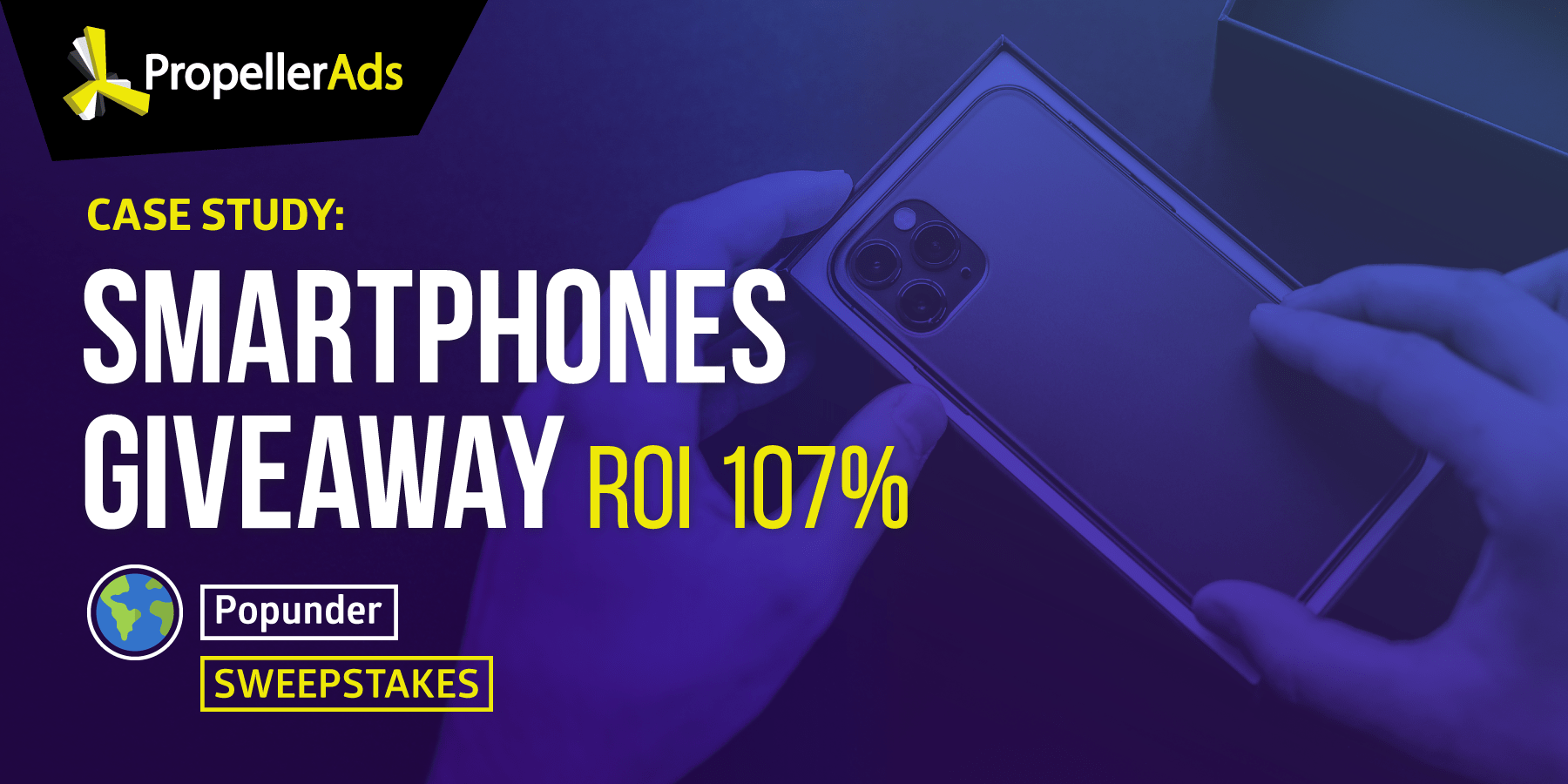
In this case study, the media buyer spent $6,430 and got $6,893, with a ~107% ROI; his testing phase began with the comparatively low CPM bid of $1.8.
- Winning setups are found faster. Again, much depends on the offer’s specifics, but in general, with push and pop traffic, you can start getting your first insights from the very first day. You need to wait for a longer time to get enough insights to optimize, but it’s still quicker: testing on Google Ads usually takes around 10-14 days, while on Meta it often takes 7-14.
One good example of this is described here:
This case study shows how the First Deposit cost lowered from $261 to $90 as a result of optimization and thorough searching for the perfect setup.
- More hypotheses can be tested. As the first performance signals appear relatively quickly and you can cut the poorly performing zones early, your budget is not locked into a single long testing cycle. As a result, you can play around with more ideas within the same overall budget and reallocate it to test more ideas and angles.
And, the example:

Here, we showed how PropellerAds traffic was integrated into a new funnel built around TikTok Shop. The team worked within whitelisted zones and adjusted the strategy to align with the social commerce model. This is a clear example of testing a new traffic channel within an already existing setup.
- You can scale without significantly raising your bids. Since prices are usually lower, you have more room between what you spend and what you earn. This extra margin makes scaling safer. Instead of aggressively increasing bids to compete with large budgets, you can often unlock additional volume with slight bid adjustments. Even a small increase in rates can open significantly more traffic, especially on sources that already perform well.
Of course, everything still depends on the vertical and the offer. But in many cases, push and pop traffic let you increase volume without your CPA getting out of control, because competition is less intense than on major platforms.
And here is some evidence of that:
This case study shows how our partner earned $833,238+ with an average ROI of 20–30%, reaching up to 225% in some months. The campaign stayed in the green while successfully scaling.
Ekaterina Tupitsyna, Senior Account Strategist at PropellerAds:
Such traffic is not always significantly cheaper than, say, Meta’s. While push and pop usually do offer a lower entry price, the final cost of acquiring a user is still defined by the market. It depends on the GEO, vertical, seasonality, competitor activity, creative quality, and how aggressively you want to scale. In high-demand segments, bids can rise very quickly, and premium traffic inevitably becomes more expensive.
Besides lower prices, advertisers also gain speed: creatives, funnels, and hypotheses can be tested faster, winning setups are found earlier, and scaling becomes easier. When needed, pop traffic can also efficiently support reach and awareness goals thanks to its massive volume.
How to Get the Most Out of Cheap Traffic?
A low click price alone guarantees nothing. Sometimes, the final CPA can easily end up higher than on more expensive platforms. It happens when your creative doesn’t match the audience, or the landing page doesn’t clearly show the offer’s value, or your overall funnel isn’t ready for big traffic volumes.
However, it doesn’t mean you should limit cheaper traffic to just a few verticals. It simply requires the right approach.
Test Properly
Lower click or impression costs don’t mean you can skip the testing phase. However, it helps you collect data faster, understand user behavior sooner, and make decisions earlier. The main principles are the same: clear hypotheses, KPI control, and quick reactions to any changes.
There is no universal rule for testing, as it strongly depends on the vertical, GEO, and offer specifics, as well as the complexity of the conversion. However, here are some general benchmarks and tips:
| Tier | Optimal Test Duration | Optimization Start |
| Tier 1–2 | 5-7 days | From Day 3 |
| Tier 3–4 | 3-5 days | From Day 3 |
Split it
Cheap traffic becomes truly efficient when it’s properly segmented. So, don’t forget to narrow your targeting and separate campaigns by sources, zones, device types, audiences, or GEO. It makes performance more transparent and easier to control: you can quickly stop the weakest campaigns, and add more budget to the top performers.
If you don’t do that, cheap traffic can turn expensive simply because inefficient segments will be hidden inside the overall results.
Keep bids competitive
The traffic is cheap, but you still need a sustainable budget. Even with a lower entry price, campaigns need enough time and volume to clearly show you their real patterns. Short and cheap tests often lead to premature conclusions.
Here is how a proper budget approach generally looks:
| Tier | Total Test Budget | Recommended Daily Budget per campaign |
| Tier 1–2 | $3,000–$5,000+ | $100–$150 |
| Tier 3–4 | $1,000–$2,000 | $50–$100 |
Again, numbers can vary depending on the specifics of the offer, so these are simply the most common benchmarks.
Update creatives frequently
Push and pop formats require fresh creatives: audiences get used to their visuals quickly enough. If the same creative runs for too long, CTR usually drops, and so does the performance. So, if you update your creatives regularly, you’ll prevent your traffic costs from rising due to user interest waning.

Optimize quickly
Cheap traffic gives faster signals. But these signals become useless if you don’t react to them as fast as well. So, don’t forget to quickly cut underperforming zones and allocate more budget to the winning segments.
In practice, several principles consistently work: launch multiple creatives at once, give campaigns enough volume for the learning phase, cut weak sources quickly, and reinforce the ones that show stronger engagement. The earlier you start acting on data, the faster you find a profitable setup. The advantage is that on pop/ push, this learning stage is usually reached much faster than on more expensive platforms.
Bonus part: 3 working combos for cheap traffic
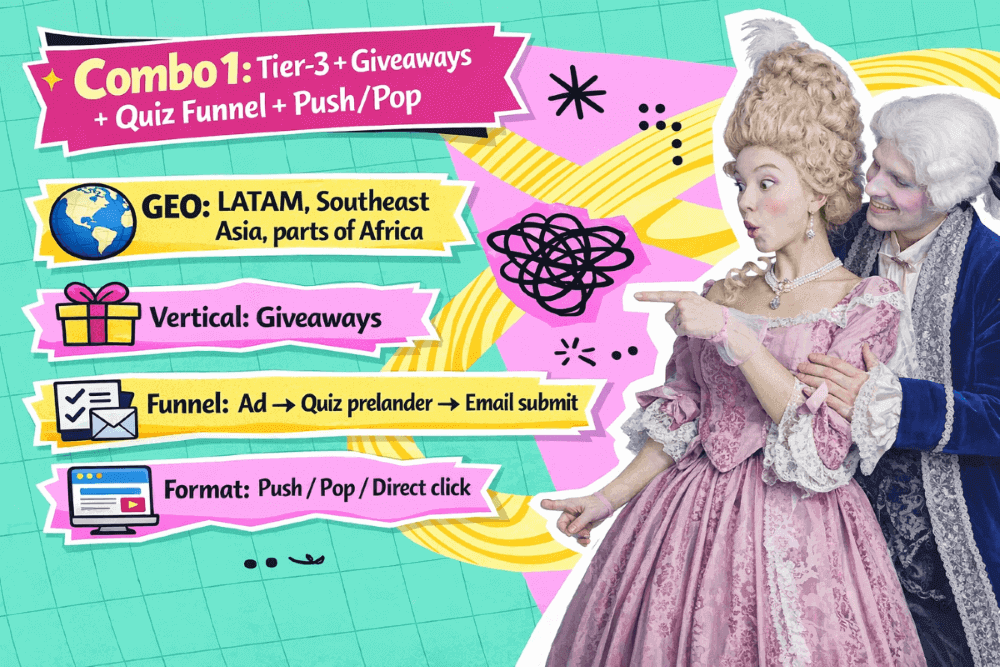
Why it works:
- Low CPM
- Gamified mechanics
- Users respond well to ‘win’ mechanics
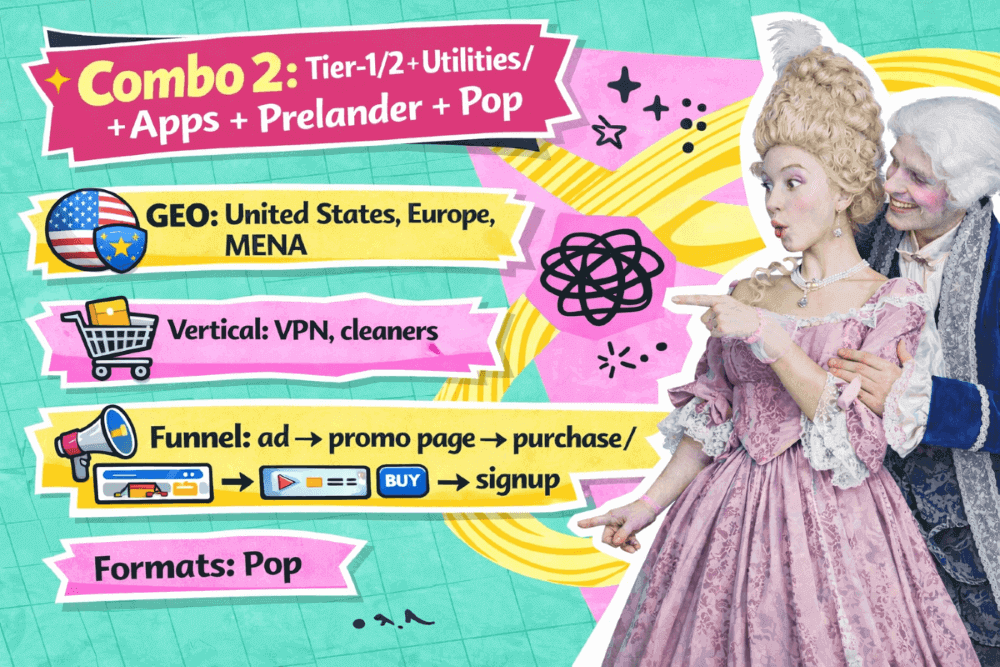
Why it works:
- Clear and easy-to-understand product value
- Pre-lander warms the user before the store page
- Short path to conversion
- Strong potential to scale in volume

Why it works:
- Pop delivers a very broad reach fast
- Increases visibility and frequency of the offer
- Helps build a large audience for retargeting and cookie-based strategies
- Ideal for rapid reach expansion and top-of-funnel activity

What Else Do I Need To Know About Cheap Traffic?
Here’s a quick FAQ to answer any remaining questions you might have.
Q: How do I know if cheap traffic is actually good?
A: You don’t judge it by the first numbers you see. Experienced teams give campaigns time: they test, optimize, and watch how results change over a few days. As a result, cheap traffic can be called good if it keeps converting, stays stable, and makes money, not just if it looks promising on day one.
Q: Why isn’t traffic quality only about price?
A: Because price per click doesn’t equal profit. In media buying, you make decisions on two levels. First – quick actions, where you change bids, cut weak slices, test new creatives, scale what works. Second – a wider picture, where you decide whether the source has a real long-term potential. You need both quick optimization and patience to understand if traffic is truly worth it.
Q: Can cheaper traffic be used for any offer?
A: In most cases, yes. There are some complex products that require more engaged users to sell: high-ticket offers, financial services, B2B, or campaigns that require very specific targeting.
This said, it doesn’t mean cheap traffic won’t work with such offers, too. You can test it, too – just with a different approach that includes better warming, more funnel steps, stronger creatives, and more time for optimization.

To Sum It Up
Traffic quality is never about price alone. It’s about results, stability, and how well a source fits your product, funnel, and overall acquisition strategy. So don’t be afraid of something that’s cheaper than Meta or Google: it can become exactly what your funnel needs.
Join our Telegram for more insights and share your ideas with fellow-affiliates!