Pop-Up Advertising in 2026: Evergreen Classic or a Blast From the Past?
Pop-up advertising has been part of the digital advertising ecosystem for decades. But in 2026, media buyers are asking a different question: Does pop-up advertising and pop-up traffic still deliver results for affiliates, or has the market shifted toward popunder advertising (OnClick ads)?
According to PropellerAds’ performance data and feedback from active media buyers, the answer is nuanced.
“Classic pop-ups are mostly a legacy format now – browsers block them too often, and users close them instantly. That’s why most affiliates work with Popunder (OnClick) traffic instead. It gives the same reach without interrupting the browsing session, which usually leads to more consistent engagement and faster campaign stabilization once the funnel starts converting.”
— Julia Larionova, Head of Marketing at PropellerAds
Let’s break down where pop-ups still fit into modern media buying, and why many advertisers now prefer Popunder traffic.
TL;DR
- Pop-up ads are no longer a primary traffic source due to browser restrictions and user behavior, but they still have niche use cases in aggressive funnels
- Most affiliates today rely on Popunder (OnClick) traffic, which delivers similar reach without interrupting the browsing experience
- Pop traffic is mainly used for fast testing: within the first few thousand visits, advertisers evaluate LP CTR, CR, and EPC
- Campaign logic is simple: get data → validate funnel → scale or kill
- With proper frequency capping, pre-landers, and traffic filtering, pop-based formats remain a scalable channel in verticals like iGaming, utilities, and VPN
Pop-Up Traffic in Modern Media Buying
Pop-up advertising is one of the oldest formats in performance marketing, where an ad window appears above the webpage a user is currently viewing. For years, it was widely used by affiliates who needed immediate visibility and large volumes of impressions.
Historically, pop-up ads powered aggressive direct-response campaigns, such as lead-generation funnels, flash sales, giveaway offers, app installs, and exit-intent promotions, designed to capture users just before they leave a page.
In performance marketing, these formats are usually grouped under the broader category of pop traffic, which includes both classic pop-up ads and modern OnClick (Popunder) ads.

The appeal of pop traffic has always been simple: instead of waiting for the user to notice an ad placement, the ad forces visibility by appearing directly in the browsing flow. This ability to generate massive impression volumes quickly makes pop traffic particularly useful for testing offers, validating funnels, and gathering performance data.
At the same time, running pop-up campaigns today requires a more strategic approach than it did a decade ago. Modern browsers increasingly block intrusive formats, and users are less tolerant of aggressive advertising.
According to research, “intrusive pop-up ads induce user fatigue and irritability, eventually leading to engagement collapse.”
As a result, successful campaigns now depend on factors such as traffic quality, frequency capping, landing page load speed, and precise targeting.
Pop-up advertising still has its place in the ecosystem, but today it works best when integrated into a broader strategy that considers both performance metrics and user experience.
Why Some Advertisers Still Use Pop-Up Advertising
Even as new ad formats appear, pop-ups continue to play a role in certain campaign strategies.
- Maximum visibility
One reason is maximum visibility. Unlike banners or native placements that users can easily ignore, a pop-up appears directly over the page content. This guarantees immediate attention and makes the format suitable for campaigns built around strong calls to action, such as lead generation or limited-time offers.
Research in digital advertising shows that pop-up formats can even override users’ normal attention control during browsing tasks.
- Flexibility of the creative format
Another advantage is the flexibility of the creative format. Pop-ups offer significantly more space than standard display ads, allowing advertisers to experiment with different conversion elements within the creative itself. Full-screen designs, countdown timers, lead capture forms, and multi-step flows can all be integrated directly into the ad experience.

- Used for testing
Pop-up traffic can also be useful during the testing phase of a campaign. Because pop formats can deliver high traffic volumes quickly, they allow advertisers to test landing pages, pre-landers, and different messaging angles without waiting weeks for statistically meaningful data.
However, effective pop campaigns depend on proper traffic management. One of the most important settings is Frequency Capping, which limits how often a user sees the ad within a specific timeframe. Without frequency control, aggressive exposure can lead to ad fatigue, reduced engagement, and declining ROI.
The Real Limitation: Browser Blocking
Despite their visibility advantages, classic pop-ups face a significant limitation today: modern browser restrictions.
Browsers such as Chrome and Safari increasingly block intrusive pop-ups by default. Even when pop-ups are not technically blocked, poorly timed overlays can damage user experience and reduce campaign performance.
Because of this, many advertisers have gradually shifted toward Popunder (OnClick) advertising, which delivers similar reach while creating less friction for the user.
Pop-Up vs Popunder: Key Differences for Media Buyers
Understanding the difference between these formats is critical when choosing the right traffic strategy.
| Feature | Pop-Up Ads | Popunder Ads |
|---|---|---|
| Intrusiveness | High (appears above content) | Medium (opens under current tab) |
| Browser Blocking | Frequently blocked | Less affected by blockers |
| Average CR | Moderate if timed well | Often higher due to better user tolerance |
| Best Verticals | Giveaways, Lead Gen | iGaming, Mobile Software, VPN |
| OS Compatibility | Limited on iOS browsers | Works across desktop and mobile environments |
| User Experience | Interrupts browsing | Less disruptive |
Popunder ads open in a new tab beneath the current page, allowing users to finish their current activity before interacting with the advertisement.
Because of this behavior, Popunder traffic often shows stronger engagement and better retention metrics.
➡ Learn more about Popunder advertising
How Pop Traffic Is Used in Affiliate Campaigns
In affiliate marketing, pop traffic is rarely used as a standalone strategy. Instead, it often plays a role in the early optimization and scaling process of a campaign.
Because pop formats can deliver large volumes of impressions quickly, they are commonly used to validate new funnels and identify promising traffic segments before scaling further.
A typical pop traffic workflow starts with rapid funnel validation. Rather than spending weeks gathering data from slower channels, affiliates can launch a pop campaign and begin evaluating early performance signals after the first few thousand visits.
At this stage, the focus usually shifts to several key indicators:
- LP CTR (Landing Page Click-Through Rate): how effectively the pre-lander engages visitors
- Conversion Rate (CR): how many users complete the target action
- Earnings Per Click (EPC): whether the campaign generates sustainable revenue per visitor
Once the funnel shows positive EPC, the campaign can move into the optimization phase.
Most pop traffic campaigns rely on a relatively short funnel structure:
Pre-landers are particularly important in this setup. Instead of sending users directly to the offer page, the pre-lander introduces the product or service, filters low-intent traffic, and prepares users for the final conversion step.
In many campaigns, adjusting the pre-lander angle, messaging, or layout can have a larger impact on performance than switching the offer itself.
Optimization then focuses on identifying the most profitable traffic segments. This usually involves analyzing variables such as:
- GEO performance differences
- Device segmentation (Android, iOS, desktop)
- Ad zones
- Traffic quality signals and bot filtering
Modern advertising platforms help automate part of this process. Tools such as SmartCPM bidding or CPA Goal optimization can automatically prioritize traffic segments that historically generate higher conversion rates, allowing campaigns to scale while maintaining stable ROI.
Example: Running a Popunder Campaign in PropellerAds
Below is an example of how an OnClick (Popunder) campaign setup looks inside the PropellerAds dashboard.
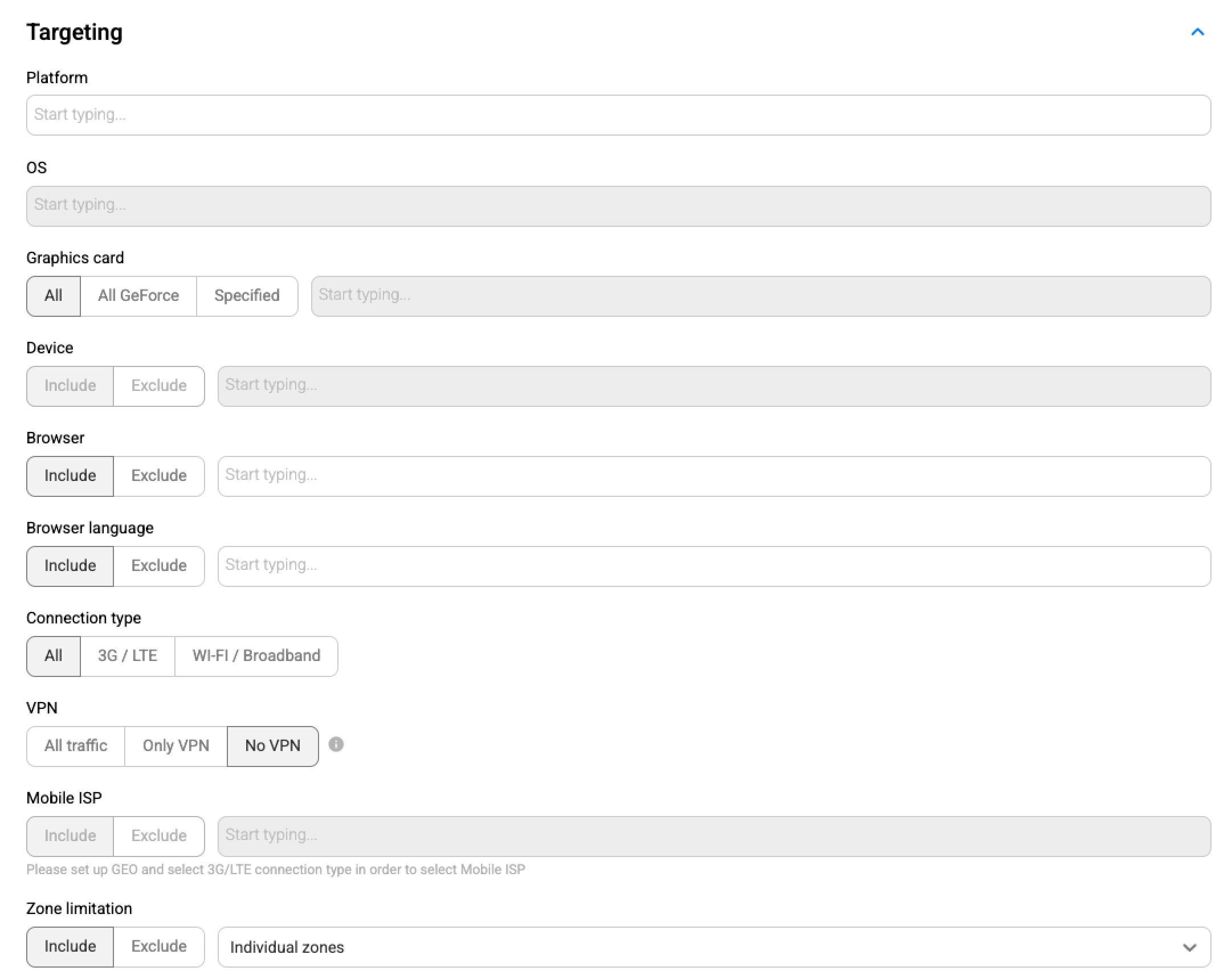
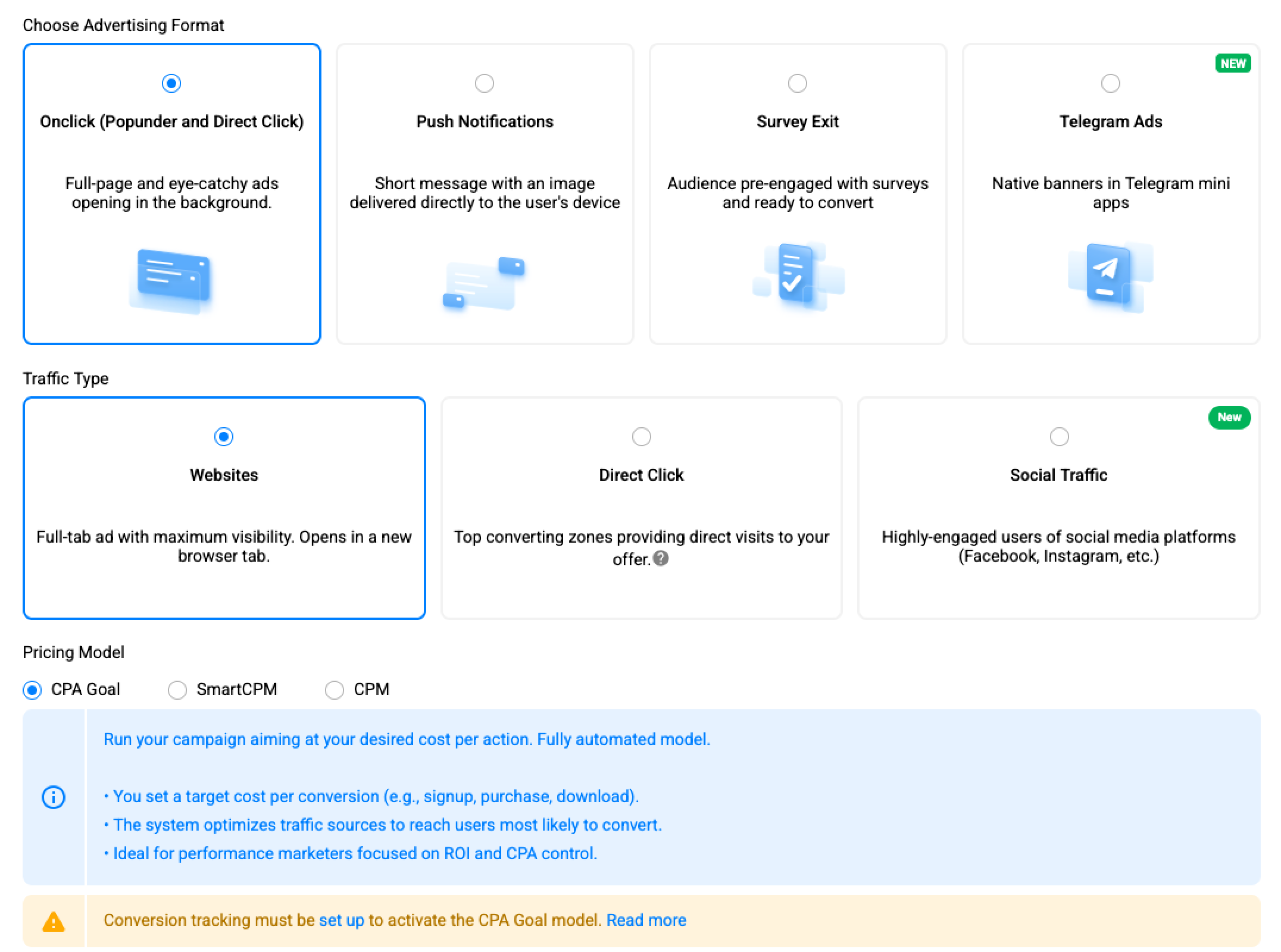
Launching a pop traffic campaign usually starts with a few key configuration steps that directly affect campaign performance.
- GEO and Device Targeting
The first step is selecting the right GEO and device types. Many affiliates begin with Tier-2 or Tier-3 regions where traffic costs are lower, and testing budgets can stretch further.
Device segmentation is equally important. Some verticals, such as Mobile Software or VPN offers, perform significantly better on Android traffic, while others may convert better on desktop environments.
- Frequency Capping
Setting the right frequency cap helps prevent overexposure and protects traffic quality. Without frequency control, the same user may see the ad multiple times in a short period, which can reduce engagement and distort performance signals during campaign testing.
A common starting point for pop traffic campaigns is one impression per user every 24 hours, but the optimal setting can vary depending on the campaign stage and vertical.
| Frequency Cap | When It’s Used | Why It Works |
|---|---|---|
| 1 impression / 24h | Default testing setup | Prevents overexposure and keeps traffic signals clean during early testing |
| 1 impression / 12h | Higher-volume campaigns | Allows more impressions while still limiting user fatigue |
| 2 impressions / 24h | Retargeting or strong offers | Useful when the funnel requires repeated exposure to convert |
| 1 impression / session | Aggressive campaigns | Ensures visibility while avoiding repeated impressions within the same visit |
In most cases, starting with 1/24h frequency capping helps maintain consistent engagement and prevents the same user from seeing the ad repeatedly during the initial testing phase. Once performance data is collected, advertisers may gradually adjust the cap depending on conversion patterns and traffic behavior.
- Bidding Strategy
Advertisers can choose between several bidding models, including SmartCPM, which automatically prioritizes traffic sources with higher historical conversion probability.
This type of automated bidding helps campaigns optimize faster by allocating impressions toward zones that are more likely to generate conversions.
- CPA Goal Optimization
For campaigns focused on conversions rather than traffic volume, CPA Goal optimization can be used to automatically adjust bids based on performance data.
Once enough conversions are collected, the algorithm begins prioritizing traffic segments that historically produce the target CPA.
Together, these settings give advertisers fine-grained control over traffic quality, cost efficiency, and scaling potential, making Popunder campaigns a flexible option for both testing new offers and scaling profitable funnels.
Best Verticals for Pop Traffic
Pop traffic tends to perform best in verticals where strong calls to action drive quick decisions.
Common examples include:
- iGaming
- Mobile software
- VPN services
- Giveaways
- Social & Relationship offers
These niches typically rely on short conversion funnels and optimized pre-landers to maximize engagement.
FAQ: Pop-Up and Popunder Advertising in 2026
Before getting into details, let’s quickly break down how pop-up and popunder formats are actually used today. These are the questions that usually come up when working with pop traffic in real campaigns.
What is pop-up advertising?
Pop-up advertising is a digital ad format where a new window appears above the webpage a user is currently viewing. The format is designed to capture immediate attention and push users toward a specific action, such as signing up for an offer or installing an app.
What is pop-up traffic?
Pop-up traffic refers to traffic generated through pop-up advertising formats. Because these formats deliver high volumes of impressions quickly, they are often used in CPA marketing and affiliate arbitrage campaigns.
What is the difference between pop-up ads and popunder ads?
Pop-up ads appear above the current webpage and interrupt the browsing session. Popunder ads, also known as OnClick ads, open in a new tab beneath the active window, allowing users to finish their current activity before seeing the advertisement.
Are pop-up ads blocked by browsers?
Yes. Many modern browsers, such as Chrome and Safar,i include built-in pop-up blockers. This is one of the reasons why many advertisers now prefer popunder traffic instead.
What verticals work best with pop traffic?
Pop traffic performs well in verticals that rely on fast user decisions, such as iGaming, mobile software, VPN services, giveaways, and social offers.
Final Thoughts: Pop-Ups Still Exist, but Popunders Lead the Market
Pop-up advertising and pop traffic are still part of the performance marketing ecosystem, particularly for testing new funnels and offers.
However, the industry has gradually shifted toward Popunder (OnClick) advertising, which provides similar reach while maintaining better user experience and traffic quality.
For many affiliates today, Popunder traffic has become the primary format for scaling pop-based campaigns.
Come join us on Telegram for more insights and communications with fellow-affiliates!
Disclaimer: Traffic results vary depending on market conditions, vertical, and audience targeting. Past performance does not guarantee future ROI. Advertising and traffic acquisition involve financial risk.