Marketplace vs Social Commerce Ads: Which Channel Should Your Budget Go To?
When it comes to choosing between Marketplace vs Social Commerce Ads, what matters most is to maximize your ROI. And while these two look similar on the surface, they operate on completely different logic, target different intents, and reach users at different points within the funnel.
Marketplace ads target high-intent users in their chosen shopping environment. Social Commerce ads spark curiosity and demand in their native, content-driven feed.
While one seals the deal, the other starts the conversation through impulse and attention-grabbing techniques. The most successful performance marketers combine both, building on scalable, always-on traffic layers.
We get it, the confusion is real and grounded, so in this guide, we walk you through how each channel works, when to use which, and how to build a strategy that converts.
What Are Marketplace & Social Commerce Ads: Definition, Differences, and Use
The place within the funnel and the way they work – that’s what sets them apart and decides their outcome and use. While Marketplace Ads appear to the user when they’re already at the decision-making stage, the Social Ads meet the user when they’re not even looking, as native pieces of the same content they’re browsing.
But let’s get into more detail with each.
Marketplace Ads
- Sponsored listings
- Search placements
- Category ads
- Buy-now logic
Think of Amazon, eBay, Alibaba, Etsy, OLX, Idealista, Bayut, AliExpress, Shoppee, and the like. They’re all marketplaces. And whether we’re talking about an app or website, you’ll notice they come with ads – the infamous Marketplace ads.
So, what are Marketplace ads?
The paid or sponsored ads (otherwise known as retail media in online retail stores) which target very high-intent users. Whoever is browsing these online stores is already at the middle of the funnel, looking to take action.
Although when you first read the header, you were probably thinking of Facebook Marketplace ads, the latter are just a subcategory of the larger marketplace ads, where the market is inside the social platform.
We could think of them as a sort of semi-hybrid marketplace within social media ads.
But regarding the larger marketplace ads, know that there are three kinds of retail media placements inside marketplaces, as follows:
- Sponsored Listings
Otherwise known as promoted listings, these paid ads stand out and reach more buyers, and might appear right after the viewed product’s description.
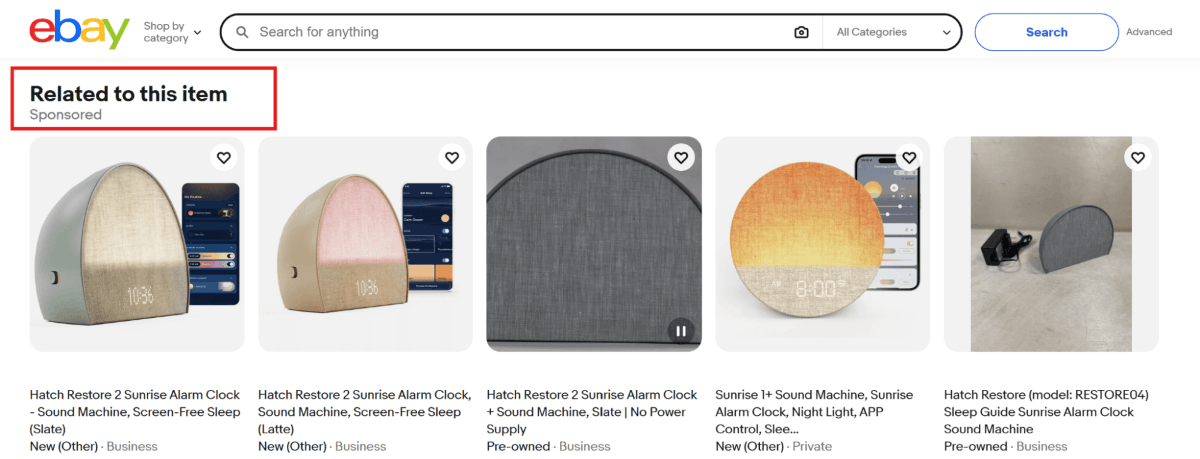
Sponsored Marketplace Ads – Image Source eBay
- Search Placements
Search placements are ads that appear when the user searches for a specific product, and they’re marked accordingly. While all search placements are sponsored, not all sponsored listings appear in search results.
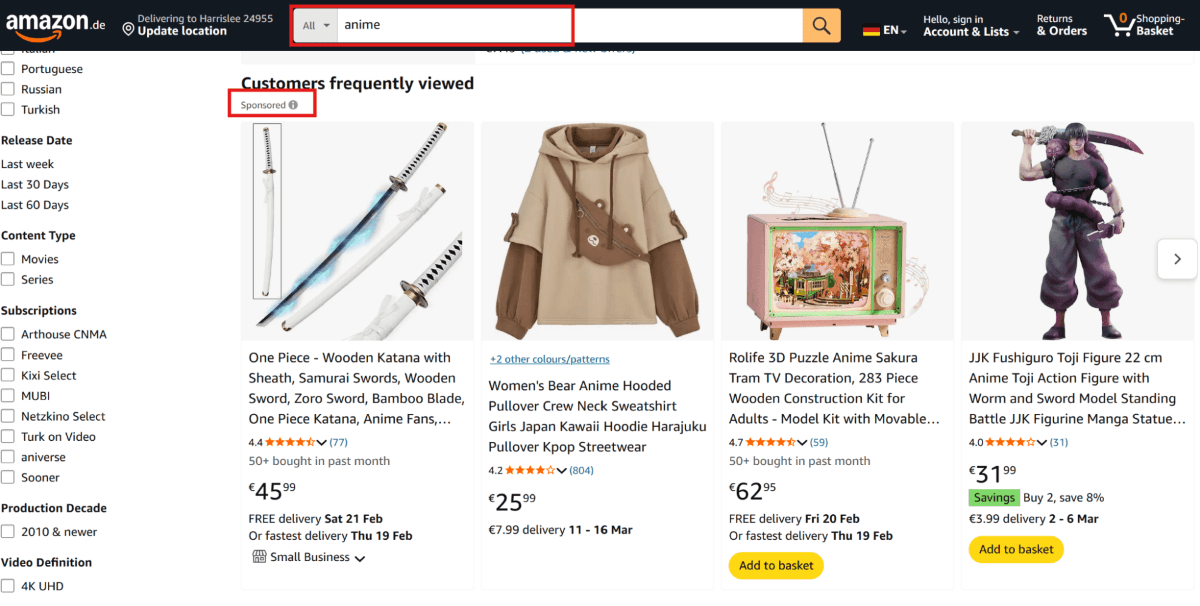
Search Placement – Image Source Amazon
- Category Placements
Category placements are ads users see in the marketplace when they browse by category (also part of the sponsored ads).
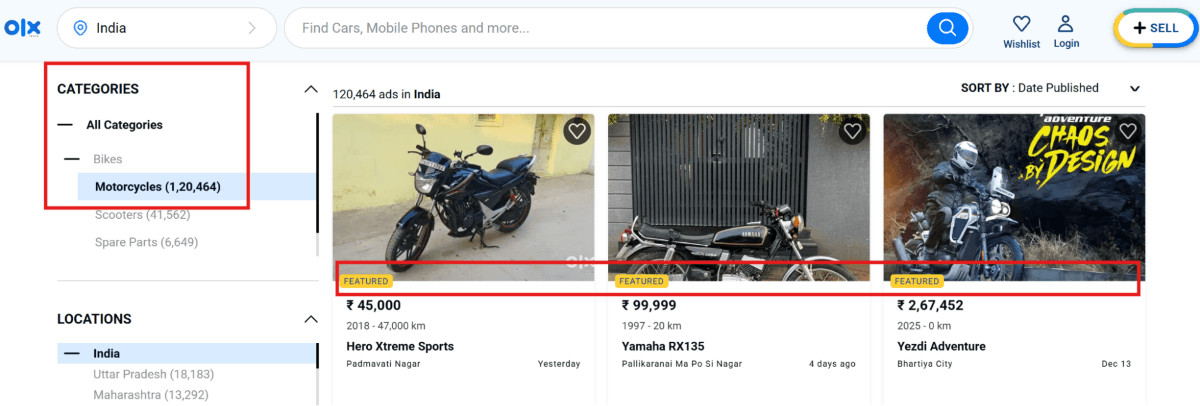
Category Placements Marketplace Ads – Image Source OLX
Main Characteristics of Marketplace Ads You Need to Consider
- Users already know what they want, and they’re ready to spend – past awareness, in the consideration phase (MOFU – Middle Of The Funnel)
- They’re now comparing price, reviews, and delivery methods – half converted
- They’re evaluating whether your offer is better than the other similar ones they find
Marketplace Glossary: Worthy Distinctions
Although these terms are more commonly used on the brand and retail side, knowing them will help you understand where your traffic fits within the broader ecosystem. So, here’s a much-needed clarification:
- Retail Media Network (RMNs) – an advertising platform owned or operated by a retailer or ecommerce platform, allowing brands to buy ad space (sponsored or banner ads). Examples of RMNs: Shopify Audiences, Amazon Advertising, eBay Ads.
- Retail Media – paid ads offered and featured on RMNs. Often used interchangeably with RMNs, however, they’re the means to the end that the latter provide.
- Marketplace – an eCommerce platform for many sellers’ online stores, connecting multiple third-party sellers. For example, eBay, Amazon, or Etsy. However, not all marketplaces operate RMNs (such as OLX, Idealista, Craigslist, Nextdoor).
- eCommerce site – platforms for online product sale. However, not all eCommerce websites are marketplaces (for example, iStorm – only sells its own products, or Shopify – although it can participate in retail media, it only provides the means to create single stores, like mini websites).

Social Commerce Ads
- Short-form video
- Live shopping
- Creator integrations
- Native in-feed units
TikTok Shop Videos, Instagram Product Tags, Facebook Shops, YouTube Clickable Product Tags, Pinterest Product Pins, and pretty much any paid/promoted UGC (User Generated Content) brand-related pieces containing a tag, product link, or in-app checkout you can think of are all part of the Social Commerce Ads.
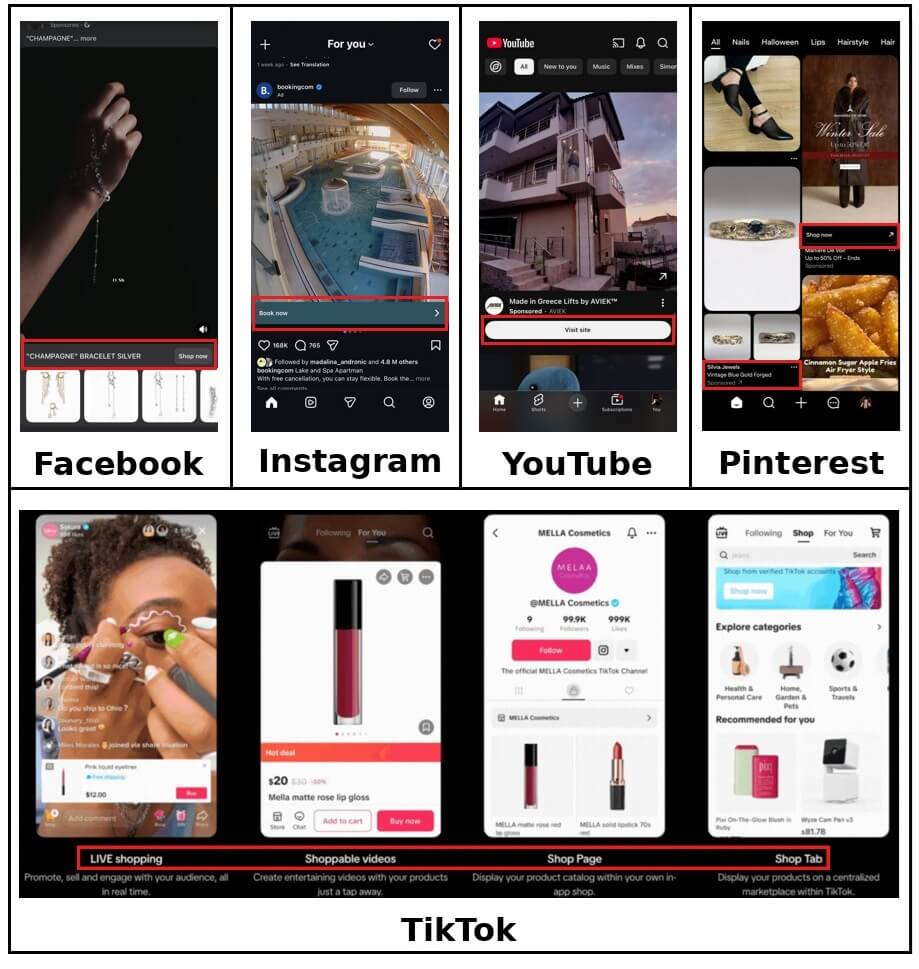
In short, Social Commerce Ads are in-platform content pieces that drive purchase through a shoppable unit (link, tag, in-app checkout), providing a near-effortless checkout.
A clear distinction needs to be made here, as organic brand mentions are not Social Commerce ads. The same way that not all social ads are Social Commerce ads – for example, an affiliate or traffic ad that leads to an external landing page is not a shoppable unit.
What Are the Characteristics of Shoppable Ads inside Social Feeds?
- Content-led demand creation – emotion, entertainment, and creators influence decision-making
- TOFU (Top Of The Funnel) or awareness stage-based marketing
- Discovery-based live shopping with in-app checkout – the user was not planning to buy, but he was effortlessly led there
Note: the ad formats shape expectations. Just keep in mind that the format dictates the psychological context. While in the case of the Marketplace, the interface in its nature is transactional, when it comes to Social Commerce, the interface is designed for entertainment.
Marketplace vs Social Ads: Intent and Discovery Model
When it comes to intent, there is a very important distinction you must consider before you define your Marketplace, Social, or Marketplace plus Social Hybrid Ad Strategy.
When it comes to the funnel roles, here we’re talking about opening vs closing.
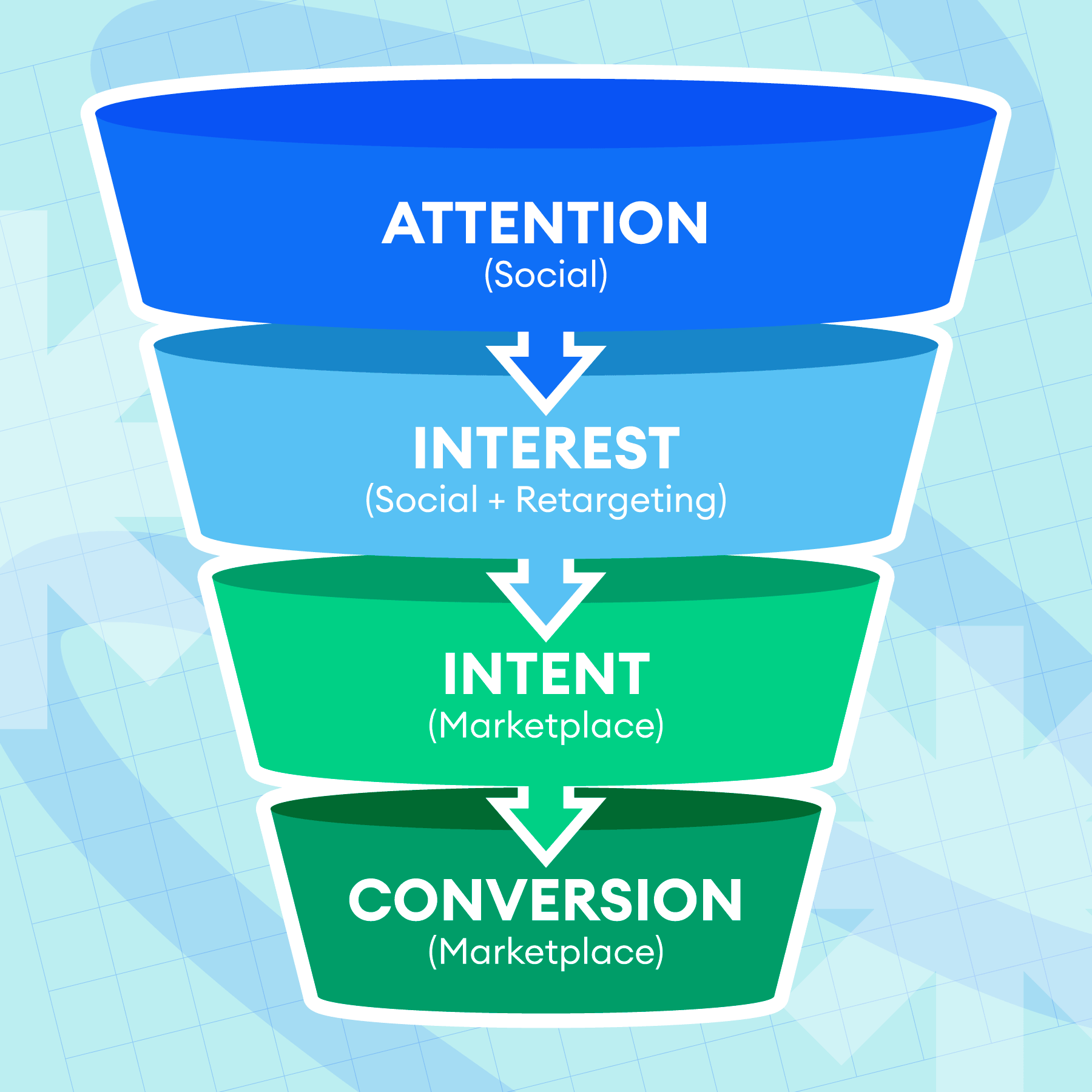
The Social Commerce & Marketplace Ads Funnel
Marketplace Ads are Search-Led
As Marketplace ads create demand based on the user’s search, it means that the users getting on these ads are interested in the product or service in question. But sure enough, they might be searching for information, comparison, price check, or to purchase, in which case they come with a strong intent.
Social Commerce Ads are Content-Led
On the other hand, with Social Commerce ads, the content creates demand. Meaning that the users who get on these ads were simply browsing content, without an active intent to purchase, and the ads play the role of intent trigger, leading to a potential purchase.
Hybrid Ads: Content-Led Discovery, Search-Led Conversion
This brings us to the Hybrid Strategy, which connects demand creation with demand capture. In other words, linking the demand creation from social platforms with demand capture on marketplaces. Or guiding users from discovery to purchase within a unified strategy.
What are hybrid ads? Just a multi-touchpoint user journey that starts from Social Commerce ads for discovery, and end in Marketplace ads for persuasion and conversion.
No worries, to make it even simpler, we put everything into a nice infographic explaining the intent from high (hot) to low (cold), along with the linear Hybrid-Discovery model:
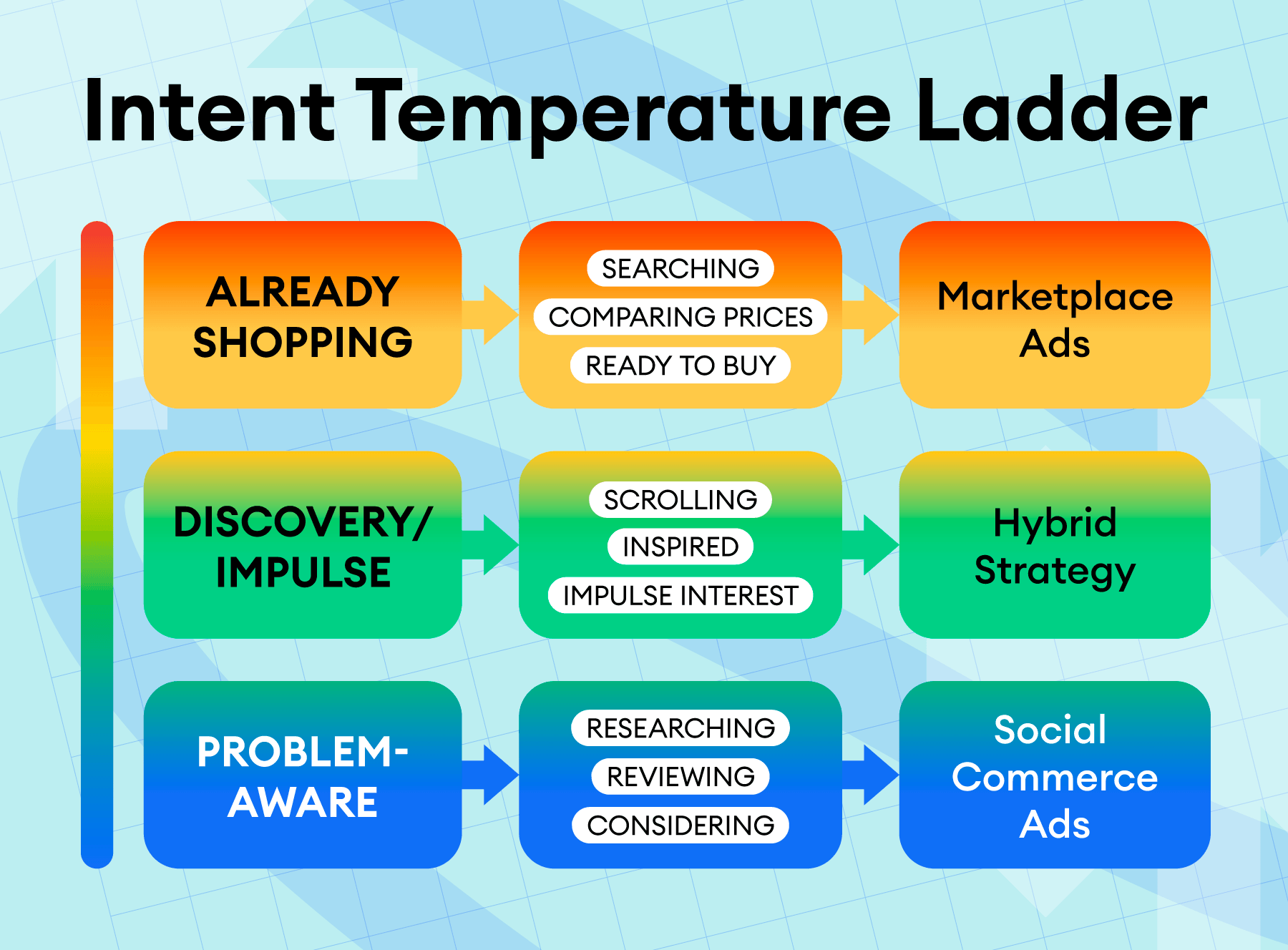
Intent Temperature Ladder
Marketplace or Social Media Ads: When It’s Best To Use Which?
Are you still unsure whether you should use Marketplace or Social Ads? Keep it simple with this If/Then logic table:
| If You Have | Then Go For |
|---|---|
| Offer-level demand & competitive vertical (e.g., finance, health, gadgets, etc.) | Marketplace Ads first |
| Offers with strong visuals or emotional appeal & payout that justifies creative spend | Social Commerce Ads first |
| An offer that needs context and explanation before converting | Social first, then Marketplace capture |
| The need for a predictable ROAS (Return on Ad Spend) fast | Marketplace |
| A new vertical or offer with no existing demand to build from | Social Commerce |
Where PropellerAds Fits?
A smart move is to use a new layer between discovery and conversion, like a network, such as PropellerAds. It will give you the chance to expand brand awareness, retarget undecided users, and diversify your campaigns.

All of these, together with lower Cost Per Mile (CPM) and higher Conversion Rates (CR), will help you get higher Return on Investment (ROI) with Social and Marketplace ads.
And here are three positioning angles for you to try:
Brand Awareness Layer
- Best Used When: You have Social Commerce spikes, a campaign or creative goes viral, and your offer gains traction.
- Use to: Capture broader discovery traffic, extend reach outside social algorithms, and support creative testing.
- How To: Push Notifications, or In-Page Push, to reach broader audiences globally, and scale awareness fast.

Retargeting Reinforcement Layer
- Best Used When: The user saw your ad on social, clicked, but didn’t convert.
- Use to: Retarget users as an always-on layer, and save on lower CPM compared to social media.
- How To: Use performance formats like Push Notifications, In-Page Push, or Popunder.
Parallel Campaign Strategy
- Best Used When: You need an extra traffic source with continuous volume and GEO diversification.
- Use To: Drive an extra, stable, and scalable support layer, to diversify channels instead of relying on a single source.
- How To: Use Popunders, and In-Page Push Ads, along with Telegram Mini-App Ads to skyrocket volumes and diversify.
While Social Commerce creates visibility and marketplaces harvest demand, PropellerAds can be the focal point connecting them.

Quiz Time
What Channel Should You Prioritize?
Answer 4 quick questions to find out whether you should start with Marketplace Ads, Social Commerce Ads, or a Hybrid approach.
What Should You Get From This
Choosing between Marketplace and Social Commerce ads is not really an either/or thing. The modern-day reality points towards going hybrid, turning more into a sequencing matter.
And if you want to be successful and to repeat it constantly, you shouldn’t pick sides, but use each channel for the right stage of the funnel, measure what works, and build on it throughout the bigger journey.
Whether you’re building demand on marketplaces, triggering discovery through social feeds, or adding an extra layer with PropellerAds, you’ll win if you properly understand the intent behind every reaction.
If you’re ready to allocate your budget, just double-check whether you’re opening or closing the conversation. Your choice will dictate which channel you must choose.
Join our Telegram for more insights and share your ideas with fellow-affiliates!
Trends
View more posts