iGaming Affiliate Programs: How to Choose a Network, a Deal, and an Offer

This post is also available in:
 PT
PT  ES
ES
Reviewed by the PropellerAds Media Buying Team | Updated July 2026
An iGaming affiliate program pays you for the players you refer to a gaming operator — a fixed price per depositor, a share of the revenue those players generate, or a mix of both.
Dozens of networks advertise similar percentages, so the choice between them comes down to the terms that sit deeper in the agreement: how a depositor is defined, which GEOs count, when the money arrives, and what the program expects from your traffic. The wider iGaming advertising stack lives on our solutions hub. If affiliate work in this vertical is new to you, start with our guide to iGaming affiliate marketing.
Note from Oleksandr Shovkun:
“Ask what counts as a first-time depositor before you ask about the percentage. A minimum deposit, a GEO list, and a verification requirement can turn the same headline CPA into a very different payout.”
Programs pay in one of three ways, and the difference between them is mostly a question of who carries the risk of a player going quiet – you or the operator.
- CPA (cost per acquisition) – a fixed sum for each referred player who completes a qualifying action, almost always a first deposit (an FTD, in industry shorthand). Published prices in Track360’s 2026 affiliate commission benchmark run from tens of dollars per FTD in Tier-2 and Tier-3 markets to $150–$400 in Tier-1; the exact figure is negotiated per deal, per GEO, and per traffic type. A buyer on CPA gets the money back inside the campaign cycle and carries no stake in what the player does afterwards.
- RevShare – a percentage of the net gaming revenue (NGR) your players generate, paid for as long as they stay active. Published ceilings across the networks in this comparison reach 50%; where a specific deal lands inside that range is negotiated per traffic profile. Early months pay little; the deal starts to work once a base of long-lived depositors accumulates, which is why an affiliate on RevShare optimizes for player LTV where a CPA buyer would optimize for deposit count.
- Hybrid – a reduced CPA plus a reduced RevShare percentage. Programs tend to offer hybrids selectively, on request, and after they’ve seen your traffic.
Whatever model you land on, read the payment section of the terms before signing:
- Payout thresholds and schedules range from automated anytime withdrawals to monthly cycles – a generous rate paid slowly can be worth less to a media buyer than a modest one paid weekly.
- Negative carryover appears in some RevShare agreements: a losing month, when players win more than they lose, rolls into the next payment period instead of resetting to zero.
Both clauses are standard, not hidden in fine print. Surprises come when a deal is picked on the headline rate, and the payment section goes unread.
CPA, RevShare, Hybrid: When the Money Arrives
Accumulated payout from one referred cohort of players, relative view over 12 months
Relative view, no currency values: line heights compare timing, not amounts. Where the lines cross — and whether they cross at all — depends on player LTV, deal terms, and your GEO mix. Not an income projection.
Best iGaming Affiliate Programs: What the Networks Offer
Search for the best iGaming affiliate programs and every list you find, including this one, needs the same disclaimer: “best” depends on your traffic, your GEOs, and your tolerance for deferred income. What a comparison can do is show what each network is built around, what it publishes about payouts, and what to verify before signing.
The five below are active networks that recur across top iGaming affiliate networks lists; the figures are what the programs and 2026 industry reviews publish as of July 2026, so treat them as a starting point for the conversation with the affiliate manager, and check the current terms — programs revise them.
Income Access
Income Access – a Paysafe company running one of the longest-standing names in iGaming affiliate tech: 20+ years on the market, a network of 300+ brands, and a tracking platform with detailed reporting behind it. Income Access publishes no flat rates, because commissions are set by each brand’s program inside the network.
- Payout models: CPA, CPI, CPL, and Revenue Share, depending on the individual brand program; hybrid terms may be available through specific brands.
- Support: dedicated account managers, marketing materials, educational webinars
- Check before signing: which brands on the network accept your GEO mix and traffic type, and how payouts consolidate across programs
RevenueLab
RevenueLab – An aggregator on the market since 2011: instead of one program, you get access to hundreds of programs and 500+ offers through a single dashboard, with direct advertiser deals for proven volumes.
- Payout models: RevShare, CPA, hybrid, plus CPL/CPI on selected offers
- Support: 24/7 support, ready-made and custom creatives, consolidated statistics
- Check before signing: which model applies to each specific program you pick, and how cross-program payouts are consolidated
Alfaleads

AlfaLeads – An international network working in iGaming since 2016, built for affiliates who already have traffic: registration is closed and requires proof of stats. In return, the published terms are among the most concrete on this list – payouts weekly, minimum withdrawal $30, methods from crypto to wire and cards.
- Payout models: CPA, CPL, RevShare, Flat Fee, Hybrid, and individual deals with raised rates after a traffic test
- Support: personal managers with analytics and optimization help
- Check before signing: the entry requirements — you will be asked to show existing campaign statistics
3SNET
3SNET– An international CPA network focused on iGaming, working with licensed brands across Tier-1 and emerging GEOs, with 1,400+ offers and most active traffic sources accepted, Push and Popunder included.
- Payout models: CPA, CPL, hybrid, RevShare; raised rates for quality traffic after testing
- Support: personal manager, GEO and funnel recommendations, market insights
- Check before signing: payout minimums ($250, or $1,000 by bank transfer, published as of 2026) and the qualification bar for new accounts
Boomerang Partners
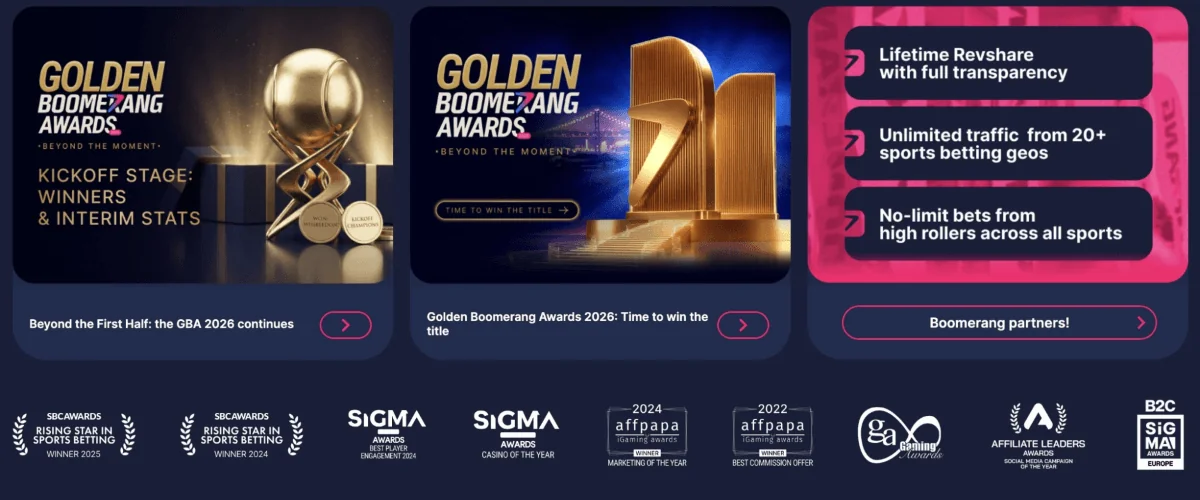
Boomerang Partners – A program family built around 15+ in-house brands: 100+ offers across 30+ GEOs, with crypto payouts and a personal manager per partner. Industry reviews in 2026 put its RevShare ceiling at 50%, and that conditional wording is the point to slow down on, because where your deal lands depends on what your traffic looks like in their review.
- Payout models: RevShare up to 50% (reviewed ceiling), CPA, hybrid, plus Spend and Prepay schemes
- Support: personal managers, onboarding, ready-made creatives, traffic tournaments
- Check before signing: the exact conditions attached to the top RevShare tier, and payout minimums for your method (reviews cite €100 for e-wallets and crypto, €500 for bank transfers)
Two names an affiliate will also meet in every “leading companies” discussion are Better Collective and Catena Media. These iGaming affiliate companies operate their own portfolios of content sites and sell audiences to operators.
Better Collective, the largest of them, reported €86.3M in revenue for Q1 2026; Catena Media runs the same model with a focus on North and Latin America. You don’t join them the way you join a network – for an SEO-led affiliate, they are competitors, and their public earnings reports are the rare open data on what affiliate traffic in this vertical is worth.
| Network | Published payout models | Built around | Payouts: frequency and minimum | First thing to verify |
|---|---|---|---|---|
| Income Access | RevShare, CPA, hybrid (per brand program) | Network of 300+ brands plus tracking platform, on the market since 2002 | Set by each brand’s program, not published centrally | Brand availability for your GEO and traffic |
| RevenueLab | RevShare, CPA, hybrid, CPL/CPI | Aggregator since 2011, 500+ offers in one dashboard | Per program; consolidated through one dashboard | Model and terms per specific program |
| Alfaleads | CPA, hybrid, individual deals | Closed network for proven affiliates, 5,000+ offers | Weekly, from $30; crypto, wire, cards, local methods | Entry requirements (stats proof) |
| 3SNET | CPA, CPL, hybrid, RevShare | 1,400+ offers, wide traffic-source support (Push and Popunder included) | Twice a week, from $250 ($1,000 by bank transfer) | Qualification bar for new accounts |
| Boomerang Partners | RevShare up to 50% (reviewed), CPA, hybrid, Spend, Prepay | 15+ in-house brands, 100+ offers, 30+ GEOs | Monthly per reviews; from €100 (e-wallets, crypto), €500 by bank | Conditions attached to the RevShare ceiling |
Sources: the networks’ official sites and public 2026 industry reviews, checked in July 2026. Figures are published claims, not verified deal terms – programs revise them, so confirm current conditions with the affiliate manager before signing.
Oleksandr Shovkun:
“Compare the headline rate last. On CPA, check what counts as an FTD and which GEOs qualify; on RevShare, check NGR deductions and negative carryover. Clear terms and predictable payments are often worth more than the biggest percentage on the page.”

How to Choose an iGaming Affiliate Network
A strong affiliate deal is not simply the one with the highest rate. It is the one that fits your audience, cash flow, and traffic strategy, and keeps working as you scale. Five factors determine whether a deal grows with you or quietly drains your margin.
- Niche and audience fit. Sports content, prediction platforms, review sites, and paid traffic campaigns attract different players and require different offer catalogs. A network may perform well in one segment while offering little value in another.
- Payout model and cash flow. CPA delivers faster returns that can be reinvested in media buying, while RevShare builds value over time when referred players remain active. Choose based on your campaign economics, player LTV, and how long you can wait for revenue.
- Payment terms and methods. Look beyond the rate to payment frequency, minimum thresholds, available methods, and hold periods. A high commission paid quarterly may be less useful than a lower one paid every week.
- Reputation and track record. Check what affiliates say about tracking accuracy, payment reliability, and dispute resolution. A dated discussion in an independent iGaming affiliate list or forum is often more informative than an undated testimonial on a network’s website.
- Support quality. A responsive affiliate manager can resolve tracking issues, recommend suitable offers, and negotiate better terms as your volume grows. Good support is not just a convenience – it can directly affect revenue.
Choosing a network is not a one-way evaluation. Programs assess your traffic before approving a deal and continue monitoring it after launch. If player quality declines, they may reduce payouts or change the terms. The next section explains which signals they track and how those signals affect your margin.
iGaming CPA Offers: The Terms That Decide Your Margin
Two iGaming CPA offers can show the same payout and still produce very different results. The reason is simple: each program may have its own definition of a payable conversion. Before you start sending traffic, ask your affiliate manager to confirm five things in writing.
1. What exactly counts as an FTD? Check the minimum deposit, qualifying GEOs, attribution window, and any verification requirements. A $50 CPA that applies only to deposits above $20 from five approved countries is not the same deal as a $50 CPA that counts any first deposit.
2. Which traffic can you use? Confirm the traffic allowlist, including approved sources, formats, landing pages, and creatives. If a source needs pre-approval, get it before launch – otherwise, even genuine depositors may not qualify for payment.
3. Which KPIs will your traffic be judged against? Some programs look beyond the first deposit and track registration-to-deposit rate, repeat deposits, player activity, or chargeback levels during a set KPI window. Ask how long this review lasts and what happens if the traffic misses the target: a re-rate, a campaign pause, or rejected conversions.
4. When can an FTD be rejected? Find out which validation and clawback rules apply. Duplicate accounts, chargebacks, bonus abuse, failed identity checks, and suspected fraud can all affect whether a conversion is approved. Most importantly, ask when an FTD becomes final and whether an approved CPA can later be deducted from your balance.
5. How will you compare the numbers? Set up the postback URL and S2S tracking before launch, then confirm the reporting time zone and the deadline for disputes. The FTD count in your tracker should match the count used for payment. If it does not, it is much easier to resolve the difference before the payment period closes.
These details may look technical, but they directly affect what you get paid. Programs monitor deposit behavior, chargebacks, retention, and multi-accounting across affiliate cohorts, and use that data to approve, pause, or re-rate future traffic.
Quality control begins one step earlier, at the traffic source. PropellerAds uses a dedicated traffic quality system to filter traffic before it reaches your funnel. That gives you cleaner data and a stronger position when discussing KPIs, rejected conversions, or payout terms with a program.
Where Your FTD Is Counted
Who checks what between your campaign and your payout — and where disputes come from
The chain mirrors the five questions above: the traffic allowlist gates entry, the FTD definition is applied at the operator, the KPI window and clawback rules at the program, and reconciliation happens in your tracker.
Operator Affiliate Programmes in iGaming
Networks give you a catalog of offers. Operator affiliate programmes in iGaming work differently: you partner directly with one brand and send traffic to its products.
A direct relationship may give you more room to negotiate CPA rates, RevShare tiers, custom landing pages, or exclusive promotions. But better terms are not automatic. Networks can sometimes secure strong rates through volume, while a direct programme may expect exclusivity or specific traffic levels in return for an upgraded deal.
Before signing, check that the operator accepts players from your GEOs and allows your traffic sources, formats, and creatives.
Then review the commercial details just as carefully: the FTD definition, attribution window, NGR deductions, negative carryover, payment schedule, and any volume requirements. If the deal is exclusive, ask what happens when the brand pauses a GEO, changes its terms, or stops converting – relying on one operator leaves you with fewer alternatives.
Compliance is also more visible in a direct partnership. In the UK, licensed operators remain responsible for contracted third parties, including affiliates. Their agreements therefore tend to include approved creatives and placements, audience restrictions, and controls designed to prevent direct marketing to self-excluded users under the national advertising and marketing rules.
For content reaching US consumers, the FTC’s endorsement guides require financial relationships with promoted brands to be disclosed clearly and conspicuously. Simply calling something an “affiliate link” may not explain that you earn a commission. The disclosure should be easy to notice and placed close to the recommendation or link. You should also confirm the operator’s approved-state list and creative requirements before launching US traffic.
None of this makes direct programmes a poor choice. It simply means evaluating the whole partnership – commercial terms, operational flexibility, and compliance support – rather than comparing payout rates alone.
| Affiliate network | Direct operator programme | |
|---|---|---|
| Offers | Catalog across many brands in one dashboard | One brand’s products |
| Room to negotiate | Terms set per program; better tiers unlocked by volume | Custom CPA and RevShare tiers, landing pages, exclusive promotions |
| What upgraded terms cost | The network’s aggregate volume works in your favor | Often exclusivity or committed traffic levels |
| If an offer stops converting | Switch to another program in the same dashboard | Fewer alternatives — a paused GEO or changed terms hits the whole setup |
| Compliance setup | Network moderation plus each brand’s offer rules | Operator’s regulator obligations passed down in writing: approved creatives and placements, audience restrictions |

Where to Get Traffic for Your Offers
A signed affiliate deal tells you how much a conversion is worth. Your traffic source determines whether you can generate those conversions at the right cost, and whether the program will accept them.
Scale matters, but only when it comes with the right GEOs, formats, and traffic quality. According to internal platform data, iGaming campaigns on PropellerAds generated more than 254 million clicks and recorded 9.5 million conversions across Tier-1, Tier-2, and Tier-3 GEOs in July 2026. These were advertiser-tracked conversions, not necessarily verified FTDs, and results varied by campaign and offer.
That volume is available through formats including Popunder, Push, and In-Page Push. The right choice depends on the offer, target GEO, funnel, and campaign objective. Our guide to iGaming ad formats explains where each format fits, while the guide on where to get iGaming traffic compares ad networks with search, social, and other acquisition channels.
Before launching, confirm that the affiliate program allows your chosen traffic source and format. Then set up S2S tracking or a postback URL and monitor each GEO, placement, and creative separately. A large number of clicks means little if the resulting players miss the program’s FTD definition or KPI requirements.
PropellerAds is a traffic source, not an affiliate network, and it does not provide the CPA offers listed above. The offer comes from an operator or affiliate program; PropellerAds supplies the traffic you use to promote it. Keeping those roles clear matters when a program asks where your players came from or reviews traffic quality. A named source with quality controls and transparent reporting is easier to approve and troubleshoot than an unclear reseller chain.
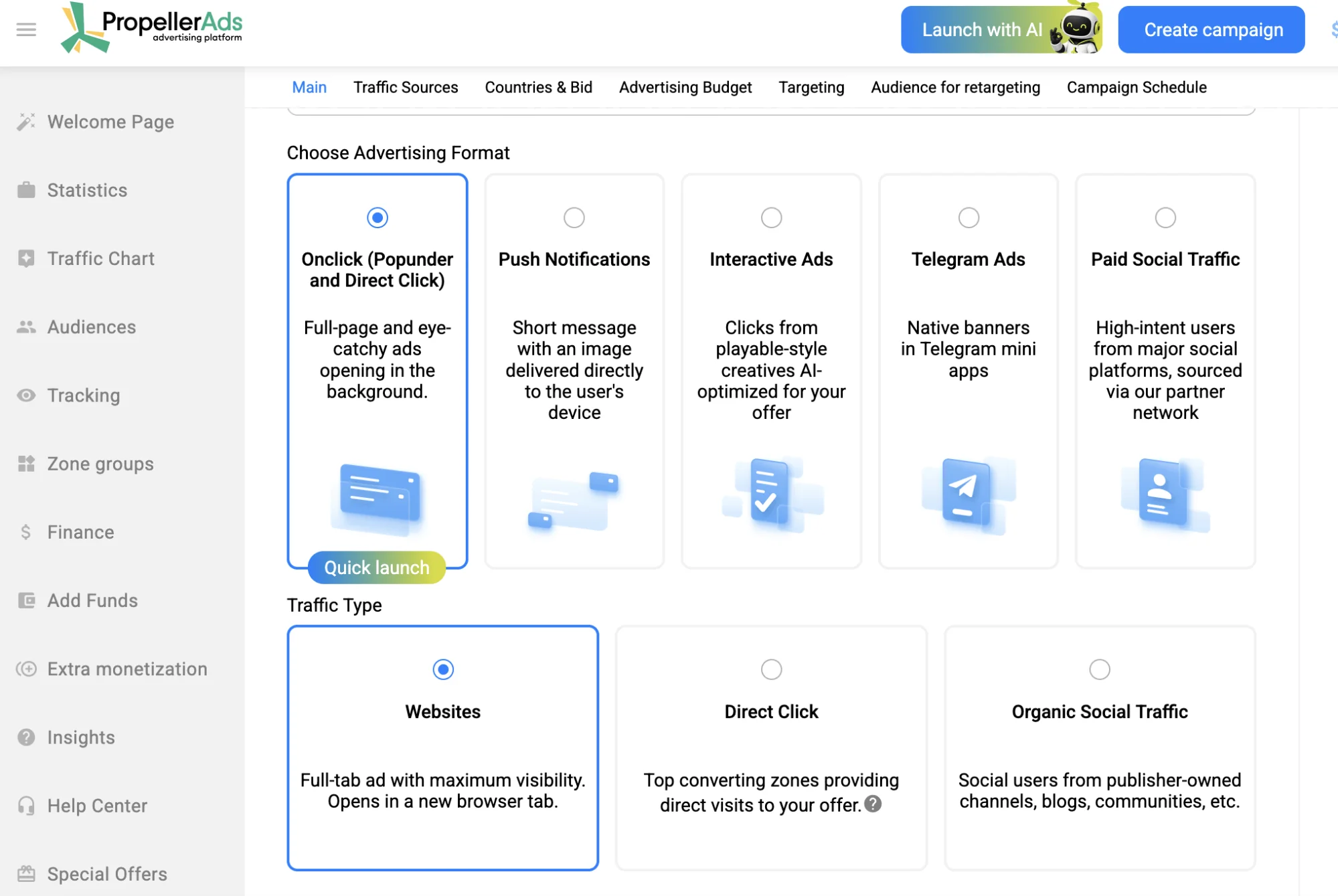
And once the program is picked, the campaign behind it still needs volume — that side lives here: iGaming ad platform.
FAQ
CPA fits media buyers who need fast payback to reinvest in traffic; RevShare fits affiliates whose players stay active, since a percentage of NGR compounds over player lifetime. High-LTV traffic usually earns more on RevShare over a year; paid traffic with untested retention is safer on CPA. Hybrid deals split the difference and are typically unlocked after a program has seen your traffic.
How Do You Choose an iGaming Affiliate Network?
Check five things: offer fit for your niche and GEOs, payout model against your cash flow, payment terms (frequency, threshold, hold periods), reputation with dates attached, and the quality of affiliate management. Then verify the FTD definition, the traffic allowlist, and the validation and clawback rules in writing before the first campaign.
Who Are the Leading iGaming Affiliate Groups?
The largest affiliate media groups are publicly traded companies: Better Collective, the biggest of them with €86.3M revenue in Q1 2026, and Catena Media, focused on North and Latin America. They operate their own portfolios of content sites and sell audiences to operators – you don’t join them as an affiliate. Alongside them sit joinable networks such as Income Access, RevenueLab, and Boomerang Partners. “Leading” shifts by market and model: content-led groups dominate SEO-driven markets, while networks aggregate offers for paid-traffic affiliates.
Who Does Outreach for iGaming Affiliates?
Affiliate managers at networks and operator programmes handle recruitment: they contact affiliates whose traffic matches their target GEOs, negotiate deal terms, and manage re-rates as volume grows. Established affiliates also get approached directly by operator partner teams. Treat unsolicited offers the same way as listed ones – the deal terms in writing are what counts, not the pitch.
What Counts as an FTD in iGaming Affiliate Programs?
A first-time depositor: a referred user who registers and makes a first deposit meeting the program’s conditions – minimum amount, qualifying GEO, attribution window, and any verification requirements. An FTD can also be rejected after the fact under validation and clawback rules (duplicate accounts, chargebacks, failed identity checks), so ask when a conversion becomes final. Every program defines this slightly differently, which is why two offers with the same CPA price can pay very differently in practice.
Do the Same Affiliate Deals Work for US and UK Traffic?
Rarely on identical terms. US market access is regulated state by state, so programs qualify traffic against a state list; the UK runs one national licensing framework with strict marketing rules that operators pass down to affiliates. CPA prices, KPI baselines, and creative requirements are usually set separately per market – confirm both before committing volume.
Choosing a Program and Running It
Choose a payout model that fits your cash flow, then get the five key terms confirmed before sending your first click: the FTD definition, traffic allowlist, KPI window, validation rules, and tracking setup. Treat published CPA and RevShare rates as a starting point – the real value of a deal depends on which conversions qualify and how reliably they are tracked and paid.
Start with a controlled test, compare your tracker with the program’s reporting, and scale only when the numbers match. Consistent volume, clear sourcing, and strong player quality give you more leverage to negotiate higher rates, faster payments, or a hybrid deal.
The program provides the offer. PropellerAds helps you bring traffic to it.
Join our Telegram for more insights and share your ideas with fellow-affiliates!